Stage 1 of 8
2026 GTA 1 - Cannobio and the Valle Stura
Published 3 July 2026

Journal Notes
The journey opens at the water’s edge in Cannobio, a town strung along the shore of Lago Maggiore in Piemont. The lake lies flat and pale in the morning light, bordered on the far side by the first folds of the Alps. Below the promenade small boats knock gently against the quay. This is the quiet end of a long road that will turn west before the day is out, away from the lakeside streets and into the high valleys where the Grande Traversata delle Alpi, the GTA, begins to thread its way from one mountain village to the next.
Along the Lago Maggiore
Cannobio sits where the river Cannobino meets Lago Maggiore, its lanes running down between tall, shuttered houses to a broad square at the water. The town has the feel of a place that once worked for a living: in the medieval period it grew rich on wool and tanning and on the lumber trade, and the older buildings still carry the weight of that commerce in their stone arcades and deep doorways. As the settlement spread from its first nucleus down towards the lake, substantial residences went up along the shore. Among the town’s stories is that of a painting of the Virgin Mary said to have bled, after which a chapel was raised to hold it; the chapel still stands, and the tale still shapes the town’s year.
Lago Maggiore is a large lake on the south side of the Alps, stretching roughly sixty kilometres from end to end. Its climate stays mild through summer and winter alike, so Mediterranean vegetation and formal gardens flourish along the shores. From Cannobio the lake reads as a single sheet of colour that shifts with the hour: silver under cloud, blue at midday, streaked with pale light towards evening.
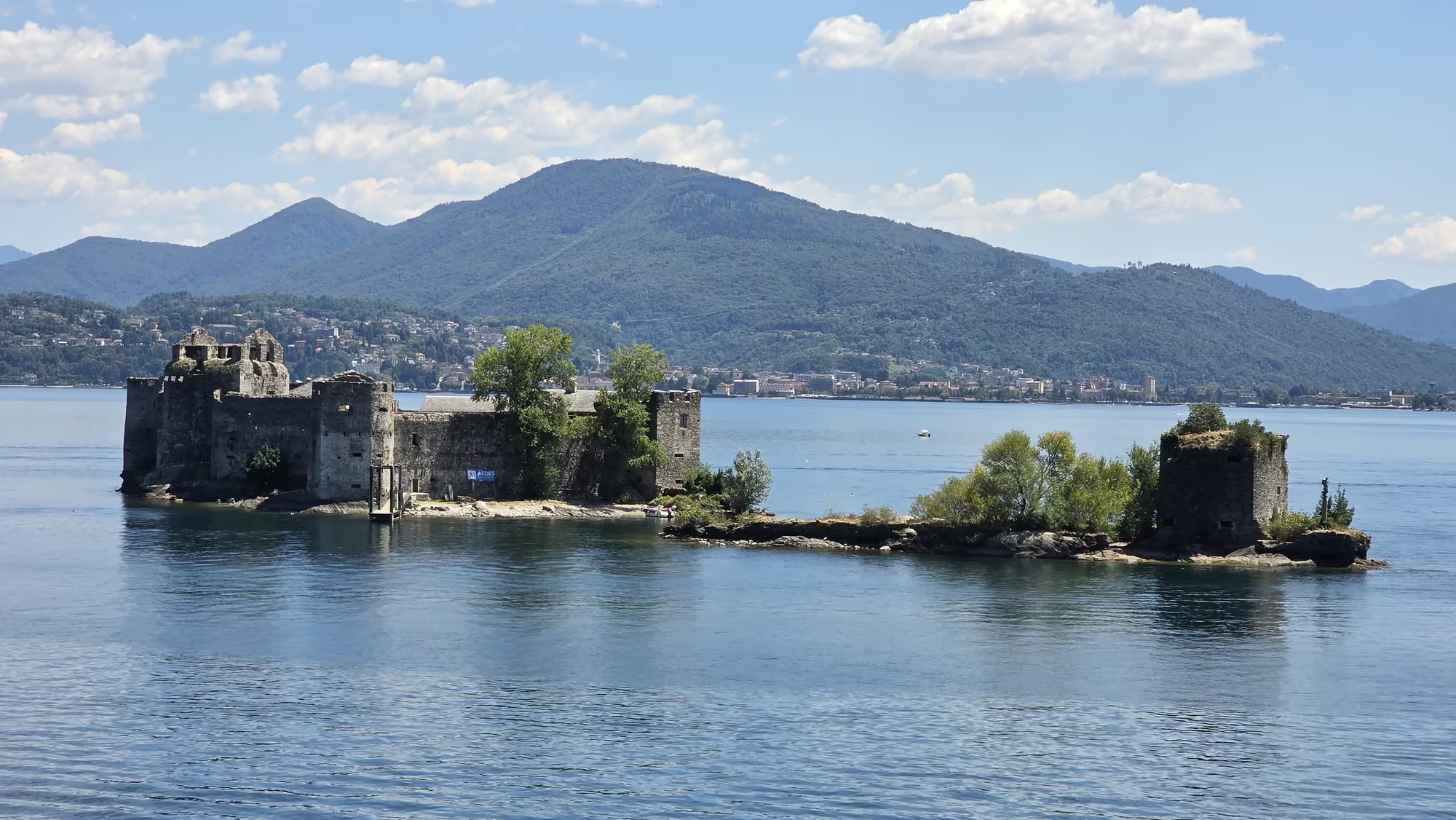
Out in the water, a short way along the shore, stand the Castelli di Cannero: three rocky islets, two of them carrying the ruins of old fortifications. They are all that is left of the Rocca Vitaliana, raised over the remains of an earlier castle, the Castello della Malpaga, which a band of brothers known as the Mazzarditi used as a base while they terrorised the district until a siege starved them into surrender. On the eastern islet the massive walls follow the irregular contours of the rock and stand directly in the water, and several towers keep part of their battlements. On the western islet only a broken tower and a crumbling wall remain. None of the ruins can be visited, being unsafe, though seen from the shore or from a boat they hold the eye, and the rocky shores draw adventurous swimmers.
Into the Valle Stura
By midday the road turns inland, leaving the lake behind and climbing away from the water. The country changes by degrees: terraced slopes and gardens give way to chestnut woods, then to bare ground and rock, and the Alps close in on either side. The destination lies well to the west, in the Valle Stura, a valley in the south-west of Piemont that takes its name from the river Stura di Demonte and runs for about fifty kilometres between summits that rise above three thousand metres.
At the head of the valley sits Pietraporzio, high and compact, gathered against the river and sheltered by a large boulder whose shape is said to resemble the back of a wild boar, the likeness behind the village’s name. The place keeps its older layers close. Near the cemetery stands the bell tower that is all that remains of the ancient parish church, its pinnacle corners carved with animal figures, while the present parish church has a bell tower capped in wooden shingles. The hamlets around it are documented from the Middle Ages, and the lanes on the right bank of the river still show fragments of arches and corner stones from that time.
This is GTA country. The Grande Traversata delle Alpi runs for roughly a thousand kilometres across Piemont, through some fifty-five day stages, following the great arc of the western Alps and joining high valley communities by historic pass routes. Where the trail crosses the Valle Stura, walkers come in from one valley and leave for the next. For now the trail is only a line on the map; the walking begins with the next stage.
Pontebernardo
A couple of kilometres further up the valley road, Pontebernardo sits at around thirteen hundred metres, a small alpine hamlet within the comune of Pietraporzio. Its parish church, dedicated to the Virgin, is first recorded in the register of a bishop long ago and later became a parish in its own right. The bell tower is the landmark of the place, and after dark it is floodlit, so that the stone and the arched openings stand out brightly against the black mass of the mountainside behind.
Pontebernardo is known above all for its museum of pastoralism, which sets out the long relationship between the valley and its sheep. The building at its centre holds a small dairy where local families make cheese from the milk of the sambucana breed, a sheep recovered from near disappearance and now the emblem of the valley’s farming. The permanent exhibition traces the work of the shepherd, an occupation that once took men from these valleys across the mountains to tend flocks in the lowlands beyond, and a shop sells blankets made from the wool. On a summer afternoon the whole hamlet smells faintly of hay, animals and woodsmoke.
Towards evening the valley cools quickly and the peaks lose their light while the sky stays pale above them. A single lamp comes on over a doorway, a dog answers another dog across the road, and the river carries through the open windows. Nothing here belongs to hurry. The first night of the trek passes in this small place, among shuttered houses and the smell of cut grass, with the ridge of the Alps standing between the hamlet and everything that lies ahead.