Day 1 - Arrival
Journal Notes
General
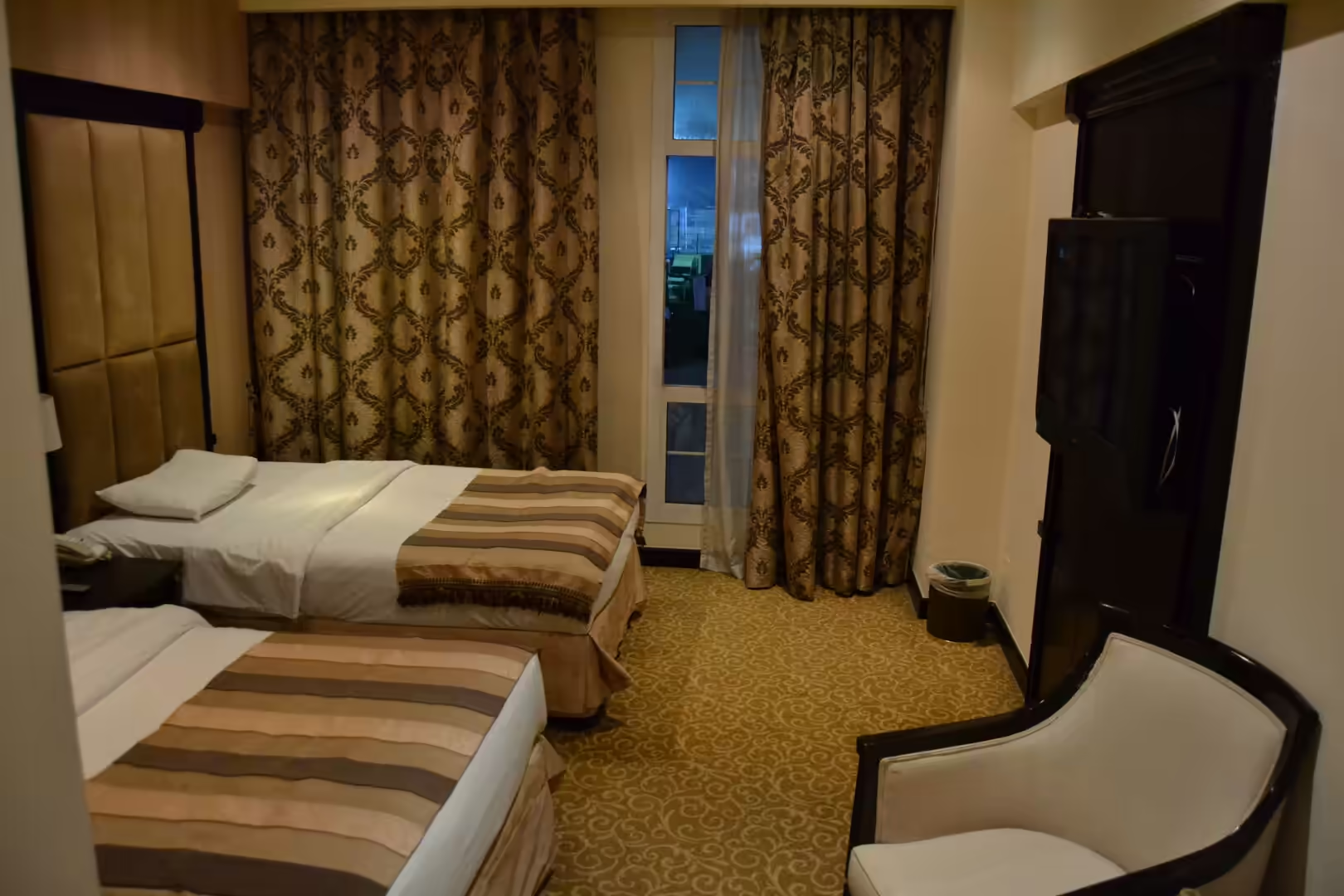
The journey began with a flight into the United Arab Emirates and a first night in a hotel on the Gulf coast. Little of the day was spent out of doors, and the one picture kept from it shows nothing more than the room itself, two beds with striped runners and heavy curtains in a warm pattern of gold. It was, in other words, a day of arrival: the immigration hall, the hire car desk, the first drive on an eight lane road, and then the quiet of a hotel corridor with the air conditioning running and the curtains drawn against a light that is different from the light at home.
The country that was entered that evening is a federation of seven emirates: Abu Dhabi, Dubai, Sharjah, Ajman, Umm Al Quwain, Fujairah and Ras Al Khaimah. Abu Dhabi is the capital and Dubai the largest city, and the state borders Oman to the east and north east and Saudi Arabia to the south and south west. It has two coastlines of very different character, the long shallow shore of the Persian Gulf along which the cities grew, and the short, steep shore at Fujairah on the Gulf of Oman, where the mountains fall straight into deep water. Arabic is the official language, English is the language of business, and rather more than half the people in the street that evening were born somewhere else. In 2024 the population was estimated at more than eleven million, of whom only about eleven per cent are native Emiratis, the rest expatriates and migrant workers, most of them from South Asia.
None of that is visible from a hotel bed, and it takes a day of driving to sense even a part of it. The plan for the days ahead was modest: a crossing of the mountains to the east coast, a morning in the gold market of Deira, and then a long drive south west towards the great sand desert that fills the southern third of the peninsula. Three journeys, each of them really a lesson in geology, and the first evening belongs to the simplest of them: arriving at all.
It is worth setting down what the arrival day really consists of, because such days are usually left out of travel writing. A plane descends over a plain of sand and gravel with the mountains standing along the horizon. There is a long walk through a terminal in which everything is cold and polished. A road runs in from the airport between date palms and hoardings, past a mosque with a dome and a minaret, and then the city becomes real: towers, car showrooms, a service station with a small shop, another mosque, and a great many roundabouts, each of them decorated with something more elaborate than the last. The hotel stands among all this with its curtains, its quiet corridors and a lobby in which a machine dispenses cardamom coffee in small cups. That was the first day, and the room is what is left of it.
History
The present-day United Arab Emirates occupies the part of eastern Arabia that has always faced the sea. Its people were seafarers and traders before they were anything else, sailing to the Indian coast and up the Gulf, and the two great industries of the coast before oil were pearl diving and the carrying trade. Then, as now, the towns lived by what the water gave them, and the water was fished for pearls rather than for fish.
The Portuguese arrived in the sixteenth century and held the Strait of Hormuz for a hundred years, taxing the shipping that passed. Their departure left the coast to the local sheikhdoms and to the maritime quarrels between them, and it was those quarrels that brought the British into the Gulf. A campaign against the maritime communities of the Trucial Coast ended with the sack of Ras Al Khaimah by British forces, and the consequence was a series of treaties with the coastal rulers beginning in 1820, from which the name Trucial States is derived. Further agreements up to 1892 turned the coast into an informal British protectorate, with responsibility for defence and foreign affairs in London and everything else left to the rulers.
For another seventy years little changed. The pearl fishery supported the coastal towns until the 1930s, when cultured pearls from Japan destroyed the market almost overnight and left the whole coast poor. The Second World War, the beginnings of oil exploration and the small income that came with it followed, and then, in the 1950s, larger discoveries of oil and gas. The money began to change things long before the oil was exported in quantity.
The decisive political step came in early 1968, when the British government decided to withdraw from its involvement in the Trucial States. Two of the most influential rulers, Zayed bin Sultan Al Nahyan of Abu Dhabi and Rashid bin Saeed Al Maktoum of Dubai, met in a desert tent on 18 February 1968 and shook hands on forming a federation. On 1 December 1971 the treaties with Britain were revoked, and the following day six of the sheikhdoms, Dubai, Abu Dhabi, Sharjah, Ajman, Umm Al Quwain and Fujairah, formed the United Arab Emirates. The seventh, Ras Al Khaimah, joined on 10 February 1972.
Zayed bin Sultan Al Nahyan became the first president of the new state and held that office from 1971 until his death in 2004. The revenues from oil found under Abu Dhabi and later Dubai were invested into healthcare, education and infrastructure, and within a single generation the fishing villages of the coast became cities. The country that a visitor enters is therefore not old in its present form at all: the federation is younger than the buildings on many of its roundabouts, and the difference between the two dates, 1971 and 2019, is only forty eight years.
Geology
The United Arab Emirates lies on the north eastern corner of the Arabian Plate, and almost the whole character of the country follows from that position. To the east the plate is running into the Eurasian Plate, and the result is the mountain range that is the backbone of the eastern emirates. West and south of the mountains the plate has been remarkably stable for hundreds of millions of years, and on it a shallow sea laid down the great thickness of limestone, sandstone, shale and evaporite that now lies beneath the desert and the Gulf.
Two of these rocks are worth naming on the first day, because a traveller meets them at once. The first is limestone, formed from the shells and skeletons of marine creatures in warm, shallow water, of exactly the kind that lies off the coast today. The second is the sabkha, the flat, salt-crusted plain that borders so much of the Gulf shore, where the water table lies a metre or two below the surface and capillary action draws brine upwards into the sun. There it evaporates and leaves behind a crust of halite and gypsum. The sabkha of the coastal regions of eastern Arabia, including Sabkha Matti in Abu Dhabi in the far west of the country, has been studied for decades because its sequence of salt, gypsum and carbonate mud is the closest thing on earth to a working model of how evaporite deposits and some dolomites form.
Beneath all this lie the rocks that changed everything, and they are not noble ones. The oil and gas of the United Arab Emirates are held in limestone and sandstone reservoirs of the kind that any visitor can see at the surface as a pale, dull stone, and the country now holds the world’s seventh-largest oil reserves and seventh-largest natural gas reserves. The petroleum geology of the emirates is unusually well documented, and the fields of Abu Dhabi, both onshore and offshore, remain the foundation of the economy even as the state has diversified into trade and tourism more successfully than any other member of the Gulf Cooperation Council.
The mountains hold something different. The range along the eastern border is built partly of oceanic crust, the Semail Ophiolite, a slab of the Tethys ocean floor that was pushed up and over the edge of the continent about ninety five million years ago. With it came the only mineral wealth of the peninsula that can be called local: copper, chromium and other metals in the altered rocks of the ophiolite. Gold, by contrast, is not mined here at all. Every gold ring in the windows of Deira, and the subject of a later day of this journey, was brought in from somewhere else.
Water is the last part of the geological picture, and in a country of less than a hundred millimetres of rain a year it is the one that matters most. Along the whole western side of the country, beneath the dunes south of the coast, lie the sand aquifers, among them the Quaternary sands of the Liwa region, which hold water that fell as rain during wetter periods and never left. They are the reason that oases exist at all in the desert, and they are the reason that a traveller can drive for four hours across the Empty Quarter through settlements that have water and date palms in the middle of nothing.
Things to See
An arrival day offers little, and it is honest to say so. What is left of it, and what is remembered, are the impressions rather than the sights: the width of the roads, the palms planted along every median, the small mosques standing white and cool behind their walls, the flags on the roundabouts, and the light, which in January is warm without being oppressive and turns everything, sand and stone and glass alike, a little paler than it should be.
The hotel room is the only thing recorded. Two beds with striped runners, heavy curtains in a gold pattern, bedside lamps, a window that looks out on a road and a car park, and the low sound of cooling machinery. It is the room of an international hotel anywhere between the Atlantic and the Gulf, and that anonymity is itself part of the experience of arriving in a country built so quickly that hotels, roads and airports often arrived before the things around them had settled.
The evening was given to the hotel and its immediate surroundings, which is what an arrival day is. There was a walk past a row of shops, a supermarket with a shelf of dates arranged by their region of origin, a small restaurant in which a family meal was eaten beside a window, and the muezzin from the nearest mosque. The practical details are worth setting down for anyone who repeats the journey: the currency is the dirham, the country drives on the right, every town has its roundabout with a monument in the middle, and in January the temperature at midday is pleasant enough for the beach and cold enough at night for a jacket.
That is all. The mountains, the gold market and the sand desert were still ahead, and the next morning began with a drive eastwards towards a range of rock that stands above the coast like a wall, and towards a coast on the other side of it that nobody arriving at the airport with the towers around them would suspect was there at all.
References
- Wikipedia contributors (2026). United Arab Emirates. en.wikipedia.org/wiki/United_Arab_Emirates
- Wikipedia contributors (2026). History of the United Arab Emirates. en.wikipedia.org/wiki/History_of_the_United_Arab_Emirates
- Wikipedia contributors (2026). Trucial States. en.wikipedia.org/wiki/Trucial_States
- Wikipedia contributors (2026). Zayed bin Sultan Al Nahyan. en.wikipedia.org/wiki/Zayed_bin_Sultan_Al_Nahyan
- Wikipedia contributors (2026). Emirate of Dubai. en.wikipedia.org/wiki/Emirate_of_Dubai
- Wikipedia contributors (2026). History of Dubai. en.wikipedia.org/wiki/History_of_Dubai
- Wikipedia contributors (2026). Dubai. en.wikipedia.org/wiki/Dubai
- Wikipedia contributors (2026). Abu Dhabi. en.wikipedia.org/wiki/Abu_Dhabi
- Wikipedia contributors (2026). Persian Gulf. en.wikipedia.org/wiki/Persian_Gulf
- Wikipedia contributors (2026). Arabian Peninsula. en.wikipedia.org/wiki/Arabian_Peninsula
- Wikipedia contributors (2026). Pearl hunting. en.wikipedia.org/wiki/Pearl_hunting
- Wikipedia contributors (2026). Musandam Peninsula. en.wikipedia.org/wiki/Musandam_Peninsula
- Wikipedia contributors (2026). Souk. en.wikipedia.org/wiki/Souk
- United Arab Emirates, in: GeoGuide (2019) 147-177. doi.org/10.1007/978-3-030-18453-7_7 doi.org/10.1007/978-3-030-18453-7_7
- A. S. Alsharhan, Petroleum geology of the United Arab Emirates, Journal of Petroleum Geology 12 (1989) 253-288. doi.org/10.1111/j.1747-5457.1989.tb00197.x
- A. Kirkham, Halite, sulphates, sabkhat and salinas of the coastal regions and Sabkha Matti of Abu Dhabi, United Arab Emirates, in: Quaternary carbonate and evaporite sedimentary facies (2010) 265-276. doi.org/10.1002/9781444392326.ch13
- F. Broeze, Dubai: From Creek to Global Port City, in: Harbours and Havens (1998). doi.org/10.5949/liverpool/9780968128862.003.0008 doi.org/10.5949/liverpool/9780968128862.003.0008
- Gazetteer of the Persian Gulf, Oman and Central Arabia: Trucial Coast. doi.org/10.1163/2405-447x_loro_com_14005 doi.org/10.1163/2405-447x_loro_com_14005