Stage 1 of 6
2024 Italy - Florence







Journal Notes
General
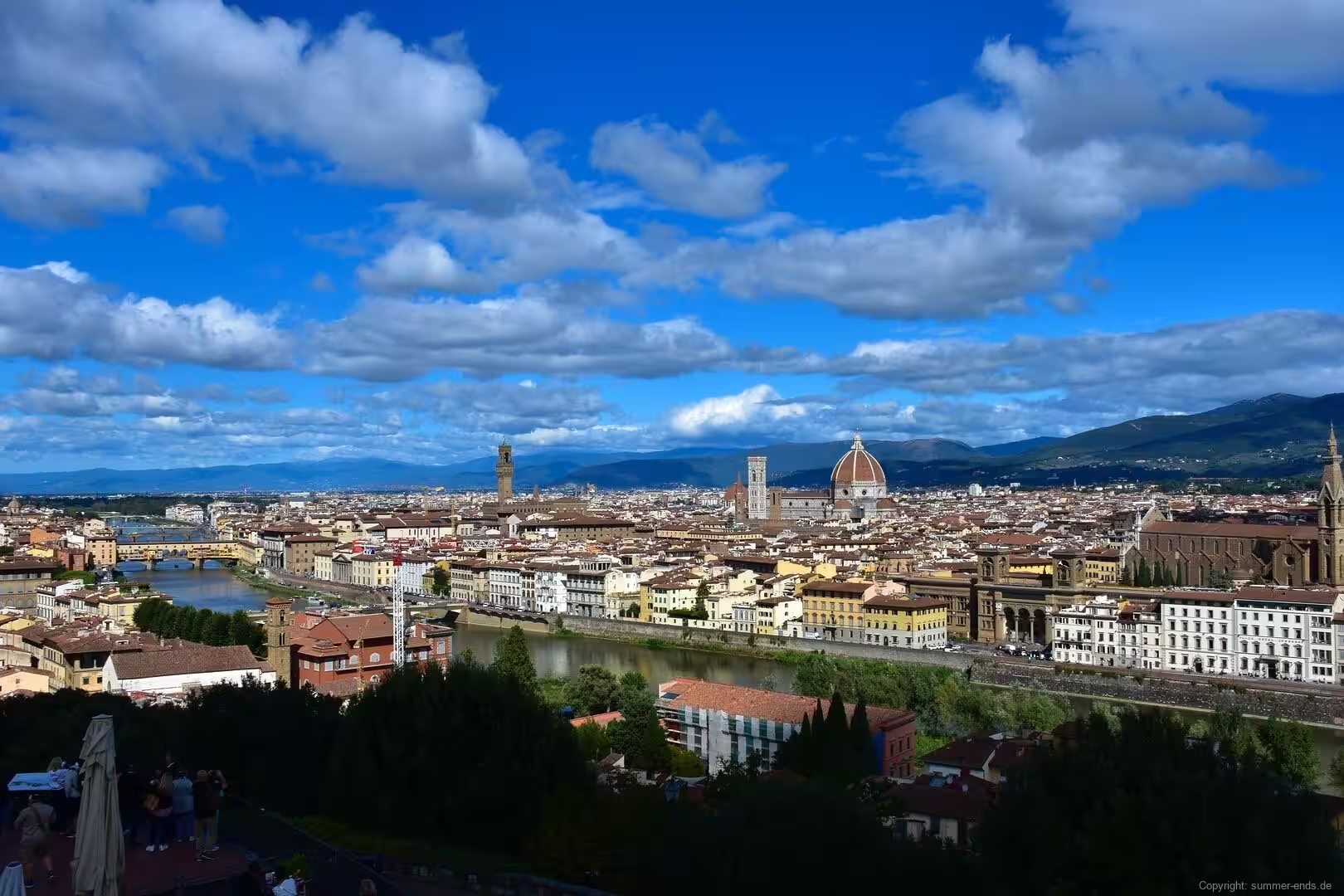
Florence is the capital of the Tuscany region of central Italy and lies in the broad lower valley of the Arno River, where the basin narrows between the wooded hills of the northern Apennines. The historic centre occupies the flat valley floor and remains closely bounded by the line of the medieval walls, beyond which the twentieth-century city spreads up the surrounding slopes and along the river. The comune of Florence has a population of roughly 380,000, while the wider metropolitan area extends well past the municipal boundary into the hills and the neighbouring towns of the Arno corridor. The city is internationally regarded as the birthplace of the Renaissance and as one of the most important centres of European art and culture, a reputation carried by an exceptional concentration of churches, palaces, galleries and public squares held within a compact and largely pedestrian historic core.
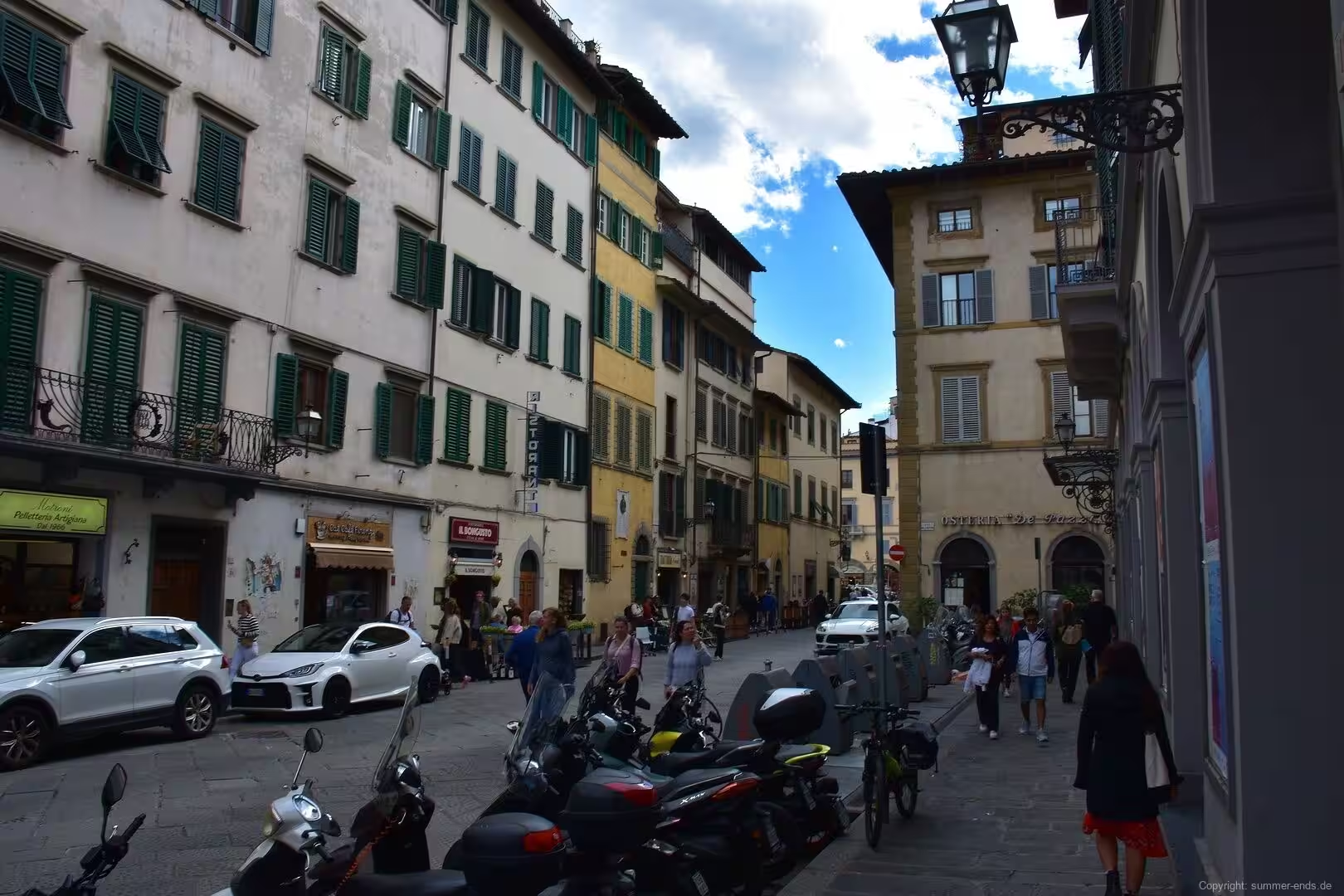
Florence functions as the administrative and cultural capital of Tuscany, and its economy is dominated by tourism, education, art conservation and heritage management, alongside the craft workshops, fashion houses and design industries that form a significant part of the local economy. The Historic Centre of Florence was inscribed on the UNESCO World Heritage List in 1982 and covers an area of about 505 hectares tightly enclosed by the remains of the fourteenth-century walls, recognised for its uninterrupted continuity of urban fabric and for its role as the cradle of the Renaissance. The city keeps a strong identity shaped by the Arno, by the hills that frame it, and by several centuries of political, commercial and artistic history concentrated in a comparatively small space. Its bridges, squares and stone streets are largely free of motor traffic in the centre, and the city is best understood on foot, moving between the cathedral square, the signorial palaces and the riverside quarters.
History
Florence was founded as the Roman colony of Florentia in the first century BCE, placed strategically where the crossing of the Arno met the route along the valley and toward the hills. After the decline of Roman authority the settlement contracted and passed through periods of instability during the early Middle Ages, but gradually re-emerged as a regional centre of exchange and craftsmanship. By the eleventh and twelfth centuries Florence had become a powerful commune driven by commerce, banking and textile production, and the wool, silk and cloth guilds established the political and economic structures that would later shape the city-state. The urban fabric of the medieval city, with its towers, churches and fortified palaces, largely survives within the walls.
The height of Florence’s historical significance came between the fourteenth and sixteenth centuries, when it became the epicentre of the Italian Renaissance. Patronage by influential families, above all the Medici, supported extraordinary developments in art, architecture, science and political thought, and figures such as Dante, Petrarch, Leonardo da Vinci, Michelangelo, Brunelleschi, Ghiberti and Machiavelli were closely associated with the city and shaped its lasting legacy. Eras of republican government alternated with periods of Medici rule, and in 1569 the city became the capital of the Grand Duchy of Tuscany, first under the Medici and later under the Habsburg-Lorraine. The city’s artistic dominance rested on a dense network of workshops, guilds and banks that financed monumental building and patronage across the region.
After a period of foreign rule Florence was absorbed into the unified Kingdom of Italy in the nineteenth century and served briefly as the national capital from 1865 to 1871, a phase that led to substantial urban clearance around the market and the aristocratic quarters. In the modern era the city has concentrated on conserving its historic fabric while accommodating tourism, education and contemporary urban life. The great flood of the Arno in November 1966, which damaged cultural heritage across the city, became a decisive moment in the development of modern conservation practice and of international restoration campaigns, and it shaped the way the city now manages its rivers, its bridges and its dense artistic inheritance.
Geology
Geologically, Florence lies within the Arno Basin, a tectonic and sedimentary depression formed during the Neogene period as part of the Apennine orogenic system. The basin is filled with fluvial and lacustrine sediments, including clays, sands and gravels deposited by the Arno and its tributaries over millions of years, and these deposits create the comparatively flat valley floor on which the historic city developed. The sediment fill is thickest toward the centre of the basin, where the river meanders across its own alluvial plain and has repeatedly shifted its course; the plain is bordered by low river terraces cut into the older deposits as the sea level and the base level of the river changed during the Pleistocene.
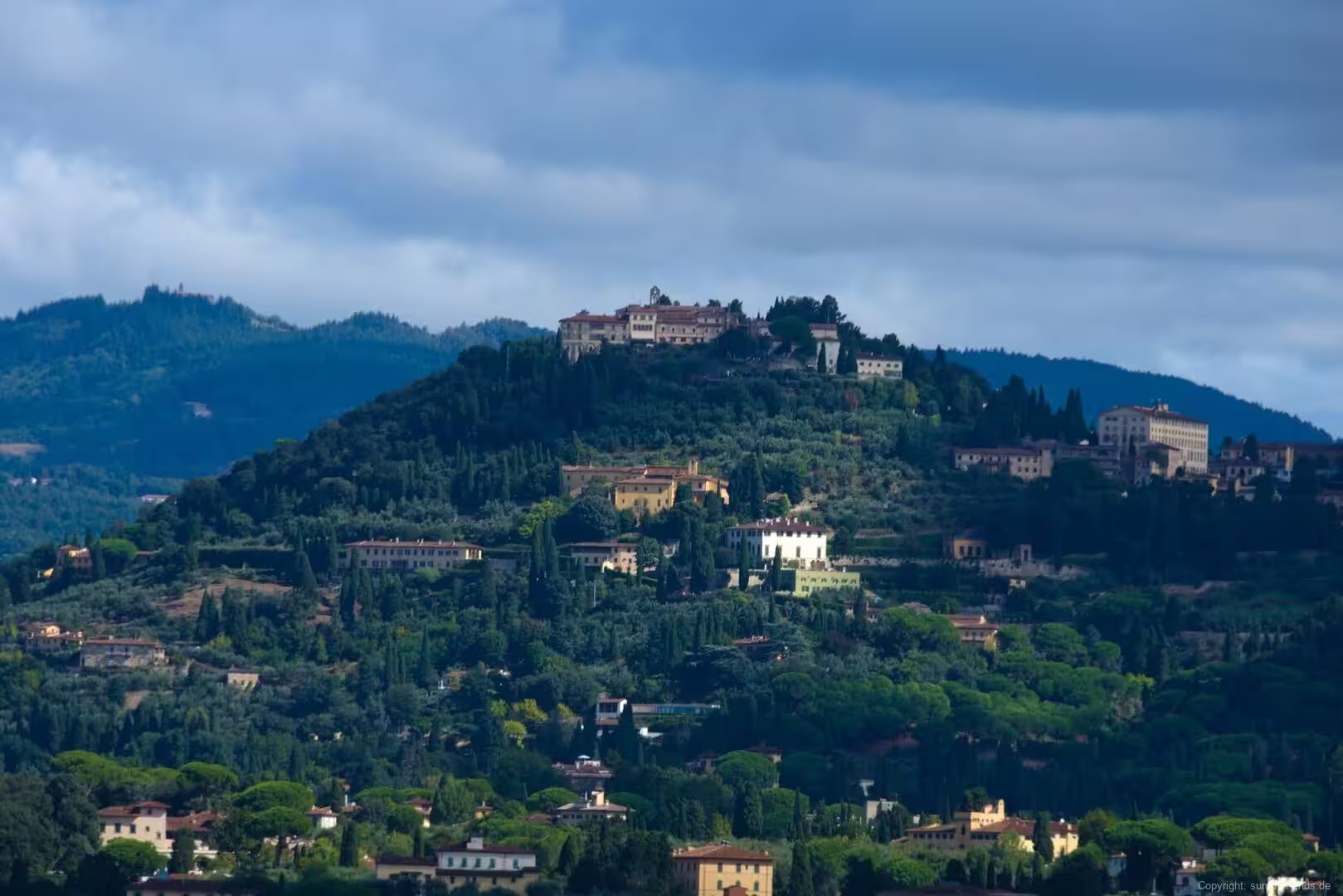
The surrounding hills consist mainly of sedimentary rocks, chiefly sandstones, marls and limestones associated with the Tuscan units of the Apennines. Differential erosion of these formations has produced the gently rolling topography that frames the city, with the harder rock forming the ridges and the softer beds cut into the intervening valleys. The classic Tuscan landscape of olive groves, vineyards and cypress-lined slopes follows these geological boundaries, and the stone of the city’s palaces and churches, quarried from the hills, gives Florence its characteristic earthy, grey and ochre palette. In several places the steepened slopes carry a risk of shallow landsliding, while the valley floor remains prone to fluvial flooding.
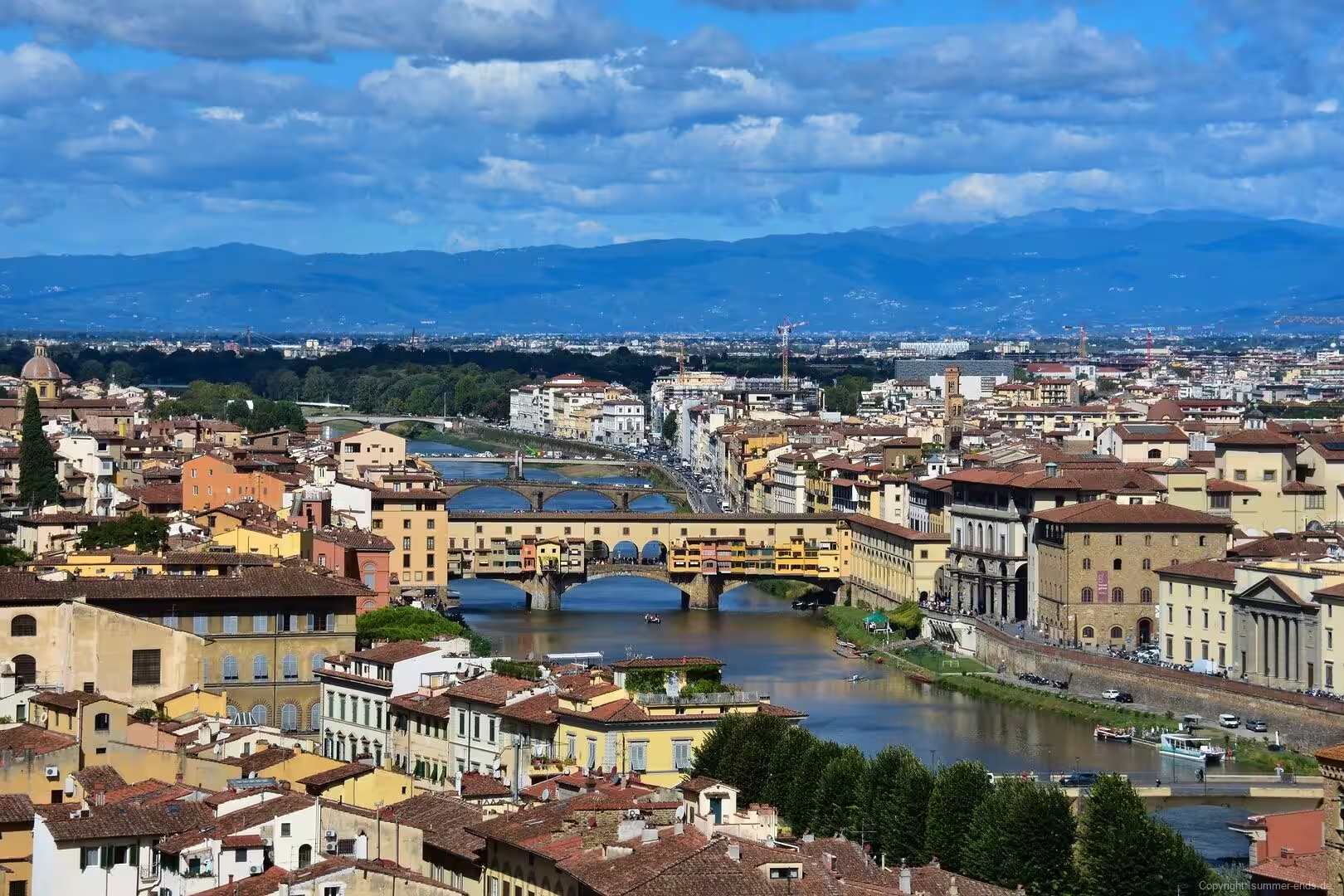
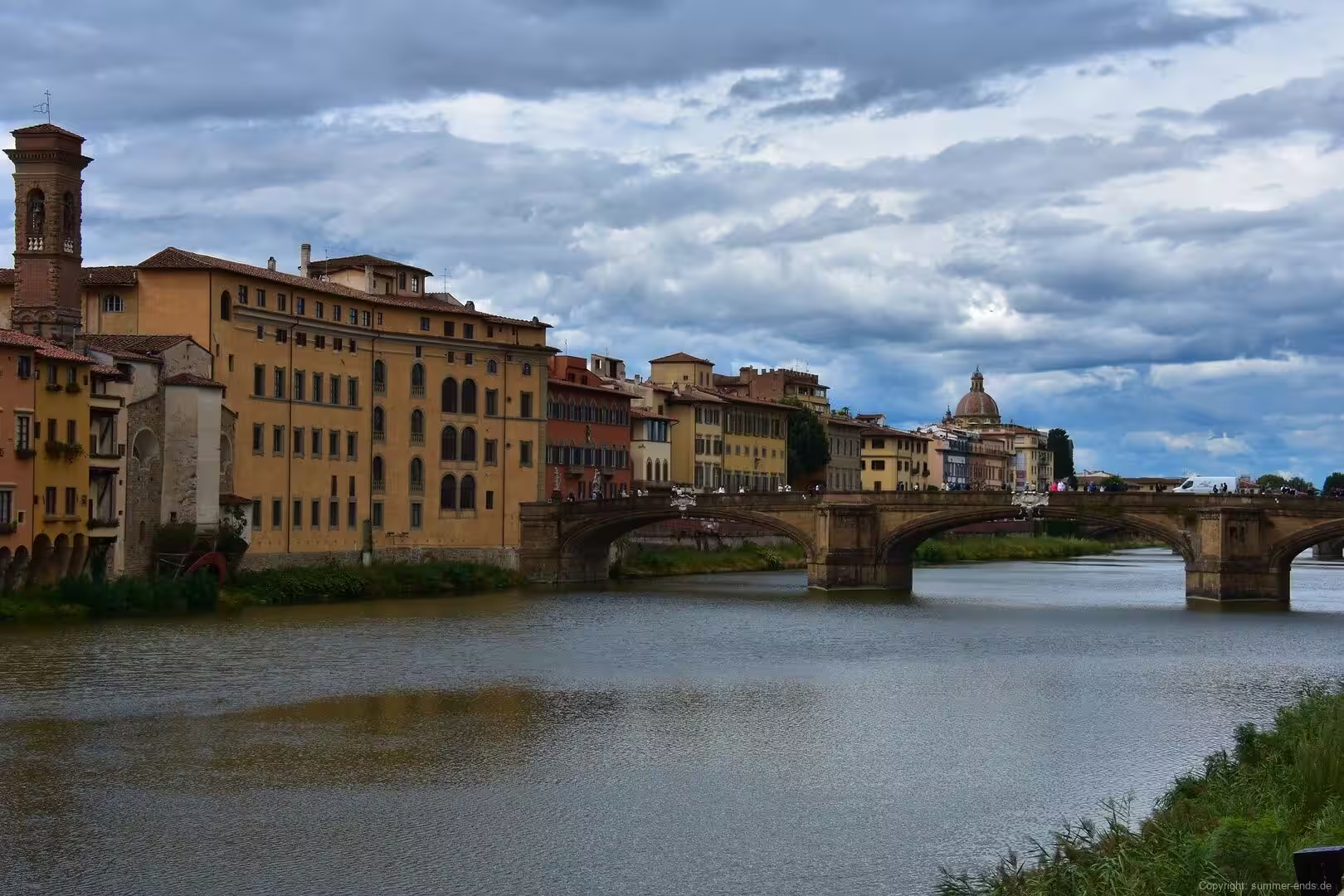
The Arno has played a central role in shaping the landscape and the history of Florence, providing water, power and transport routes and fertile alluvial soil for the surrounding countryside, while also posing a recurrent flood hazard. Bridges have crossed the river here since Roman times, and the city grew around the fords and the bridgeheads on both banks. The most devastating modern flood occurred in November 1966, when the river breached its banks and inundated much of the city centre, causing extensive damage to buildings, artworks, archive material and libraries and demonstrating the close relationship between the city, its geology and its fluvial processes. The event remains a reference point for conservation policy in Florence and across Italy.
Things to See
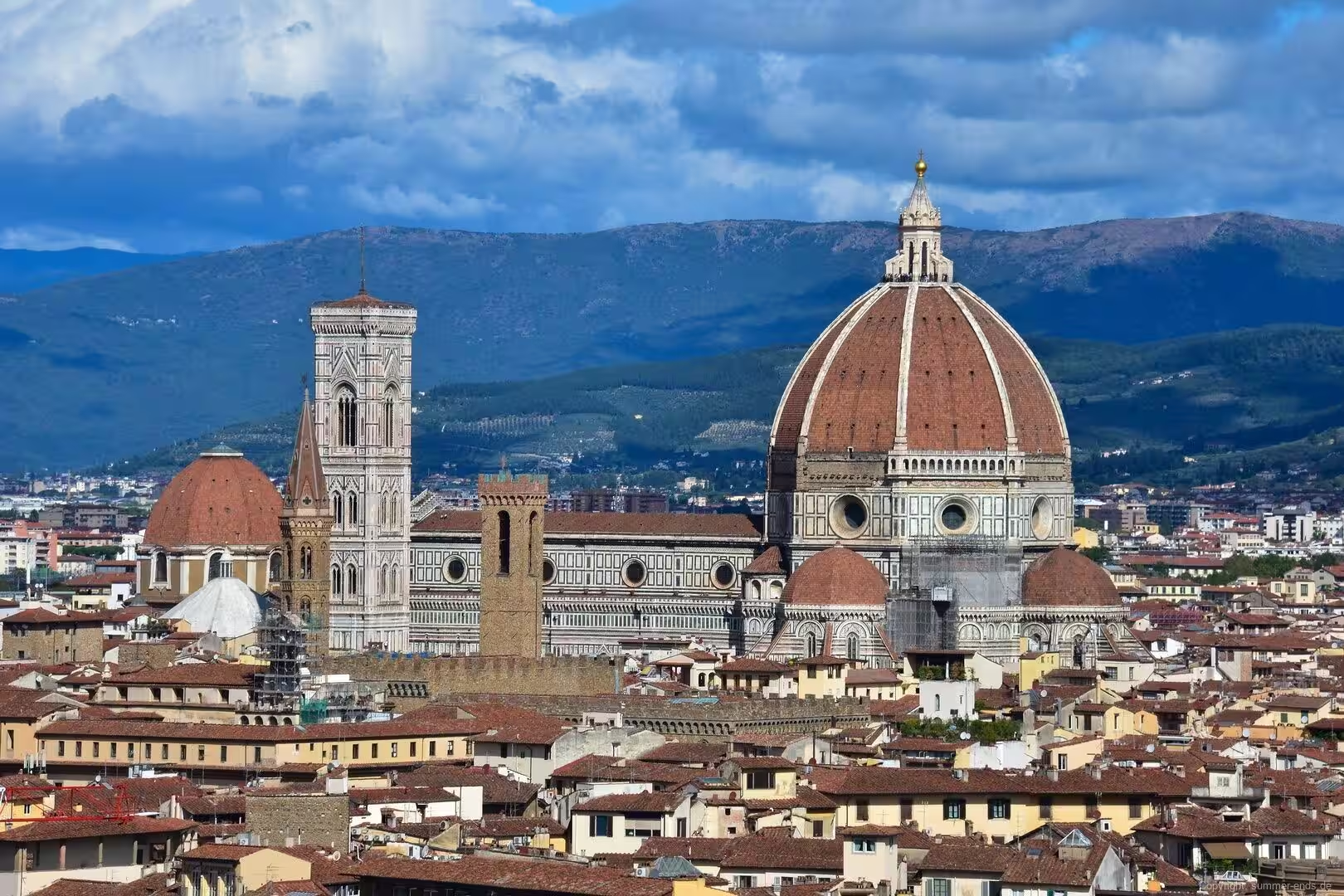
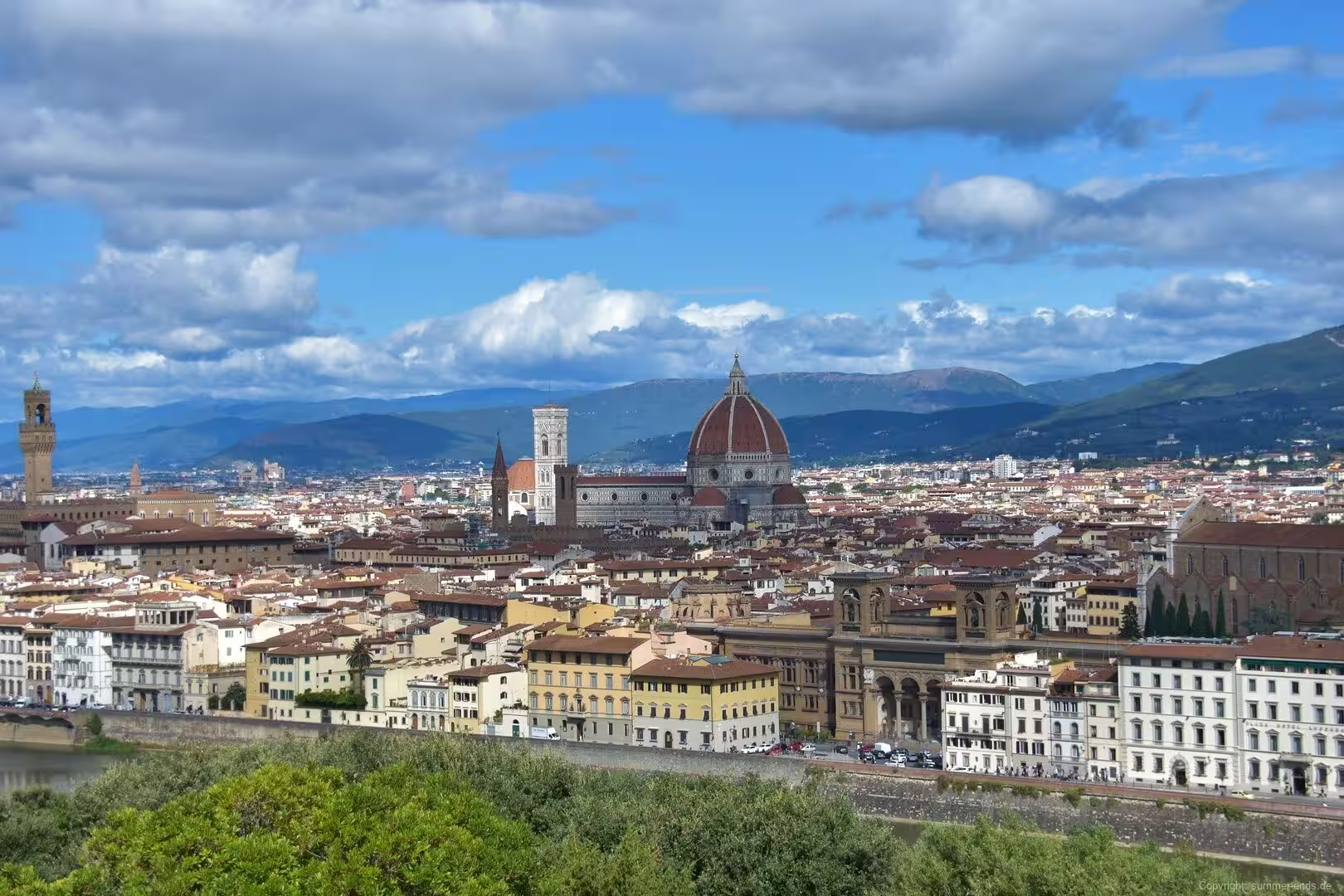
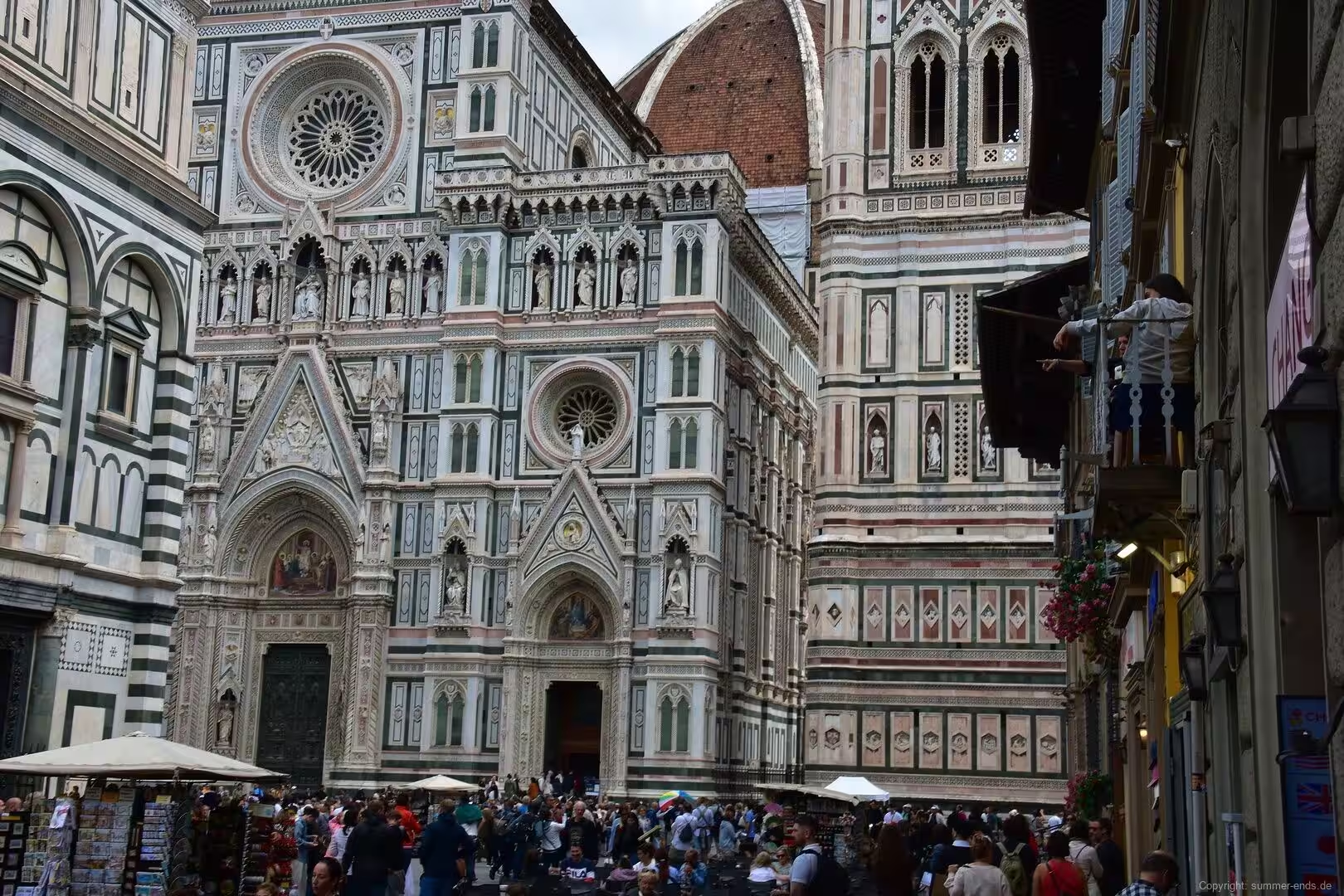
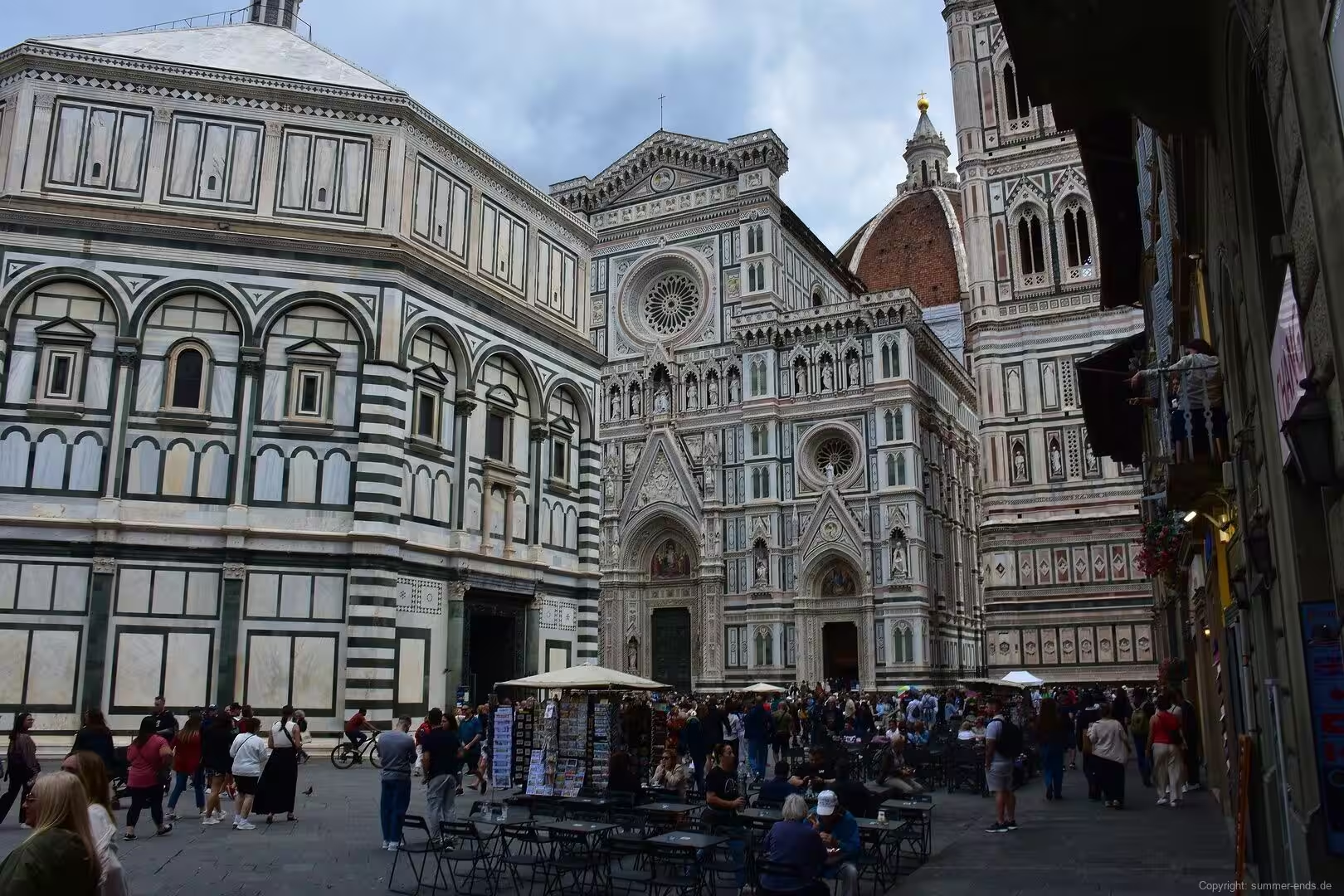
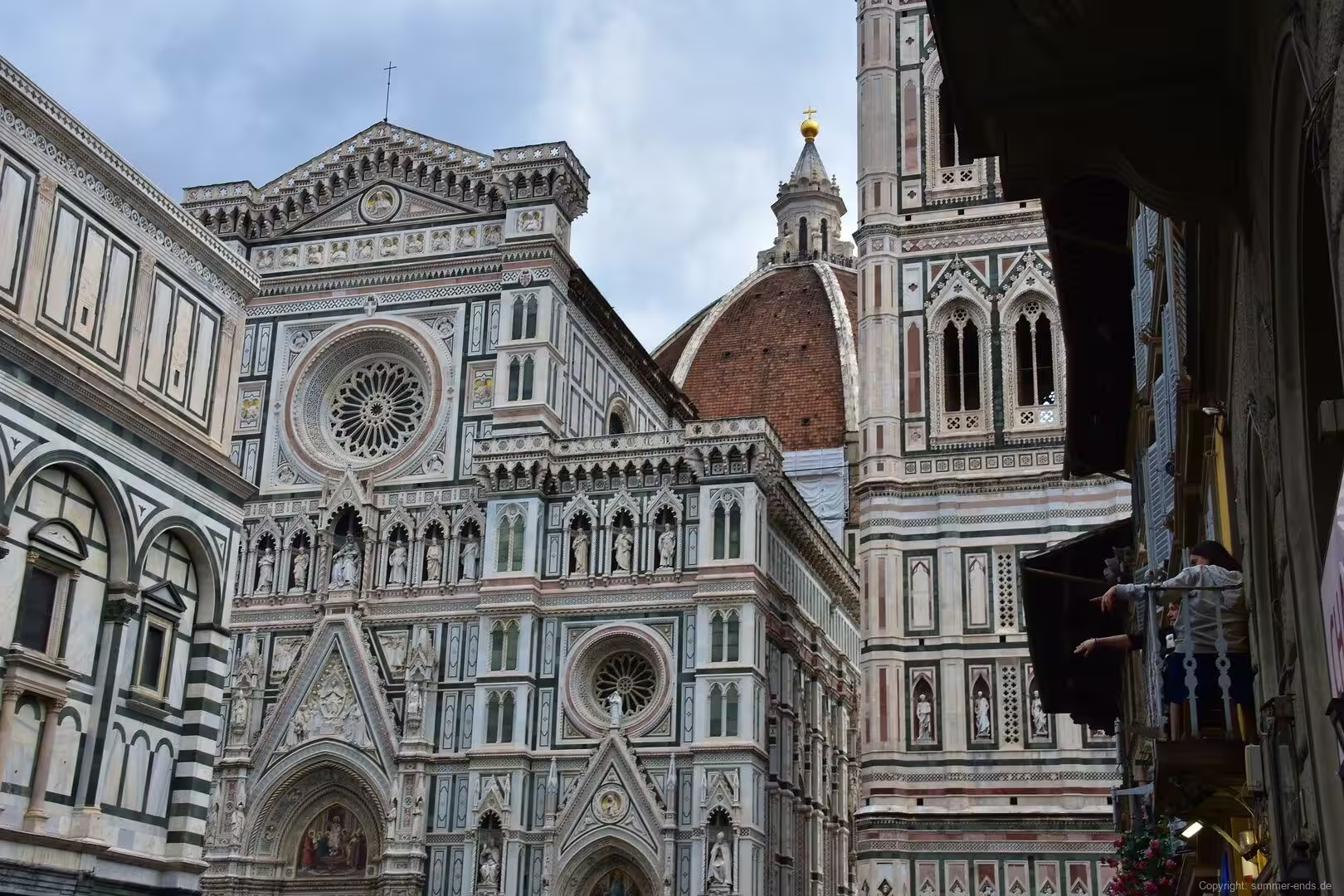
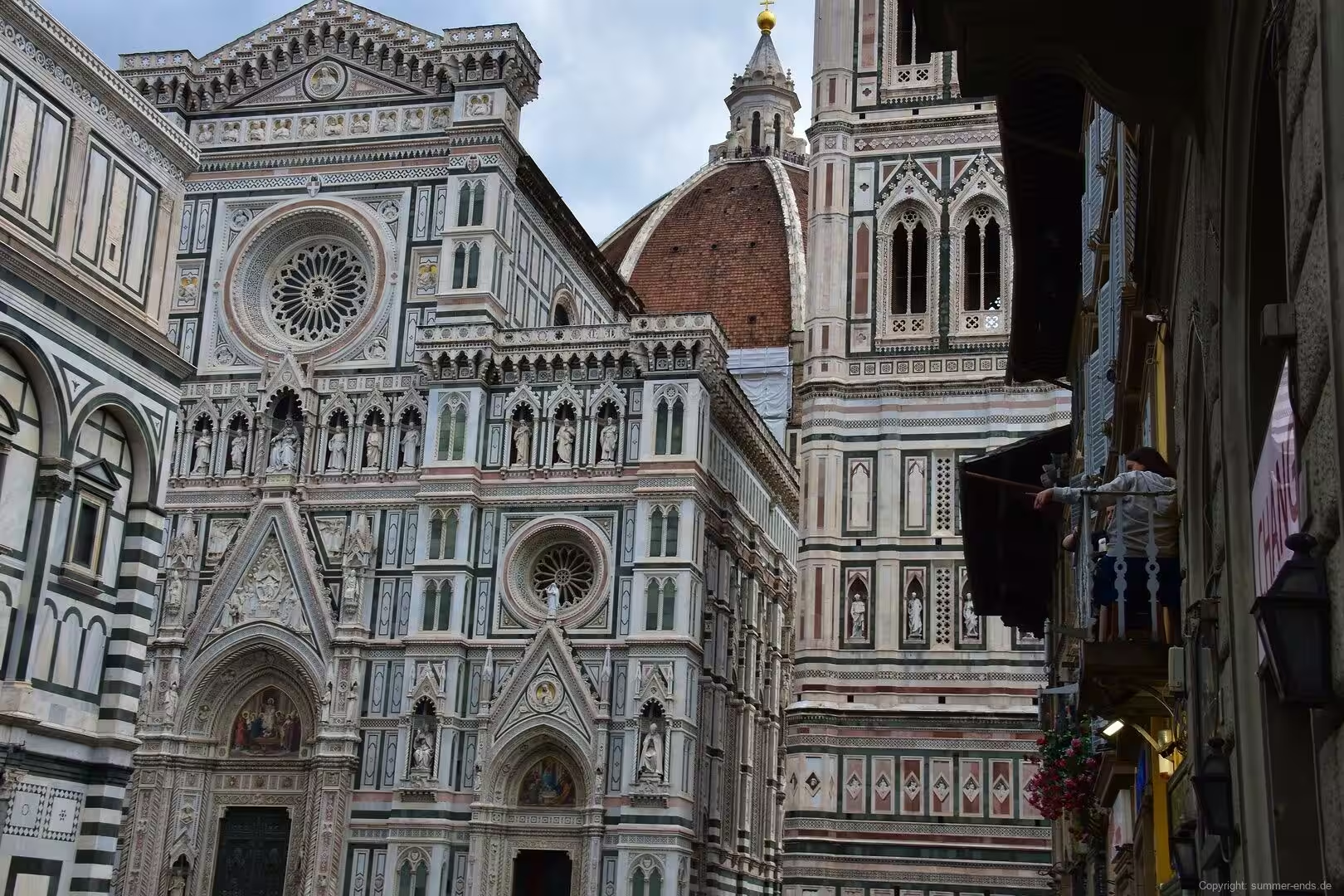
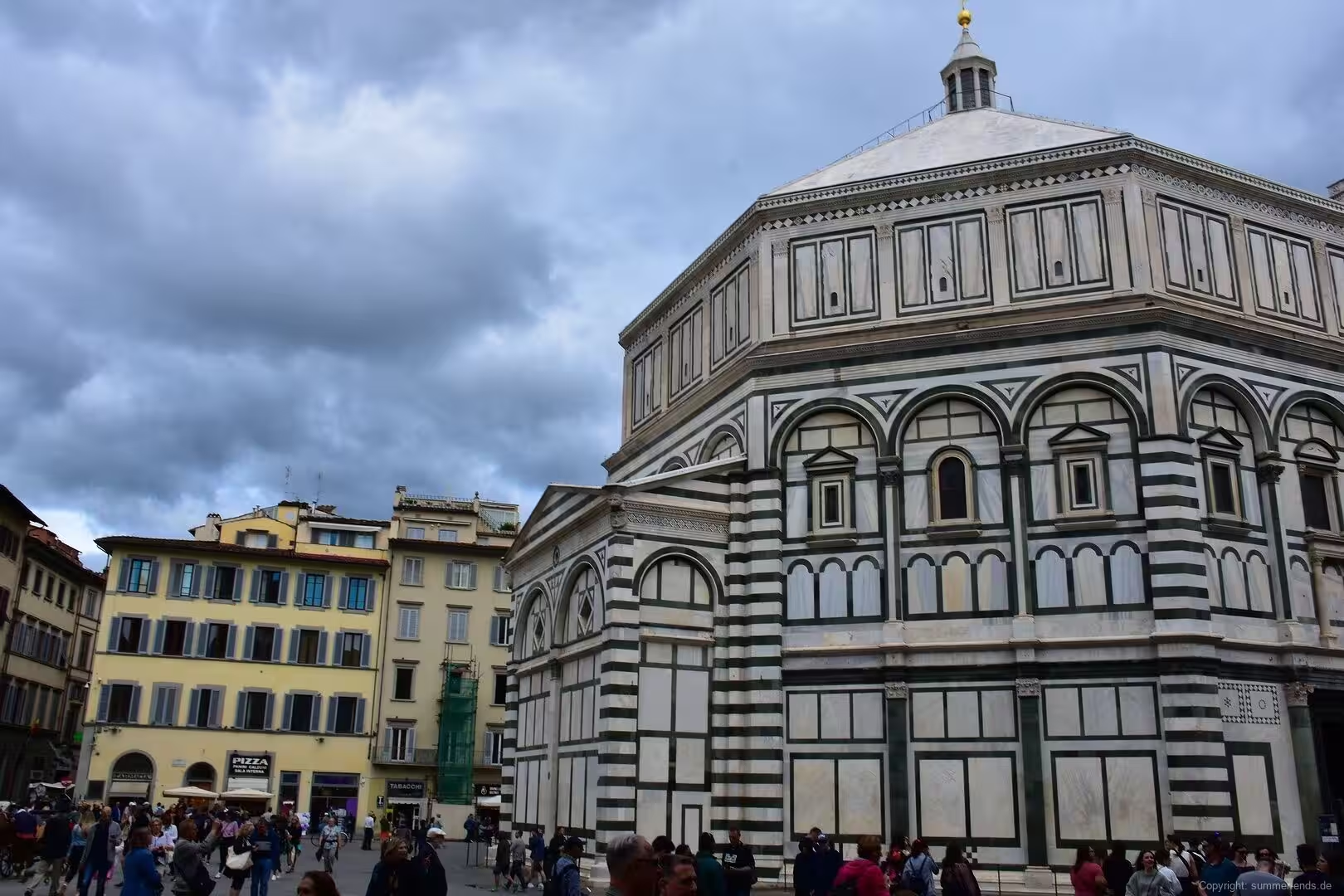
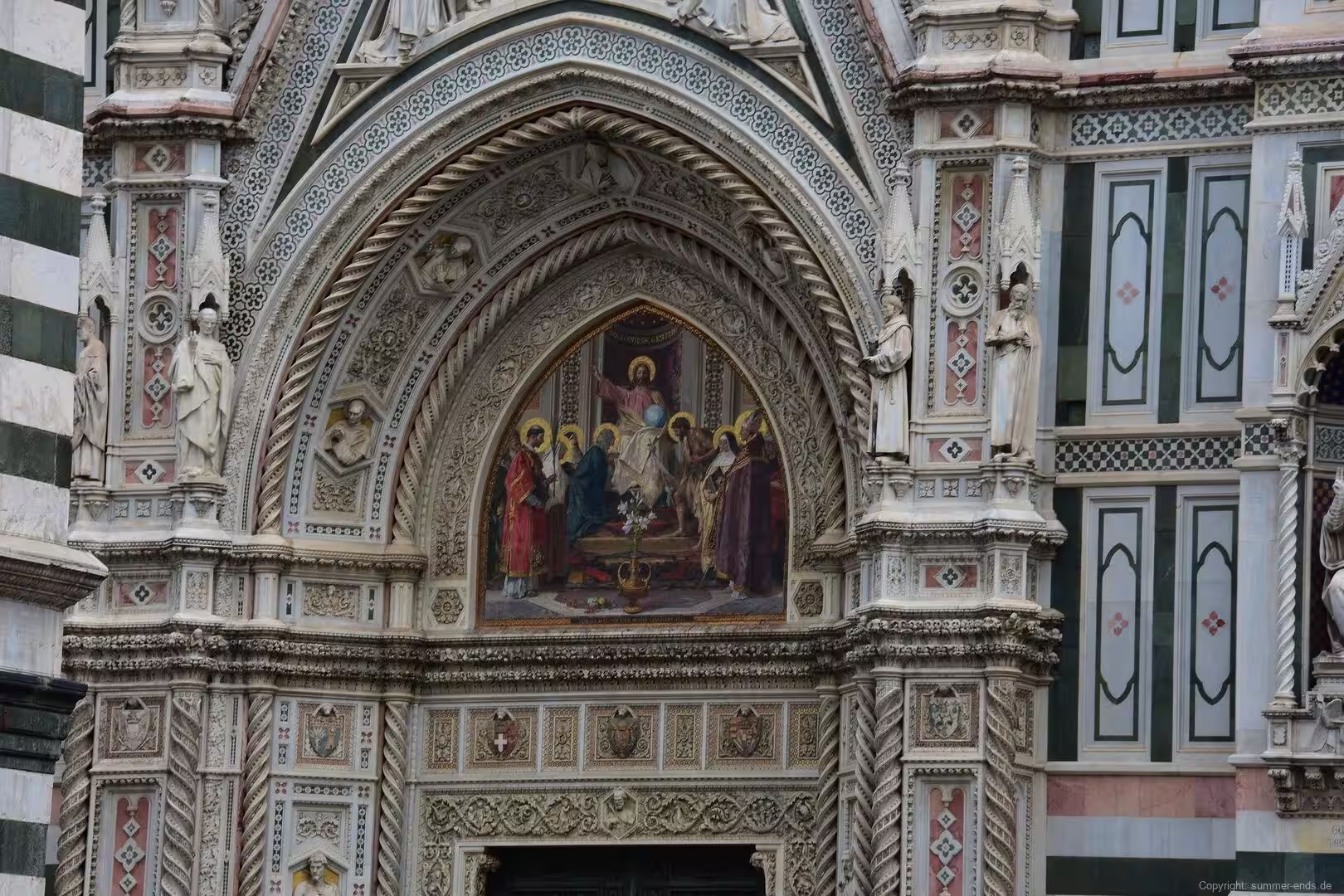
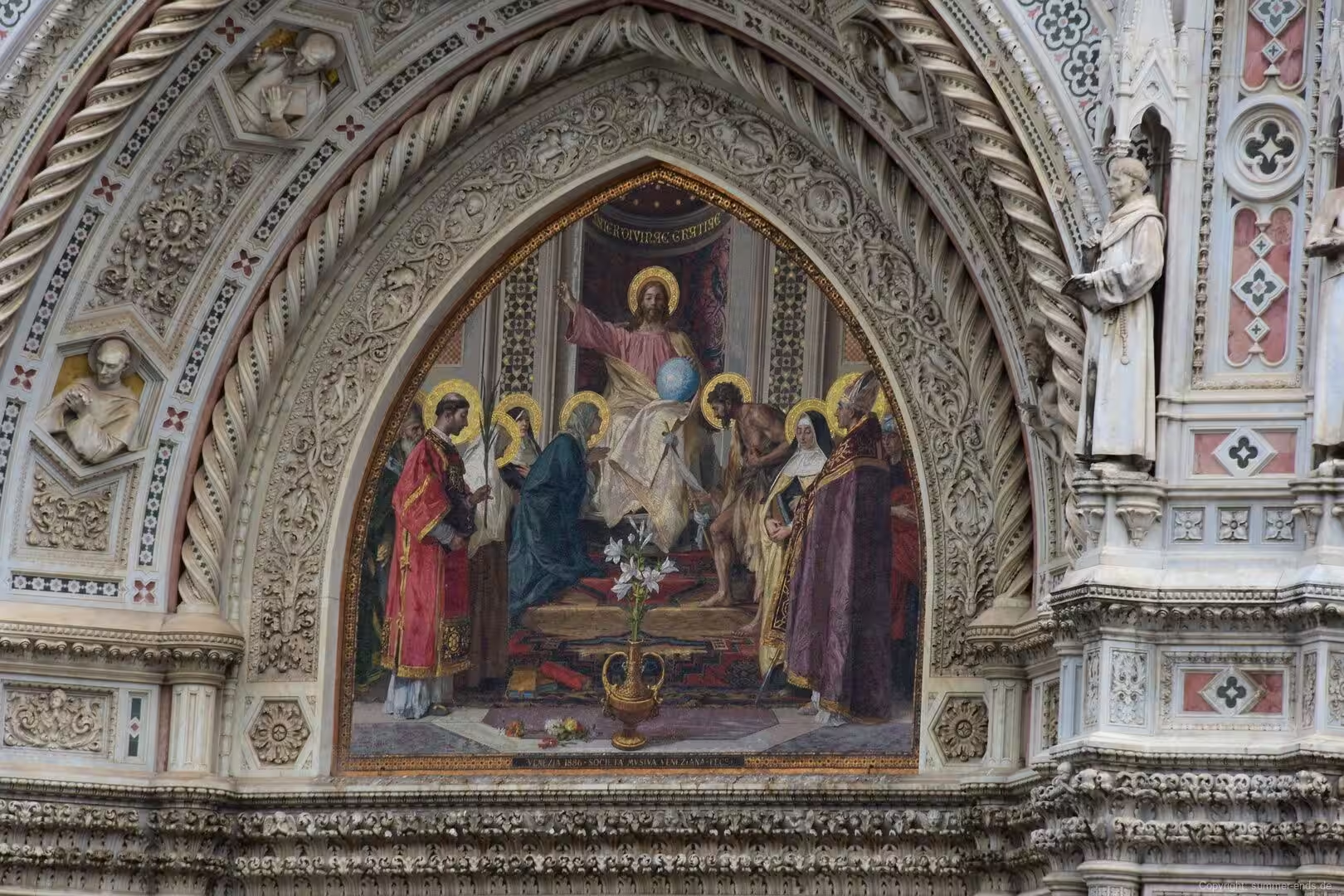
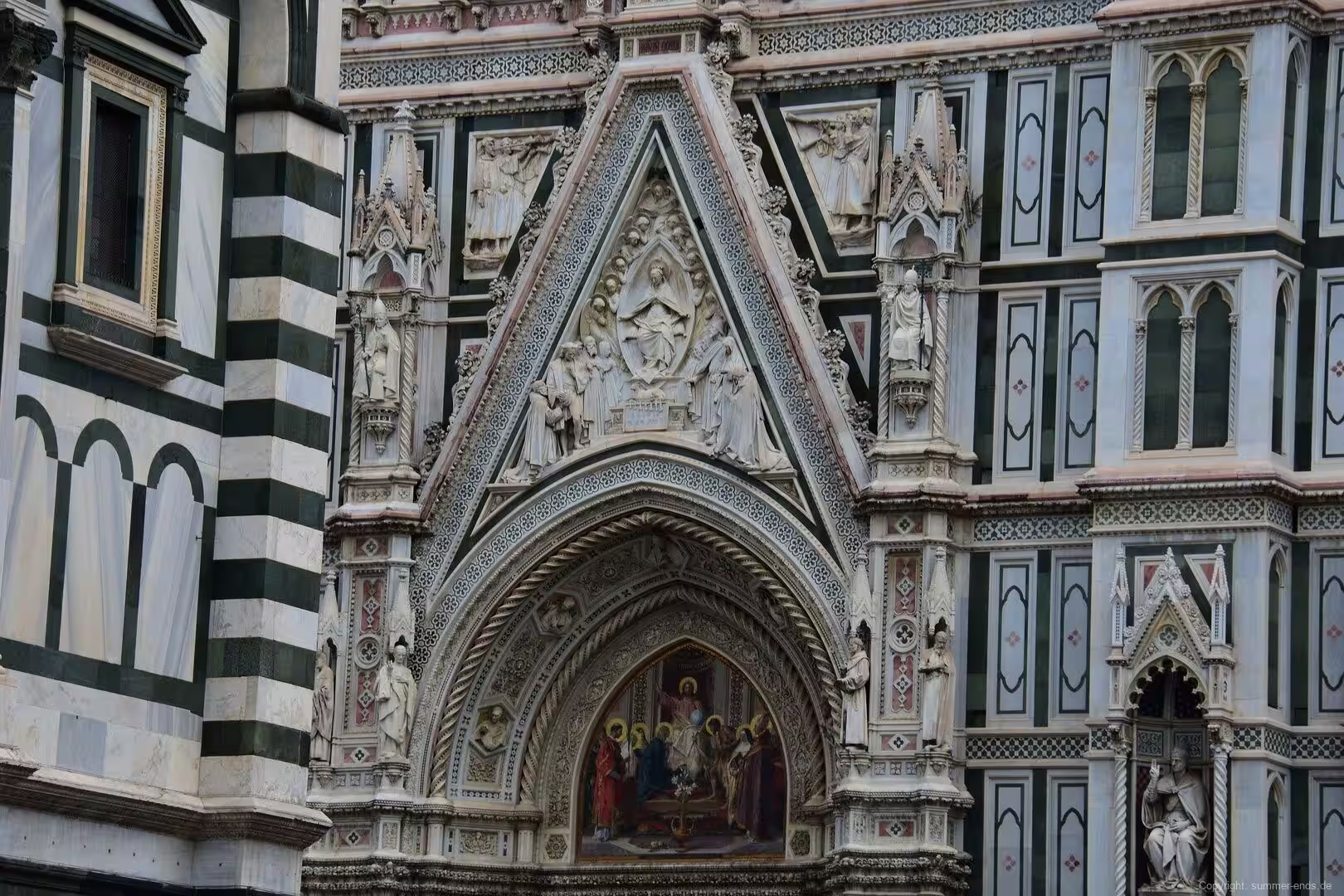
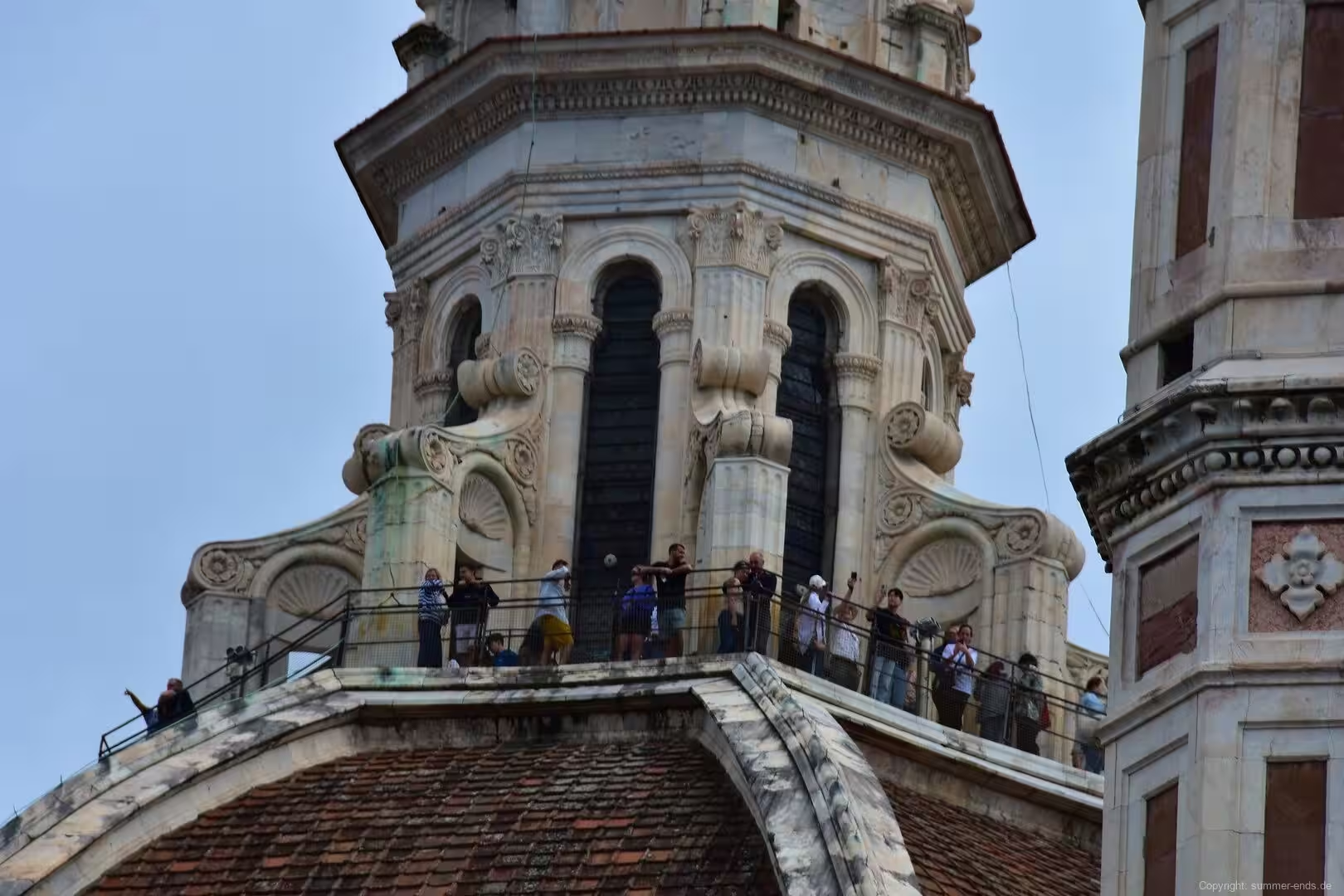
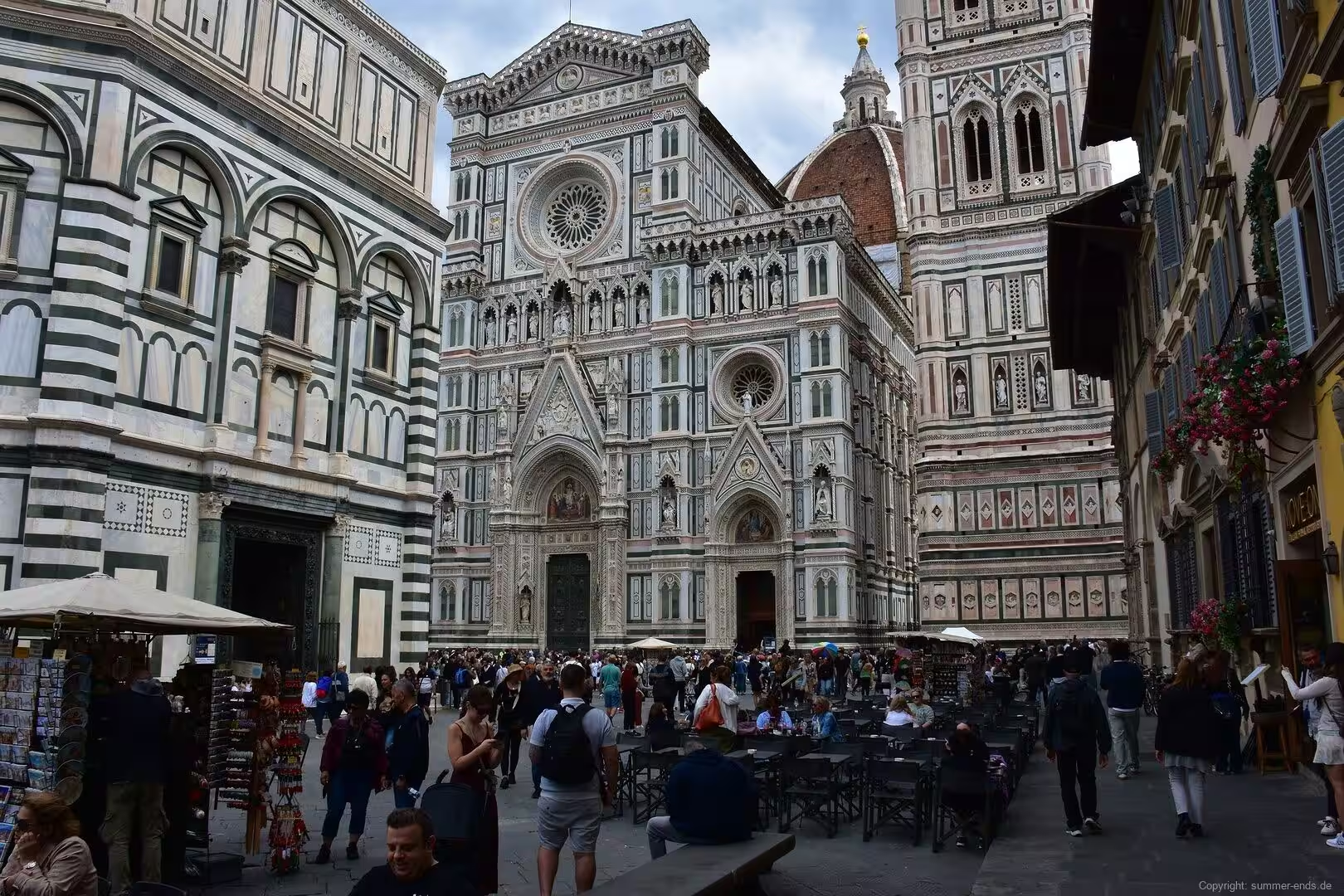
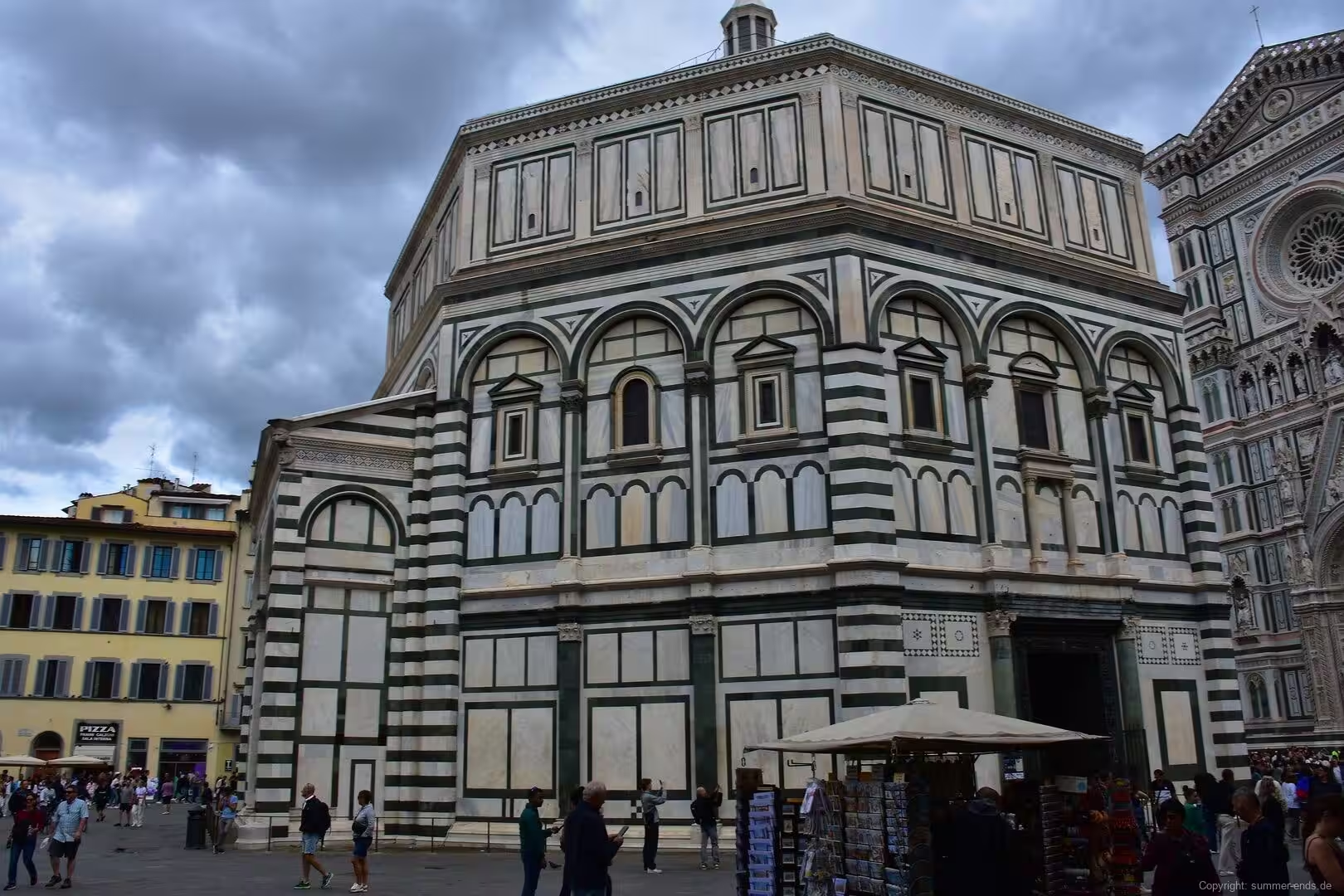
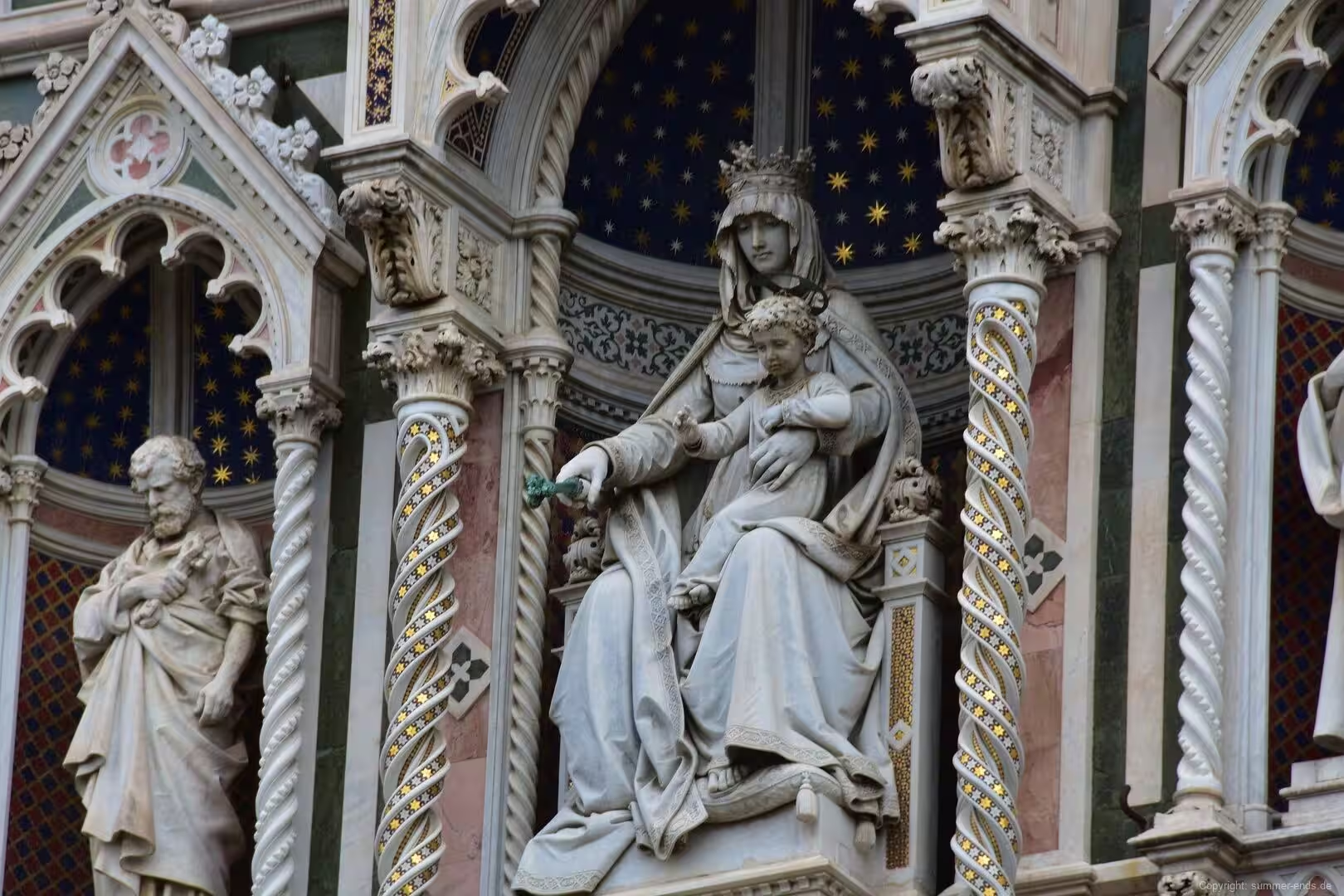
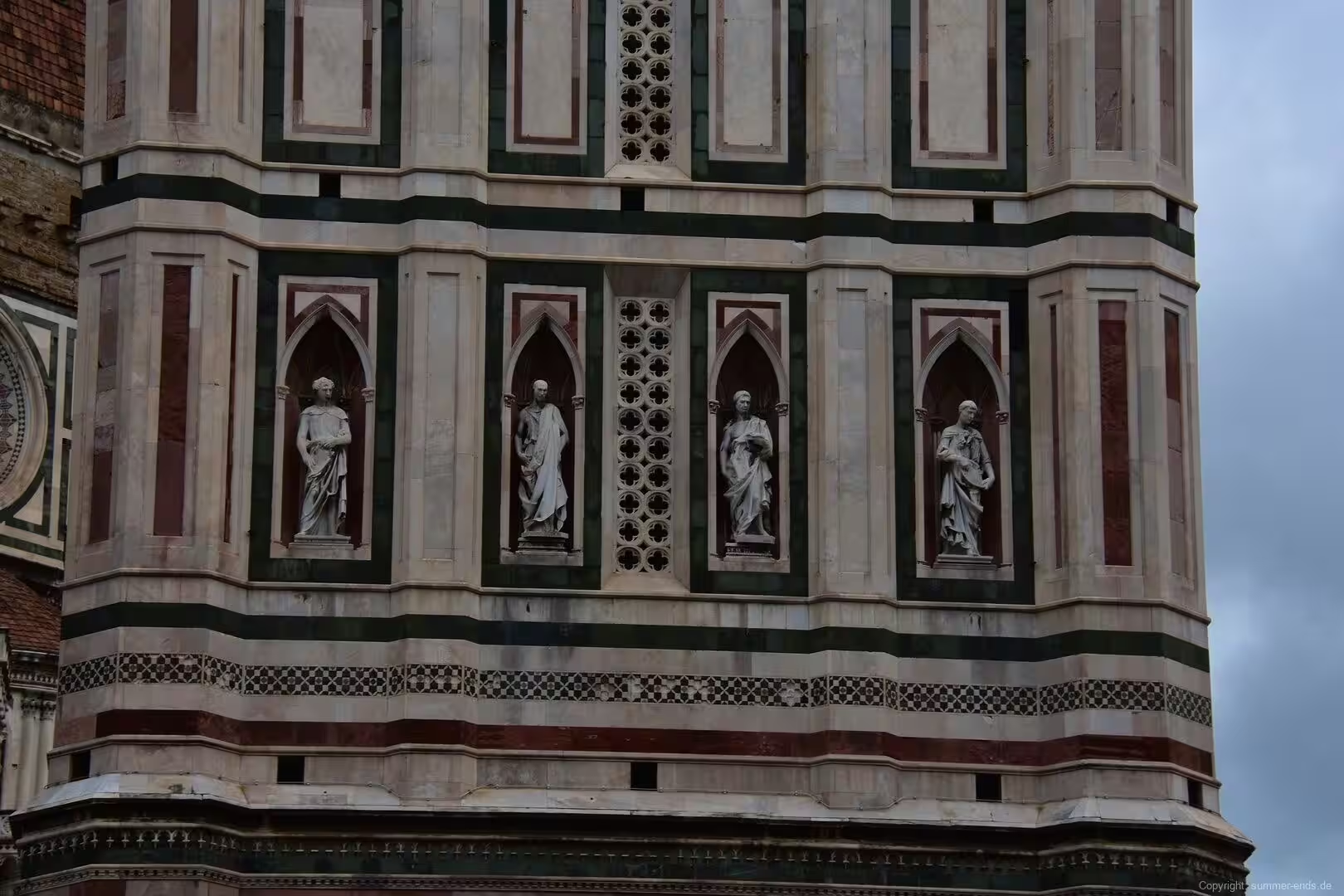
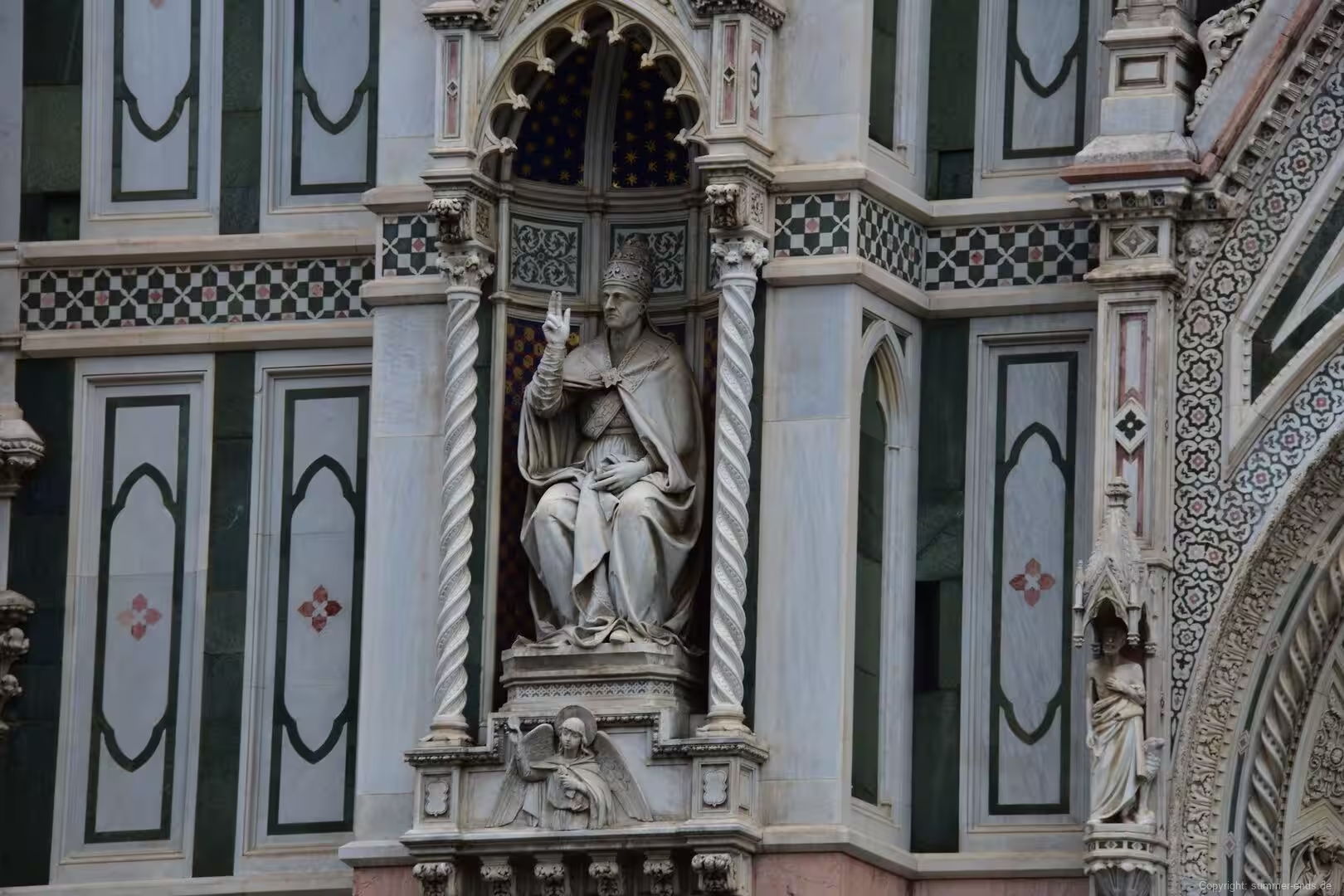
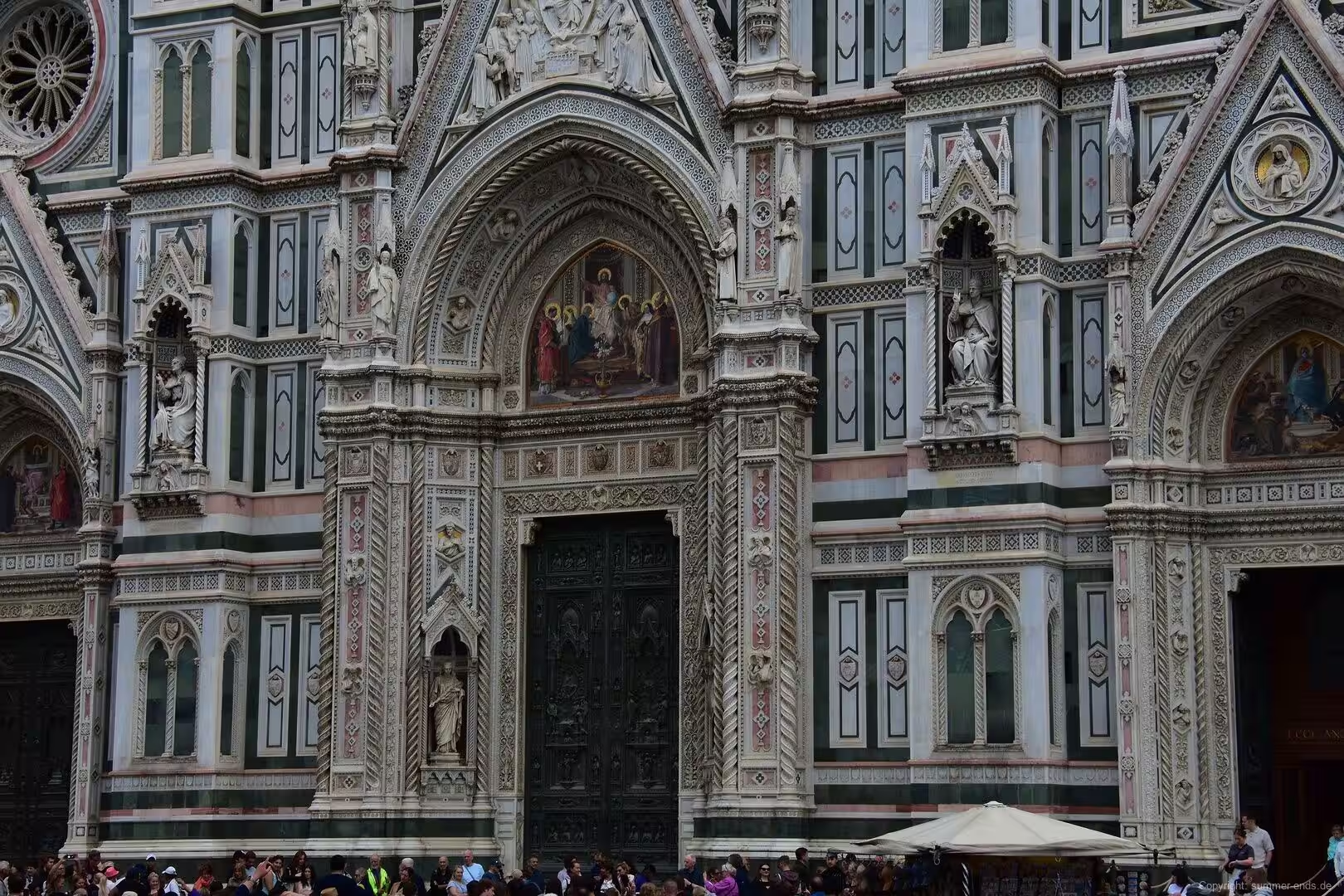
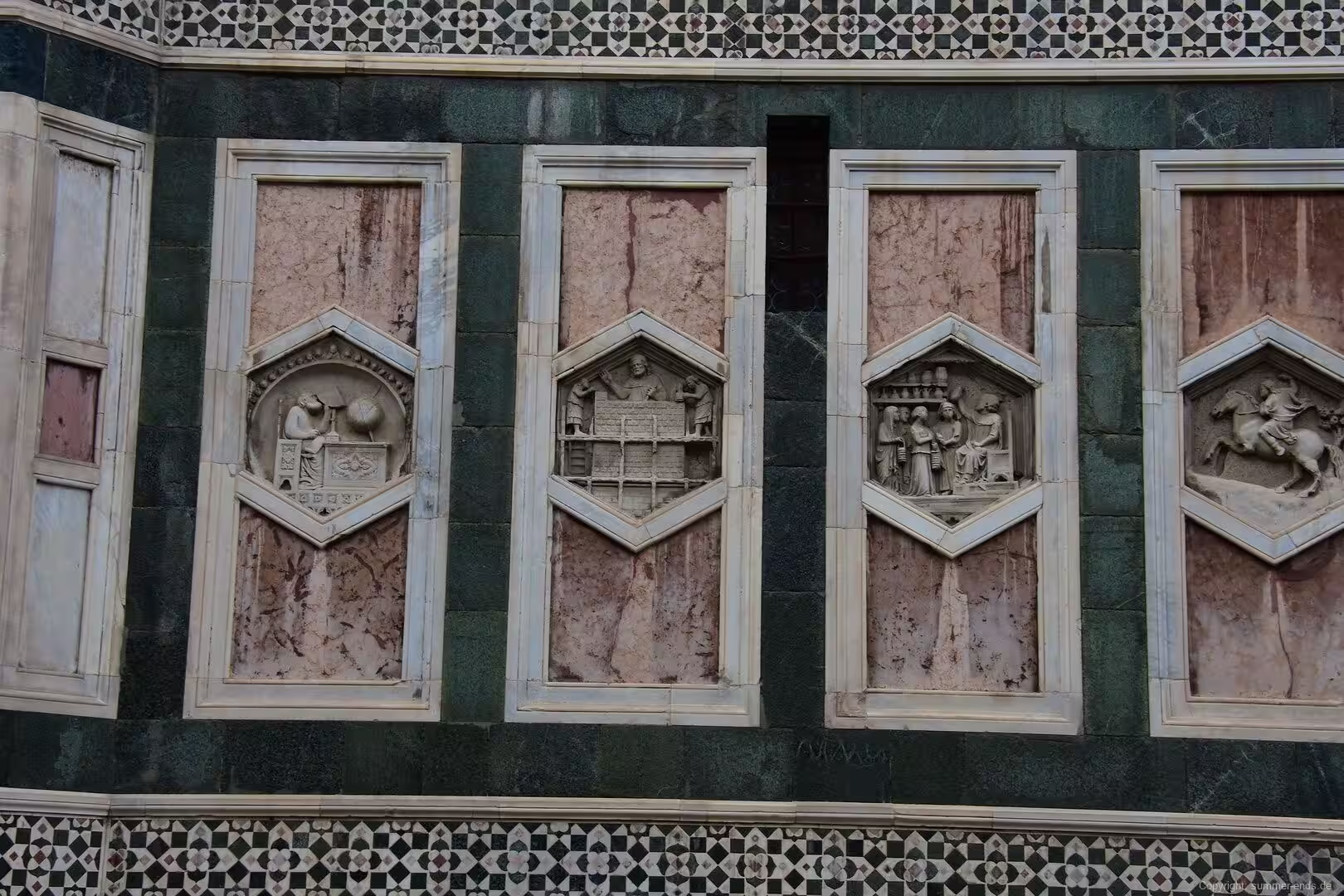
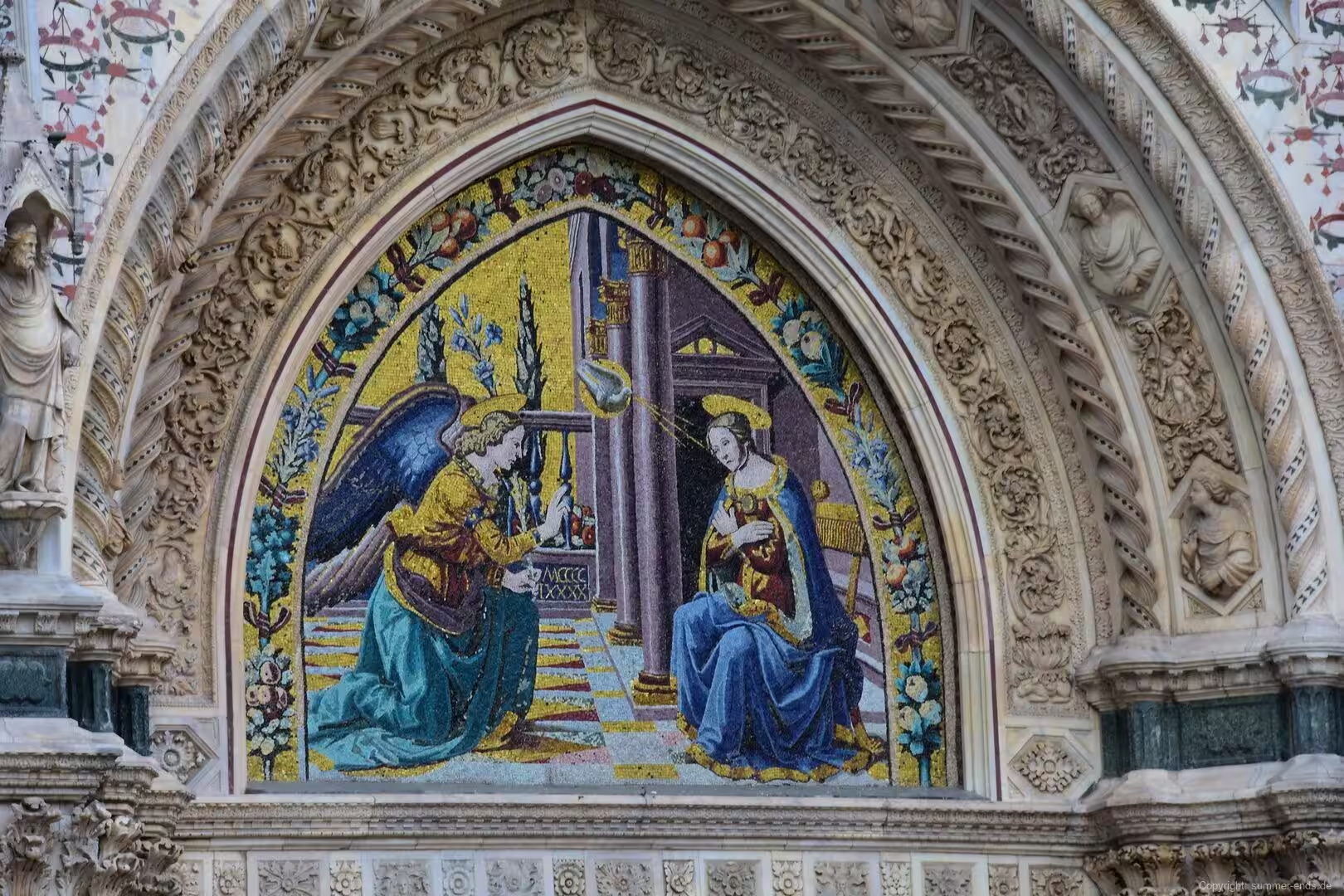
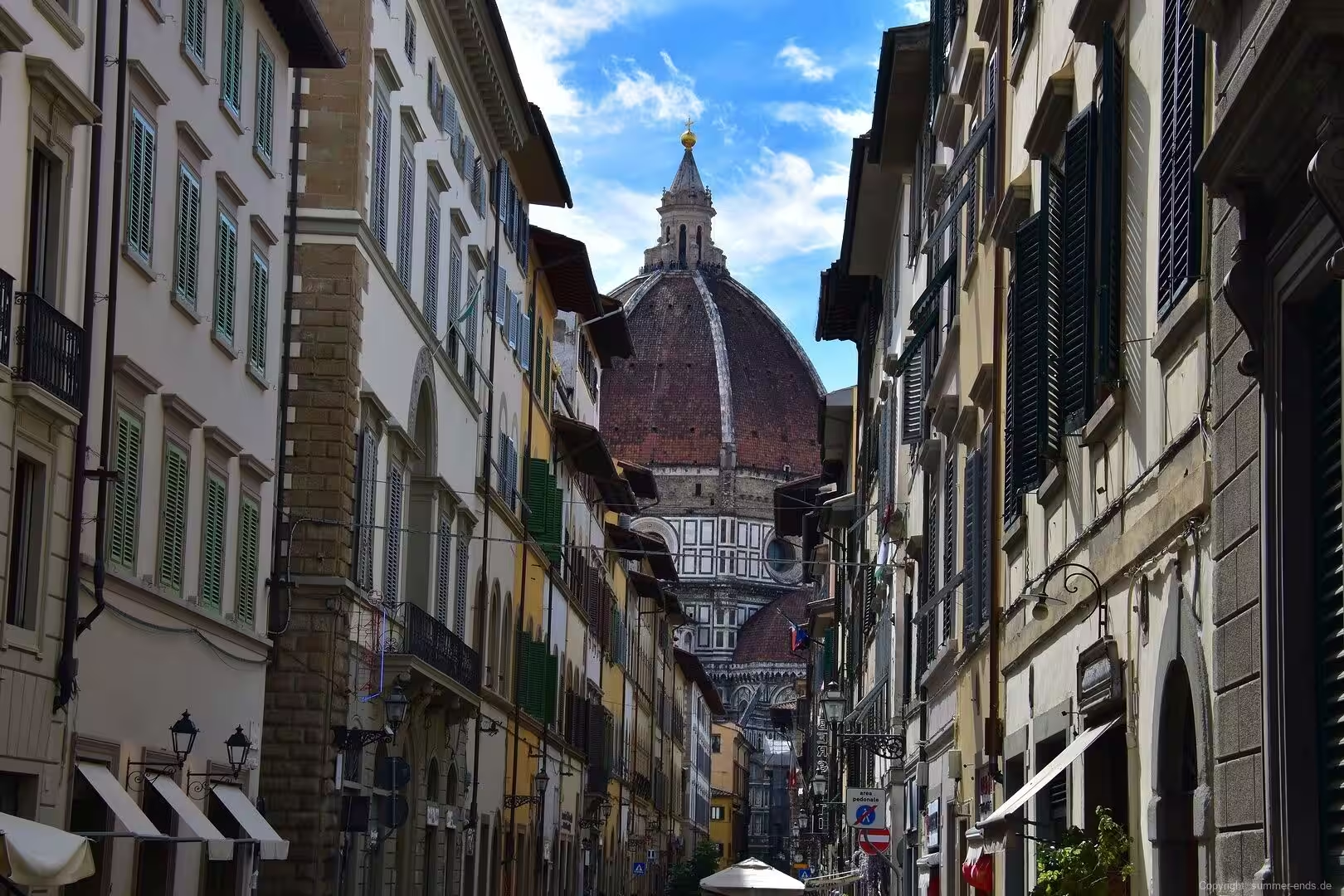
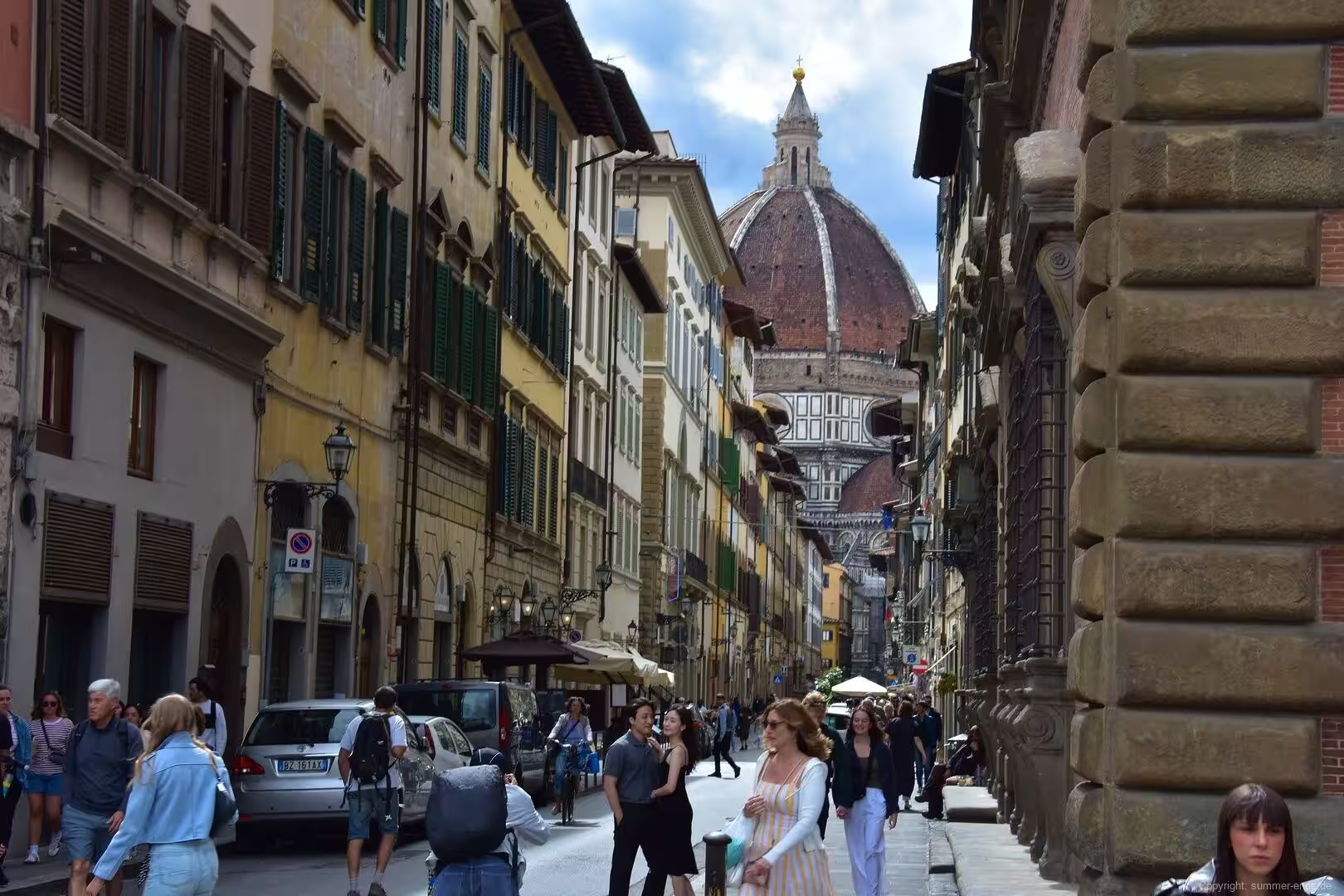
The Cathedral of Santa Maria del Fiore, begun in 1296 on the site of the earlier church of Santa Reparata, dominates the religious centre of the city. Its great octagonal dome, designed by Filippo Brunelleschi and completed in 1436, was the largest masonry dome ever built at the time and remains a landmark of Renaissance engineering, rising above the nave and the tribunes. The free-standing campanile begun by Giotto in 1334, faced in the same polychrome white, green and pink marble drawn from the Tuscan mountains, rises beside the church. Facing the cathedral in the same square stands the octagonal Baptistery of San Giovanni, an eleventh-century Romanesque building famous for its three sets of bronze doors, above all Lorenzo Ghiberti’s gilded Gates of Paradise, cast between 1425 and 1452 and depicting scenes from the Old Testament in ten gilded relief panels.
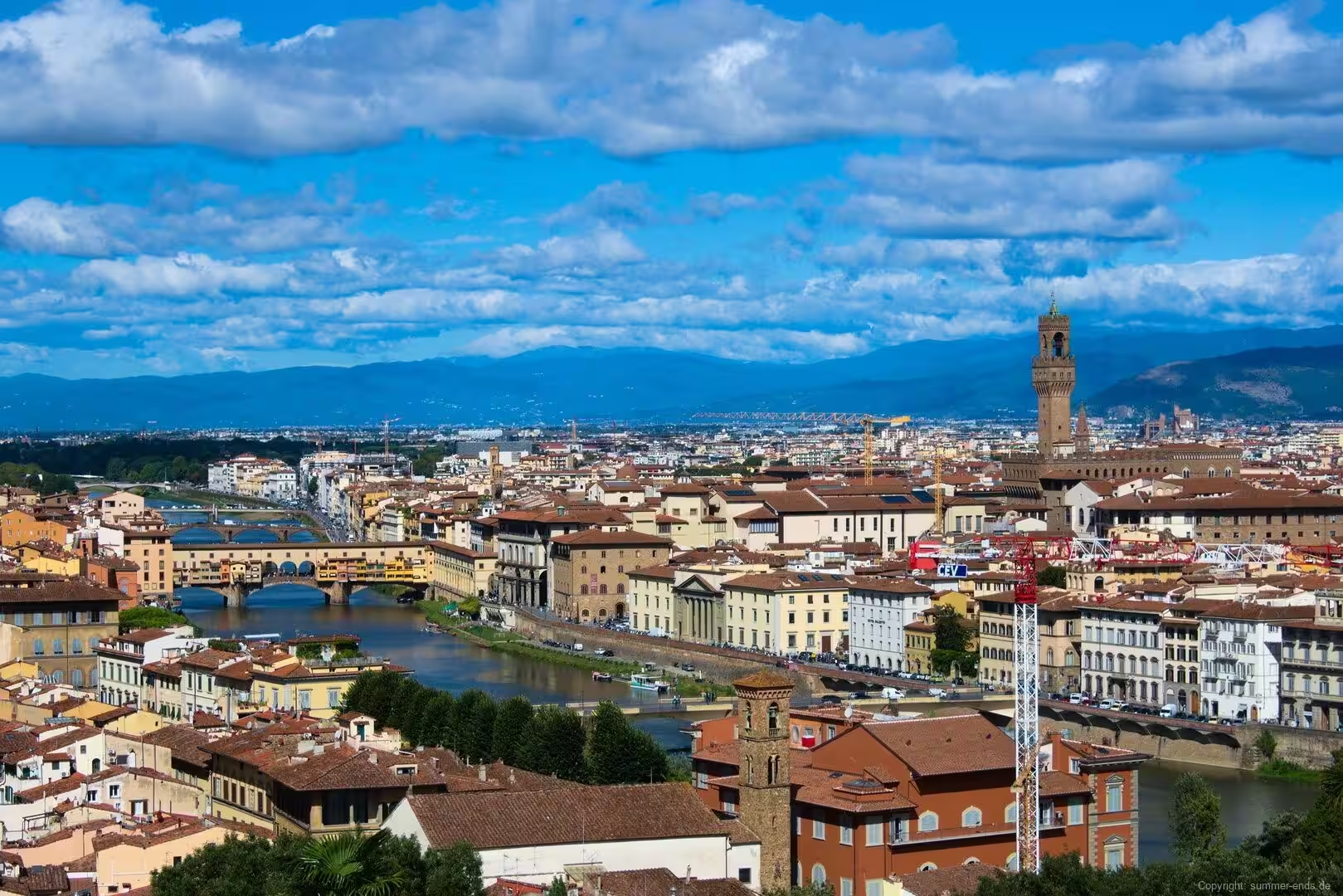
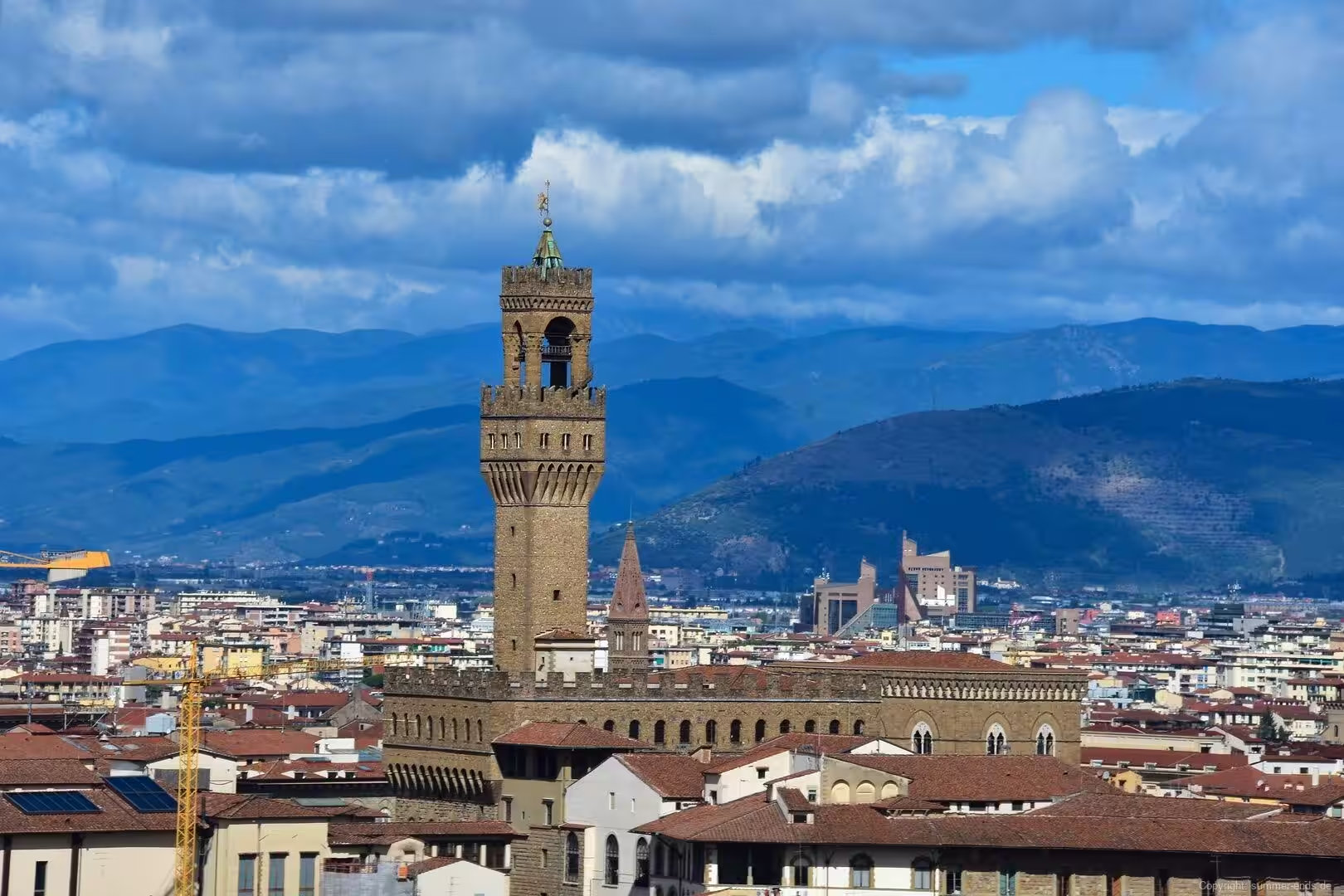
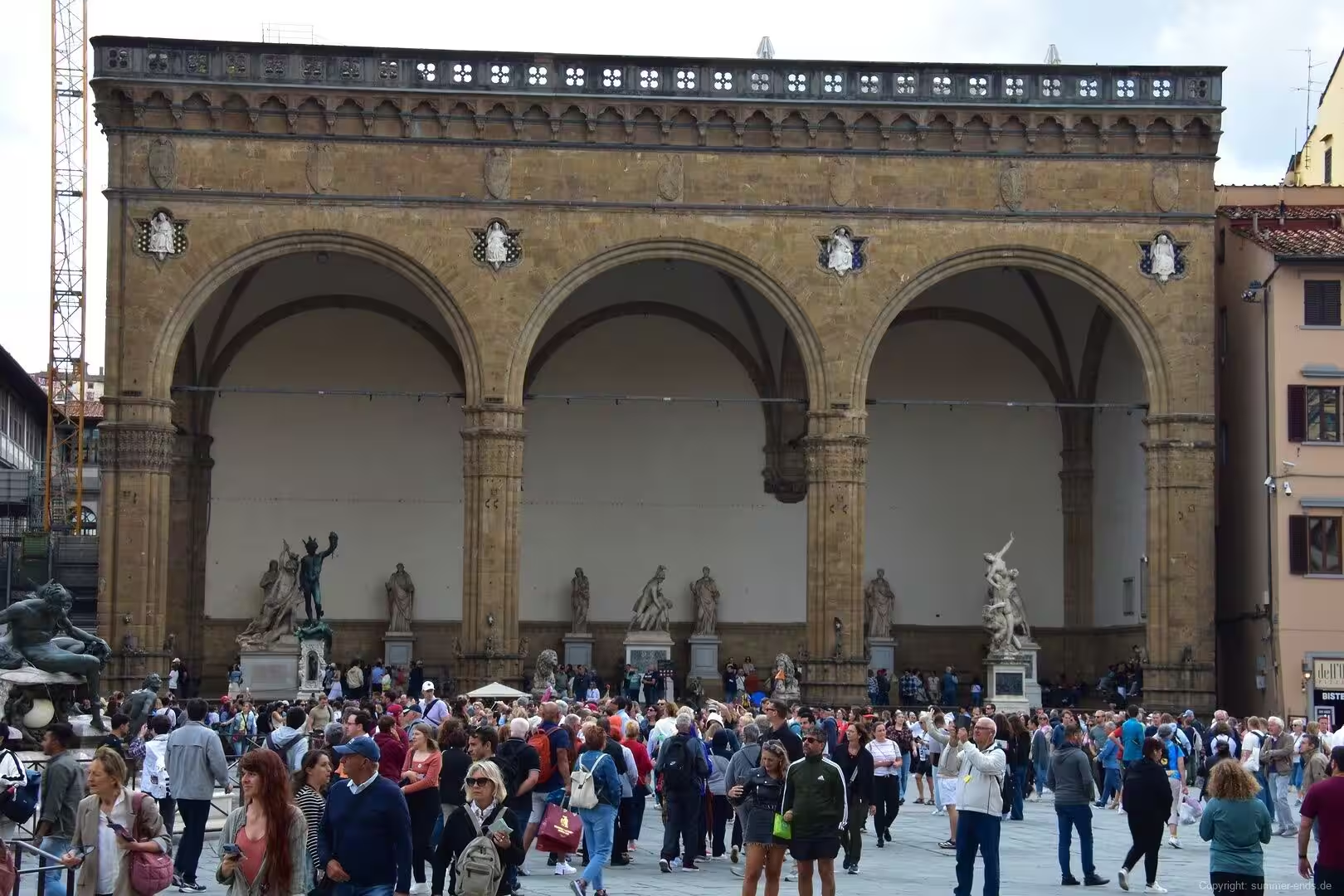
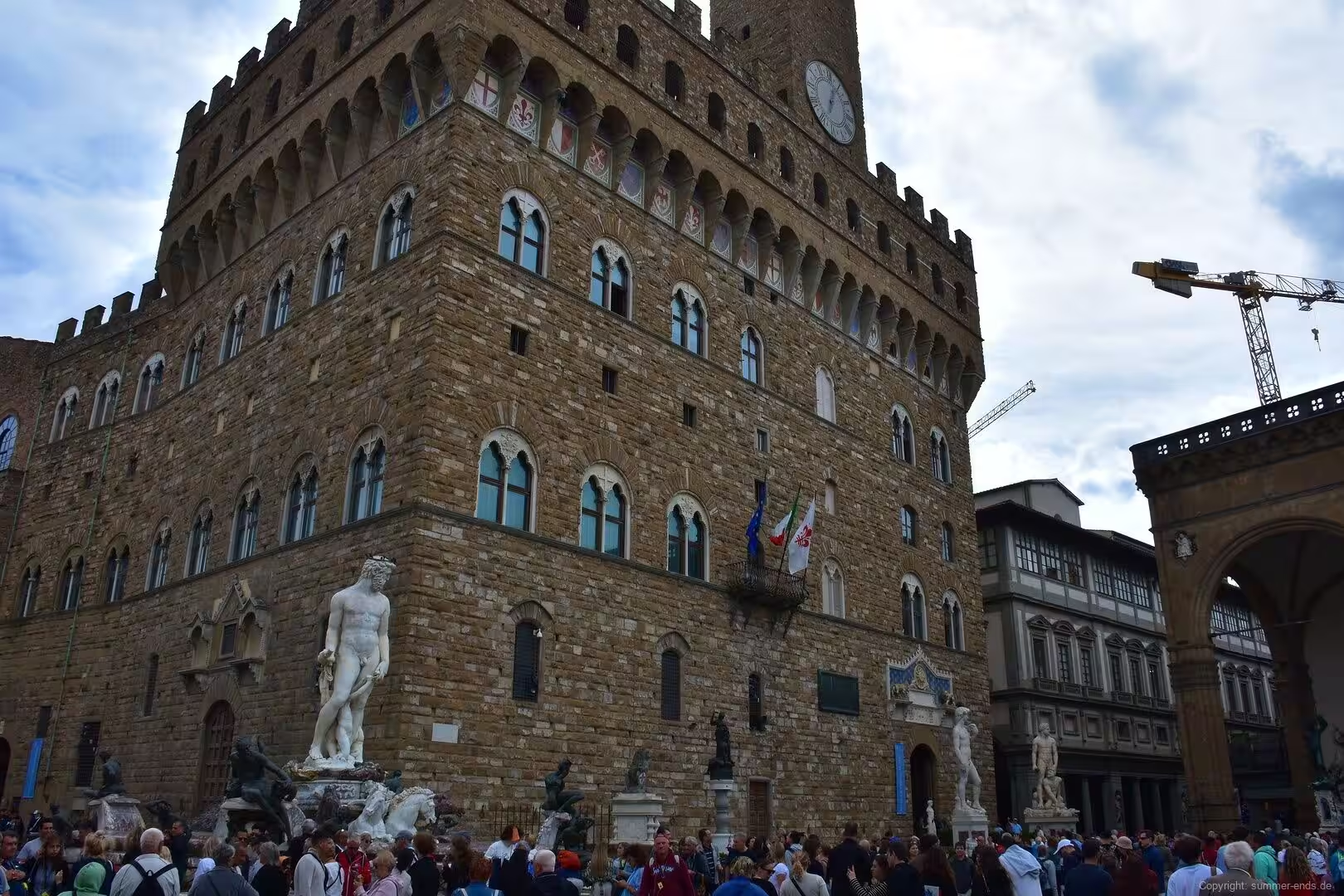
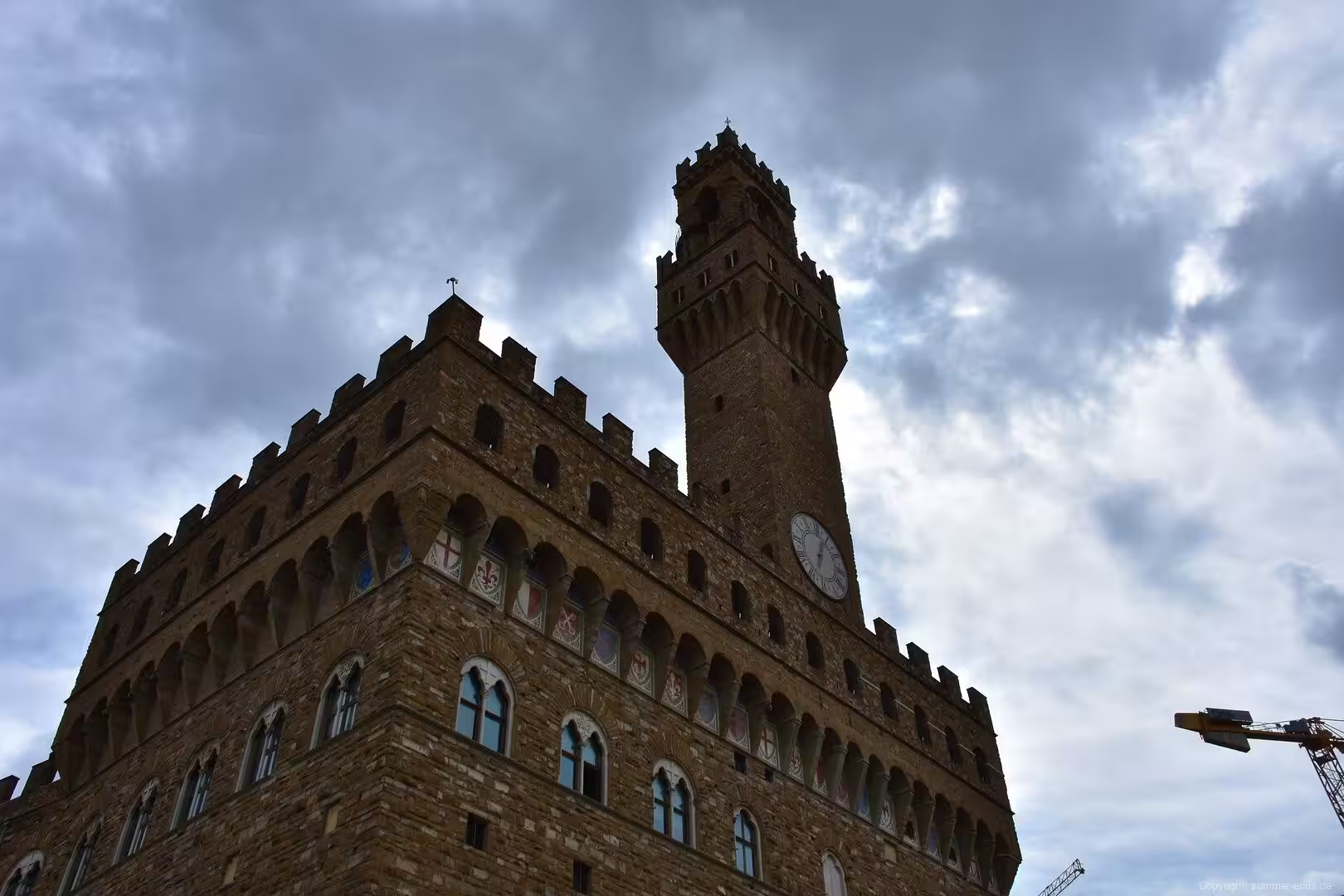
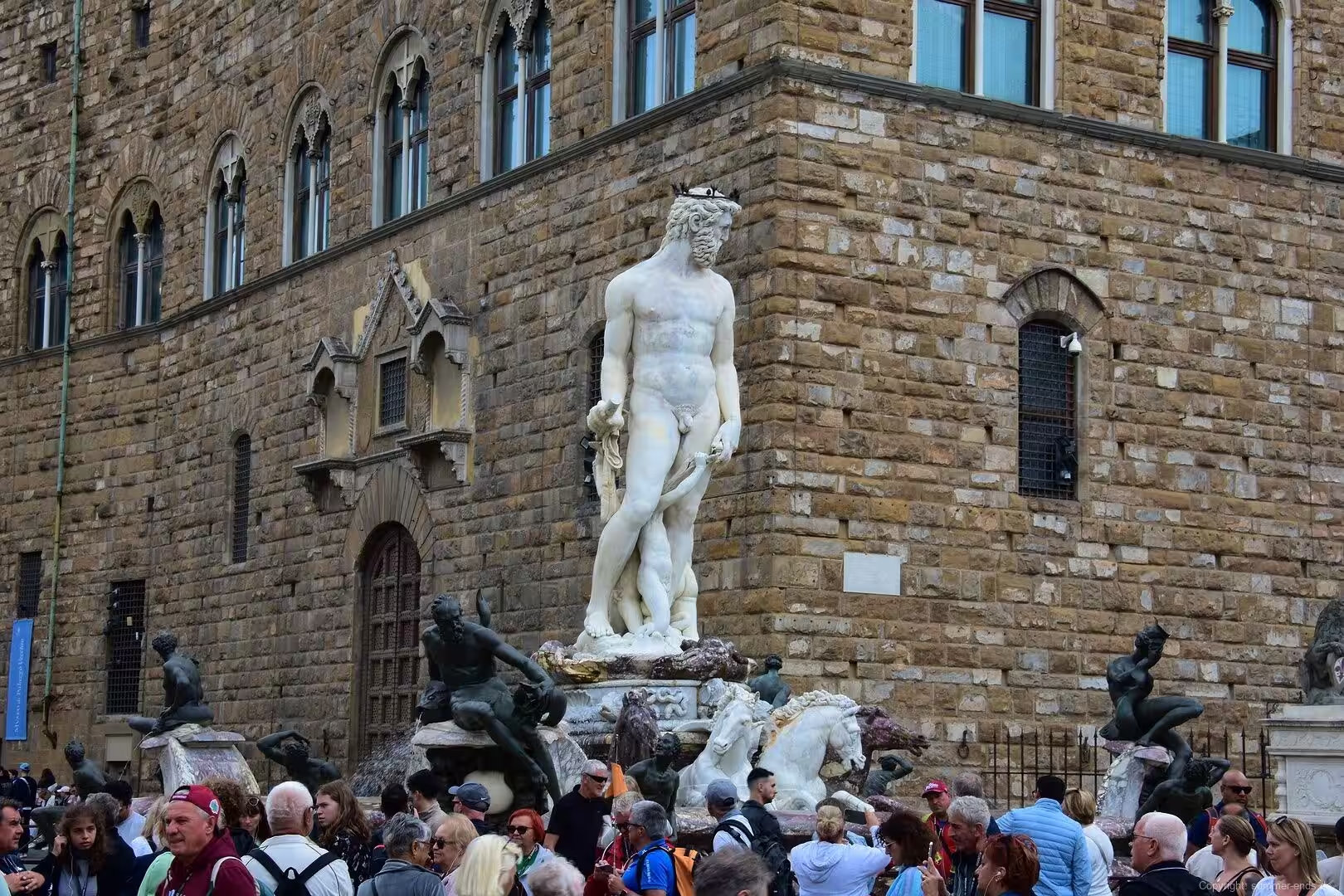
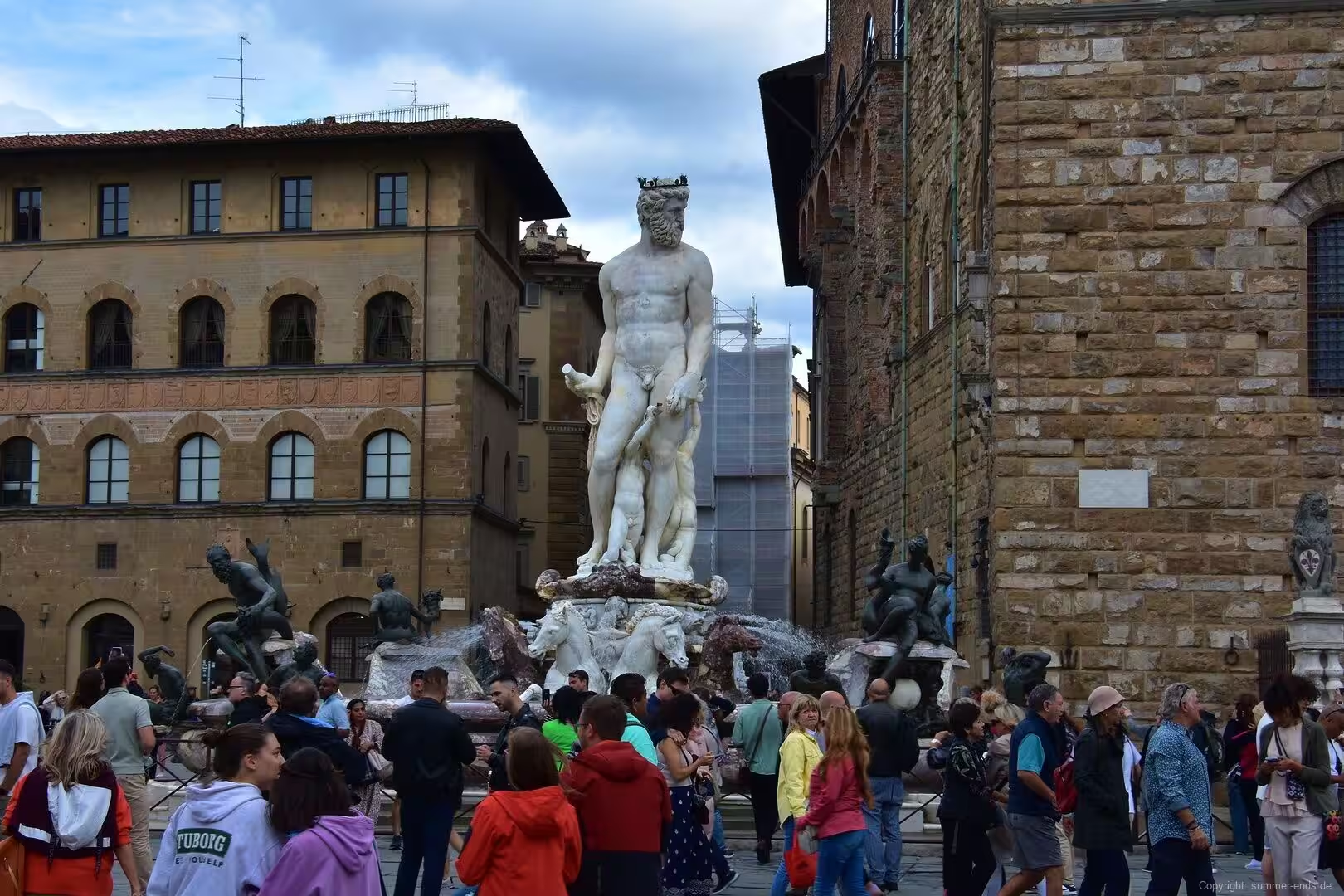
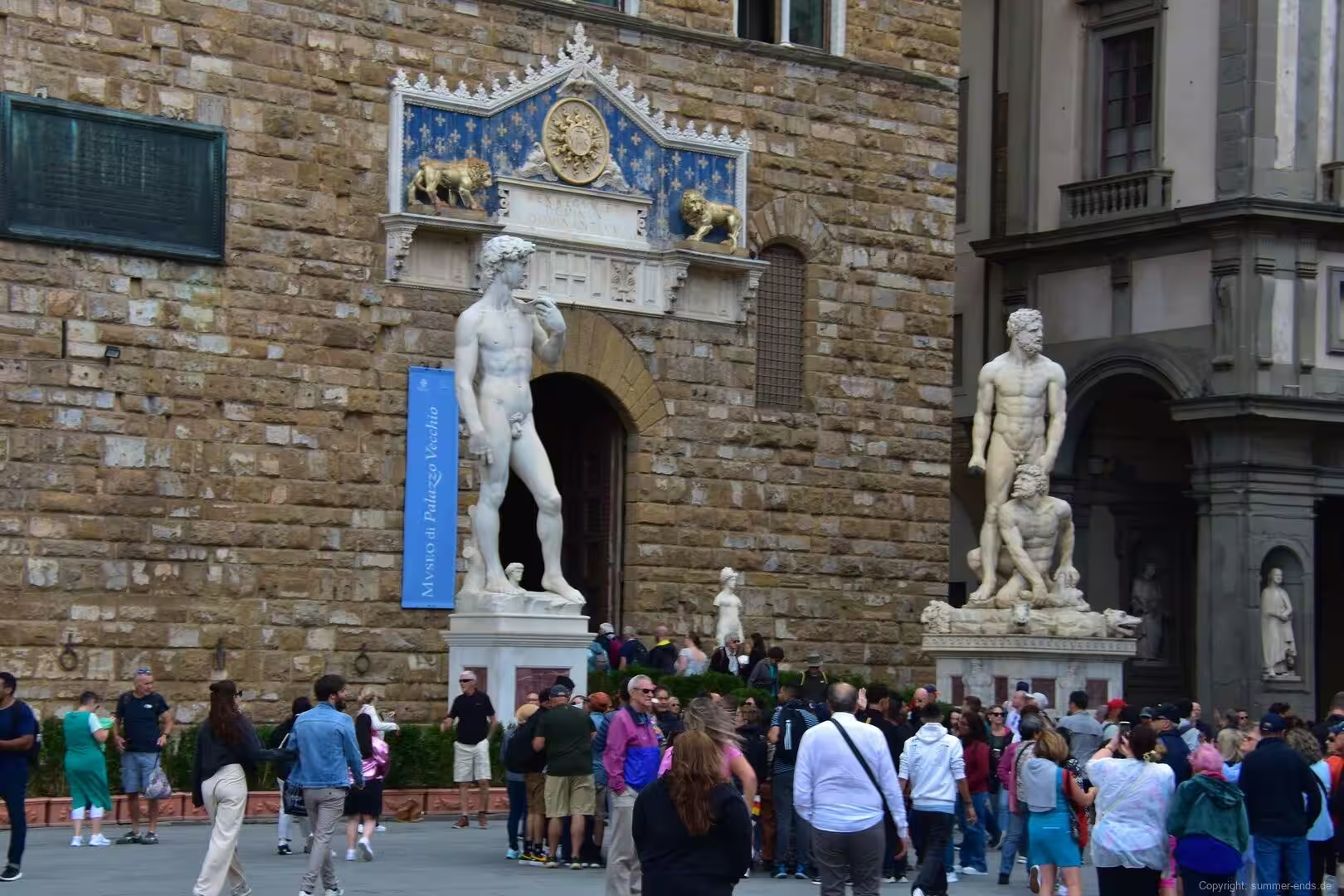
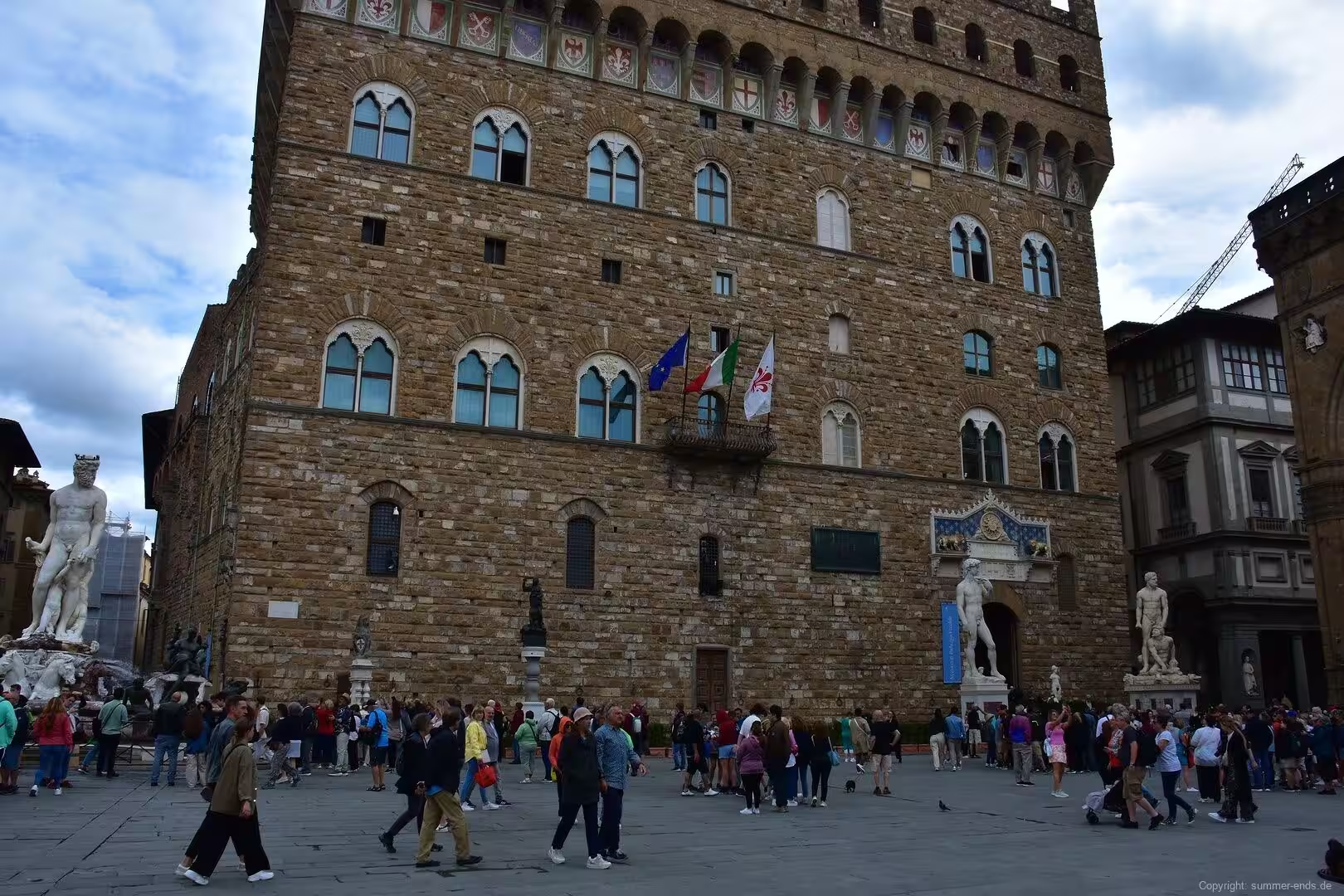
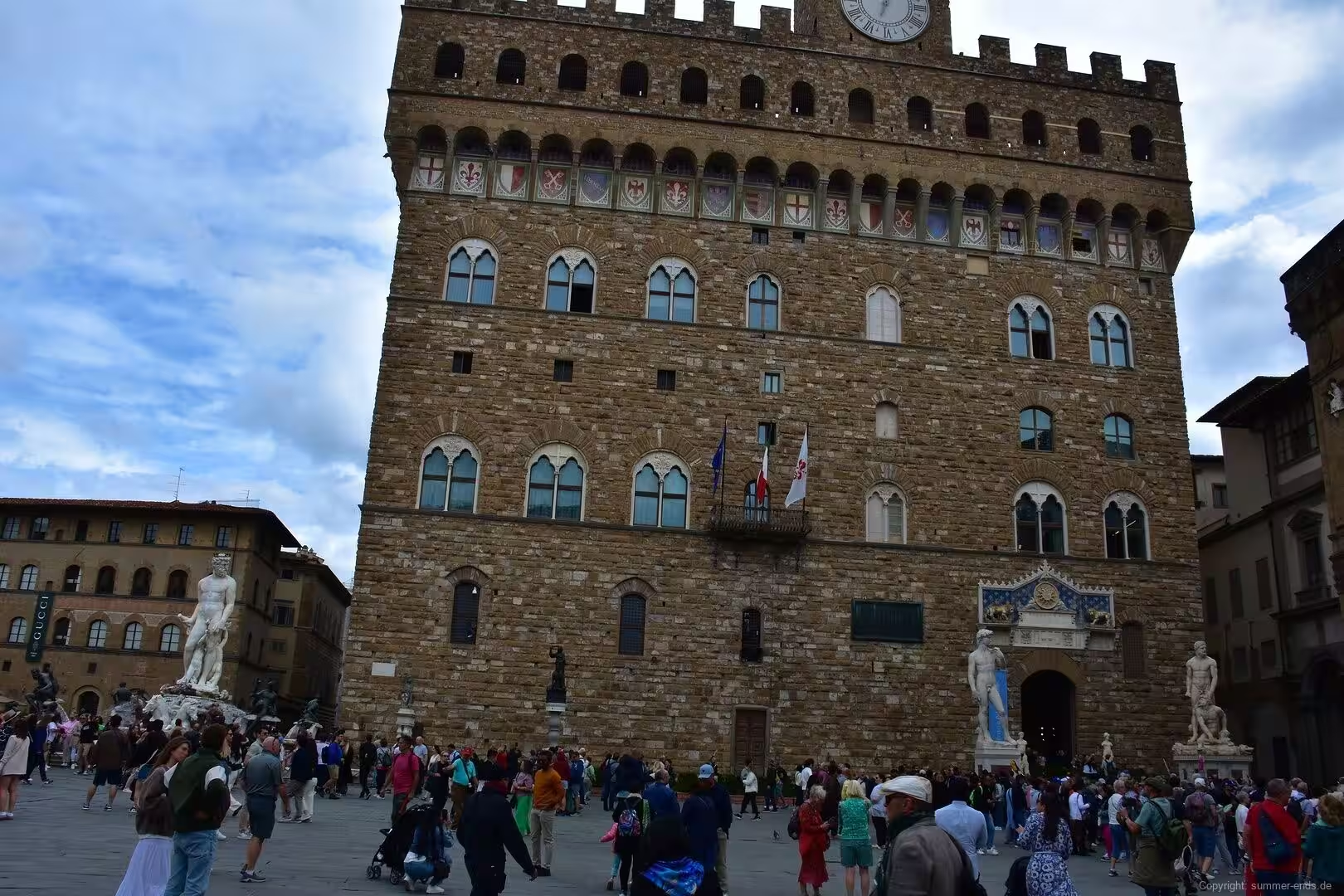
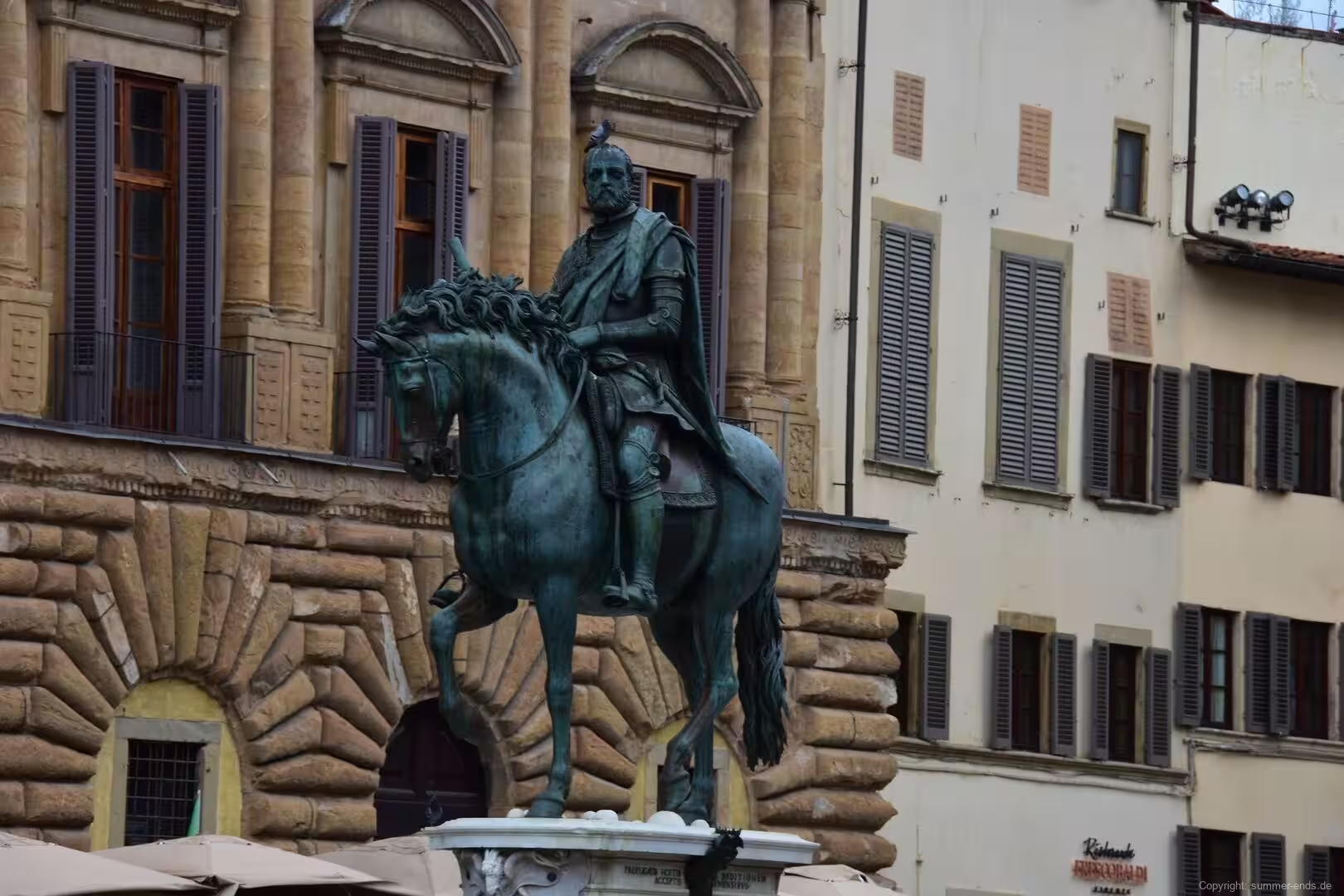
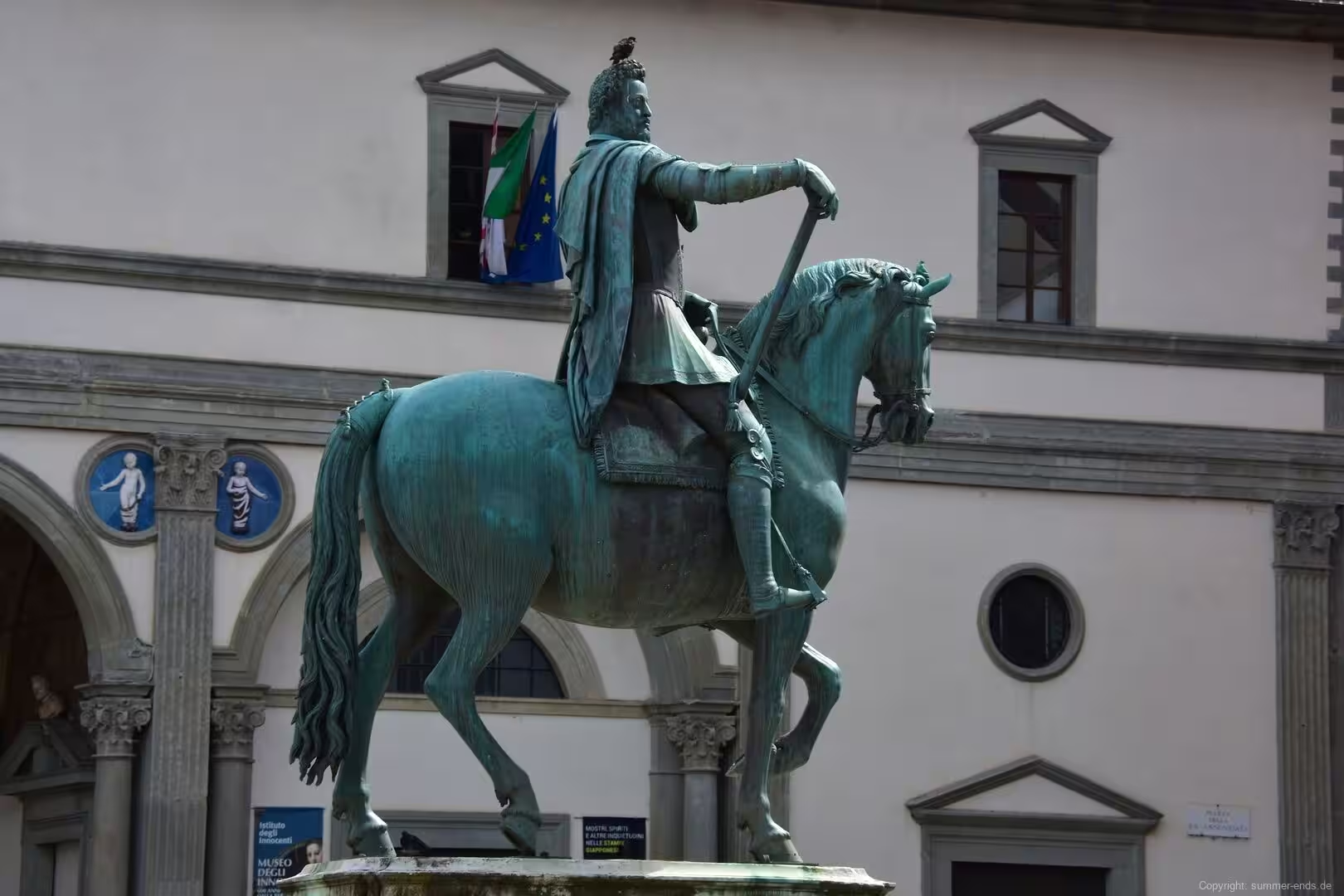
On the opposite side of the historic core, the Piazza della Signoria is the political heart of the city, dominated by the fortress-like Palazzo Vecchio, begun in 1299 as the seat of the priors and still the town hall of Florence. The square serves as an open-air sculpture gallery, framed by the Loggia dei Lanzi, built between 1376 and 1382, which shelters figures such as Benvenuto Cellini’s bronze Perseus and Giambologna’s Rape of the Sabine Women. Standing at the palace entrance is a copy of Michelangelo’s David, set in place in 1873 when the original was moved to the Galleria dell’Accademia; nearby stand the Fountain of Neptune by Bartolomeo Ammannati and the bronze equestrian statue of Cosimo I de’ Medici by Giambologna. The square’s pavement, the marble Hercules and Cacus group and the armorial reliefs above the palace doorway record the successive rulers of the city and their claims to authority.
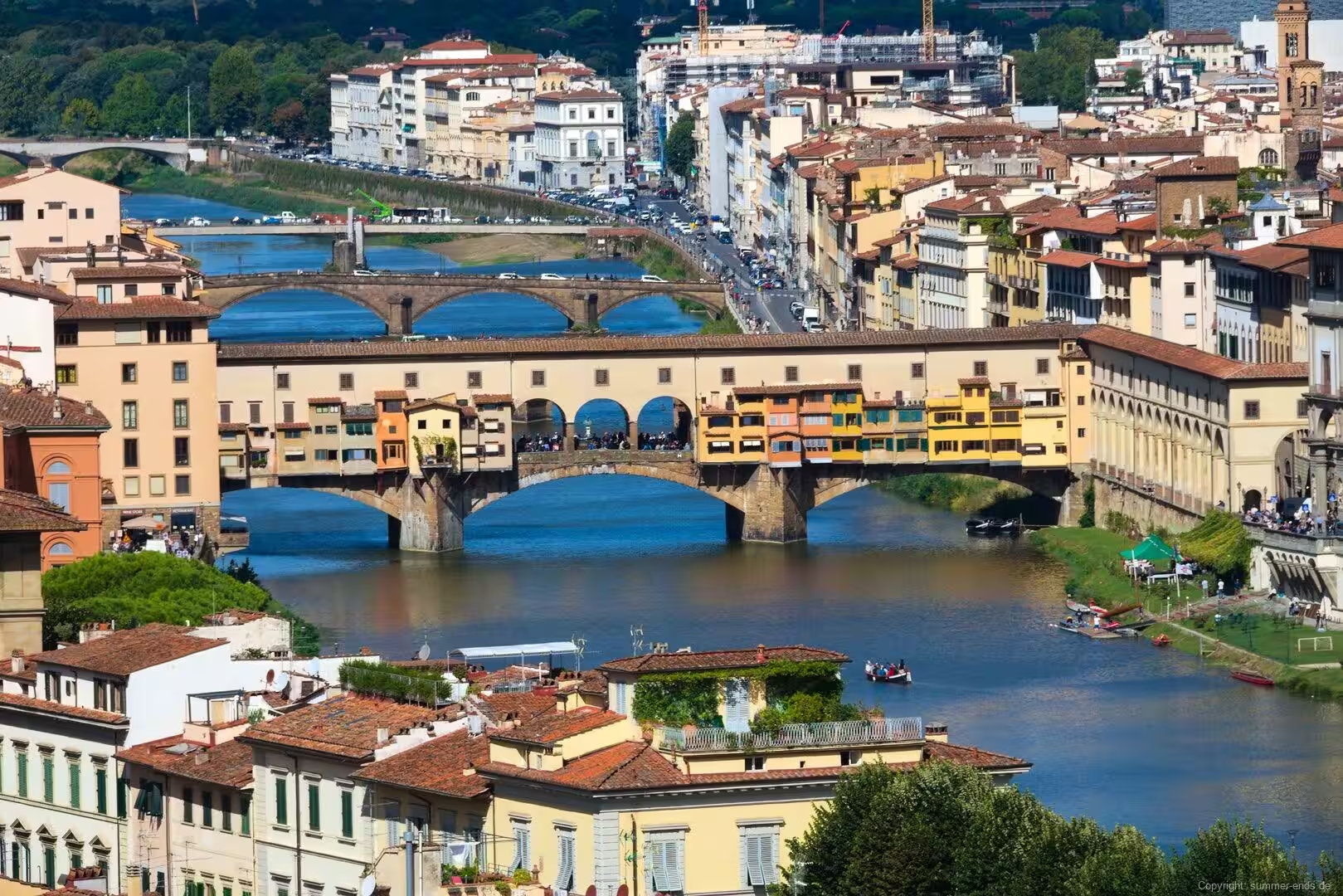
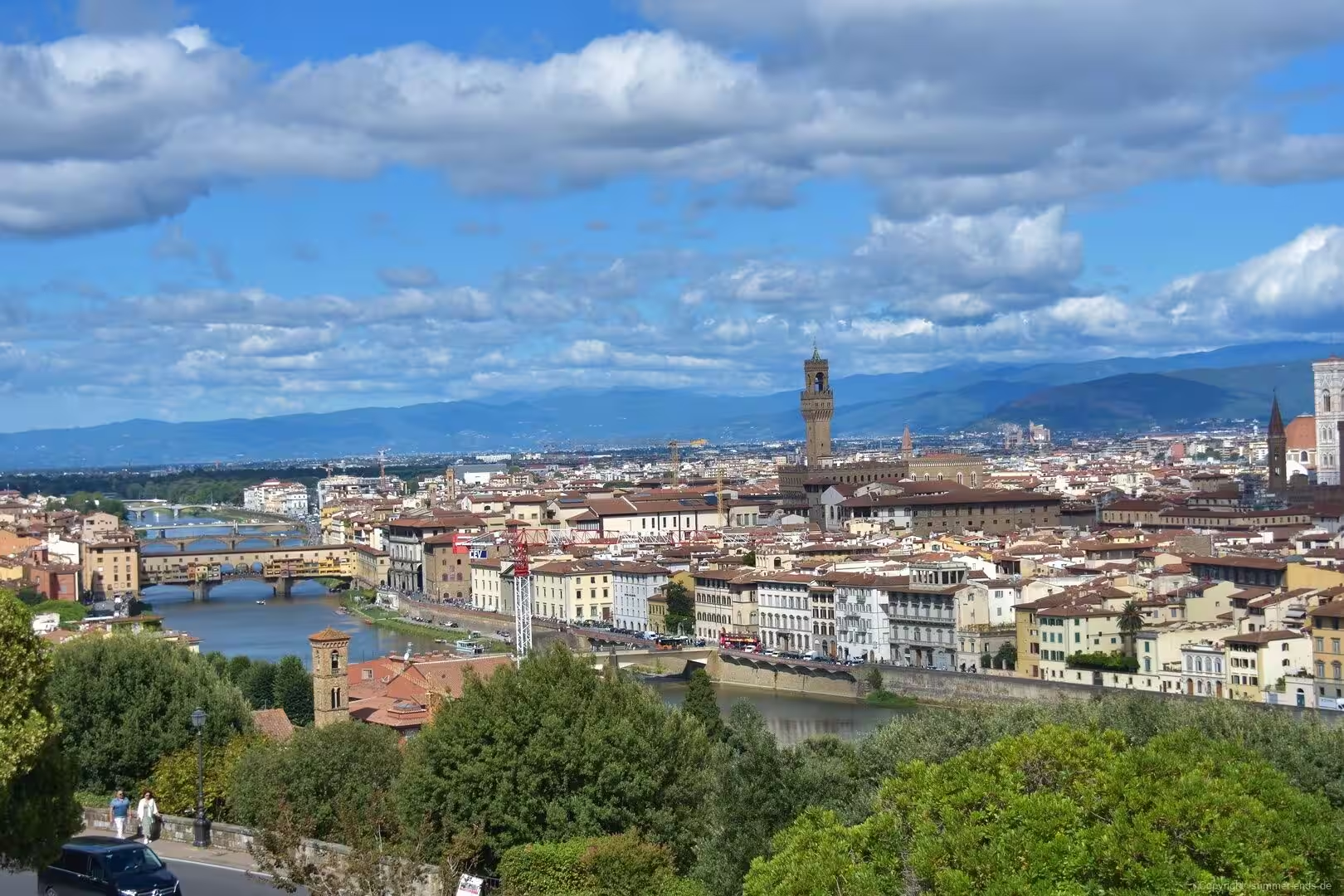
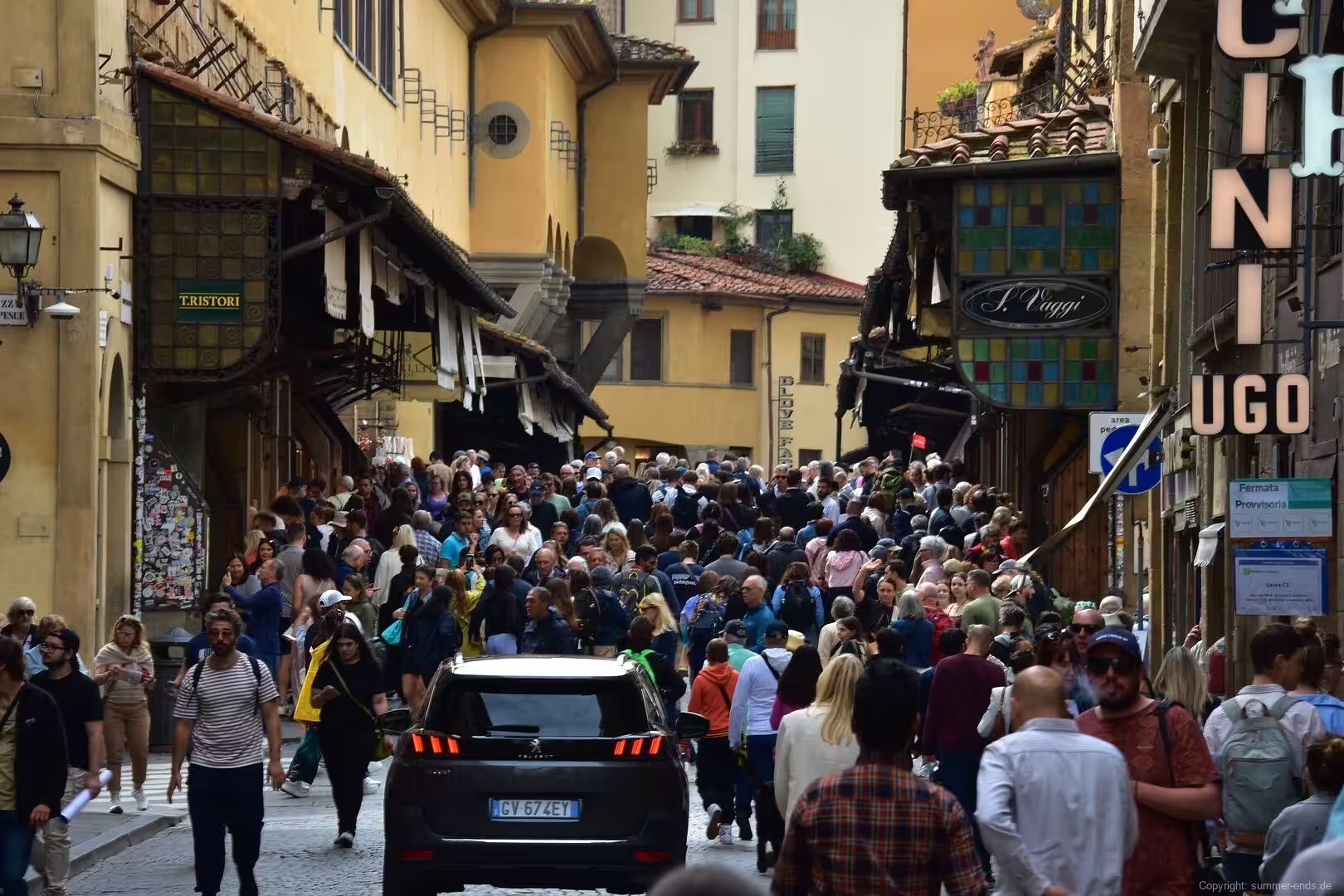
The Ponte Vecchio, a medieval three-arch bridge spanning the Arno since its reconstruction in 1345, is lined with goldsmiths’ and jewellers’ shops and carries the enclosed Vasari Corridor above the shops, a private passage built in 1565 to link the Palazzo Vecchio with the Pitti Palace. The bridge is the only one in the city centre to have survived the twentieth century largely intact, and its terraced shopfronts, shuttered houses and central open view over the river make it one of the most distinctive crossings in Europe. The Uffizi, begun by Giorgio Vasari in 1560 and developed through the following decades, houses one of the world’s foremost collections of Renaissance painting, while the Galleria dell’Accademia holds the original marble David of Michelangelo.
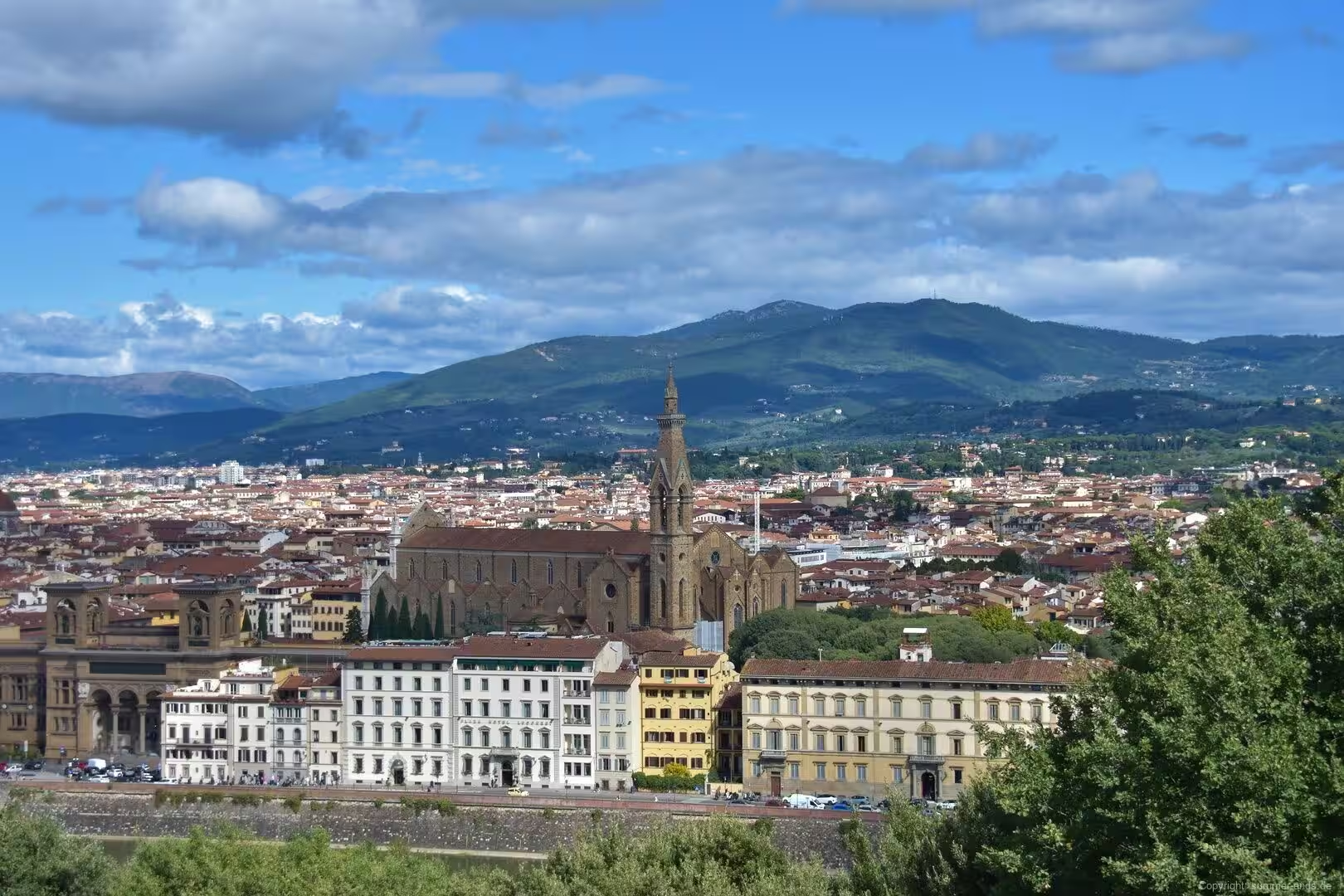
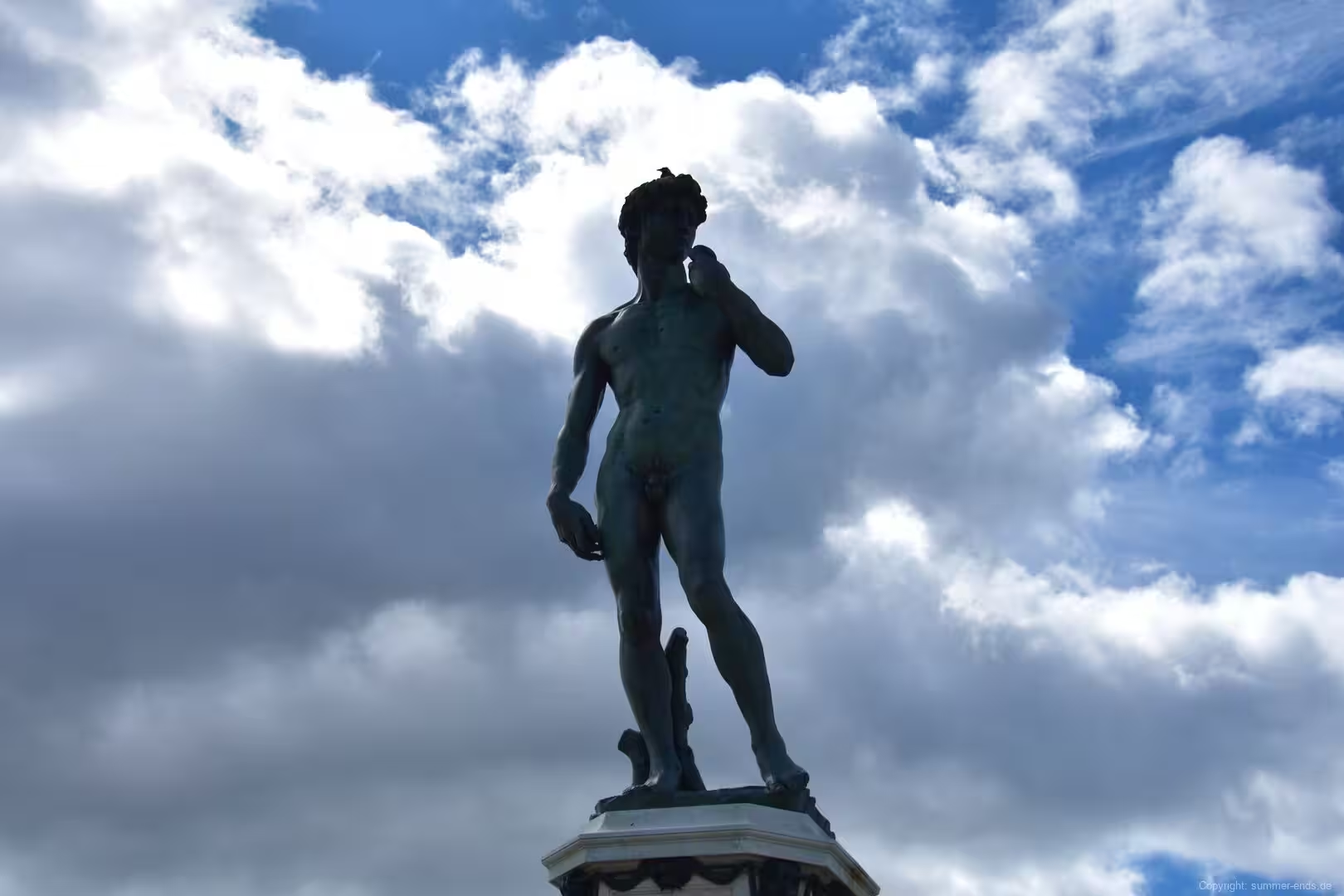
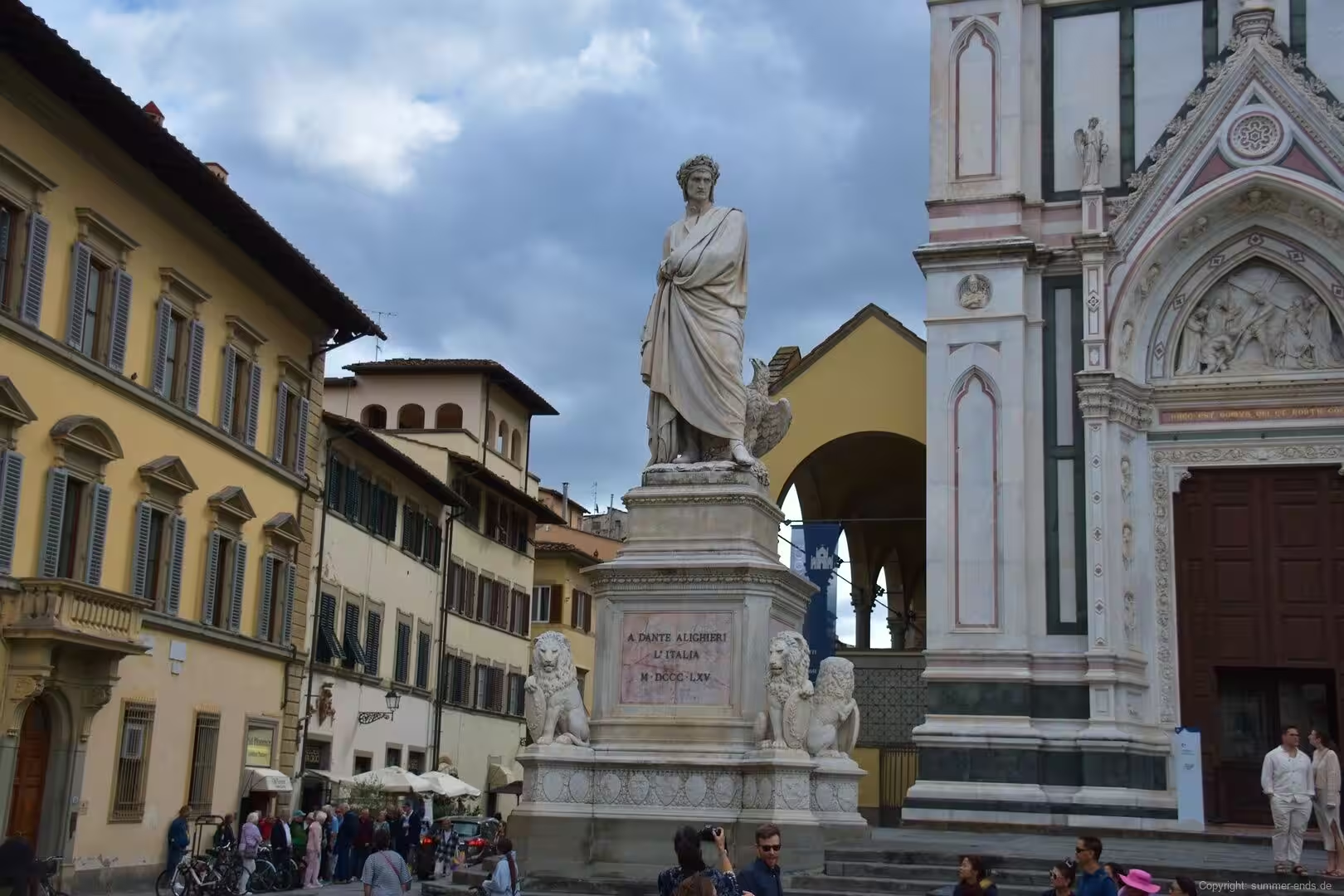
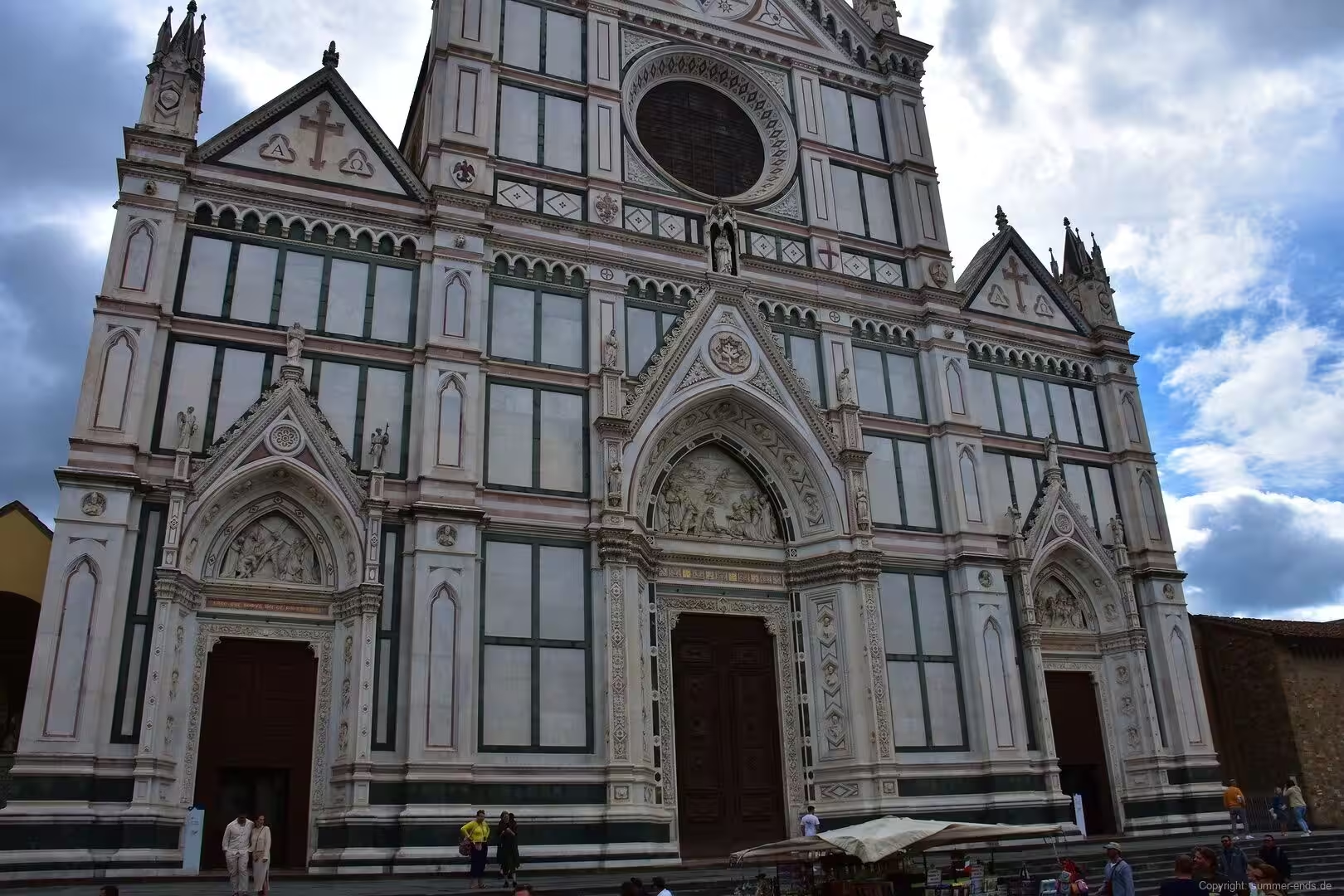
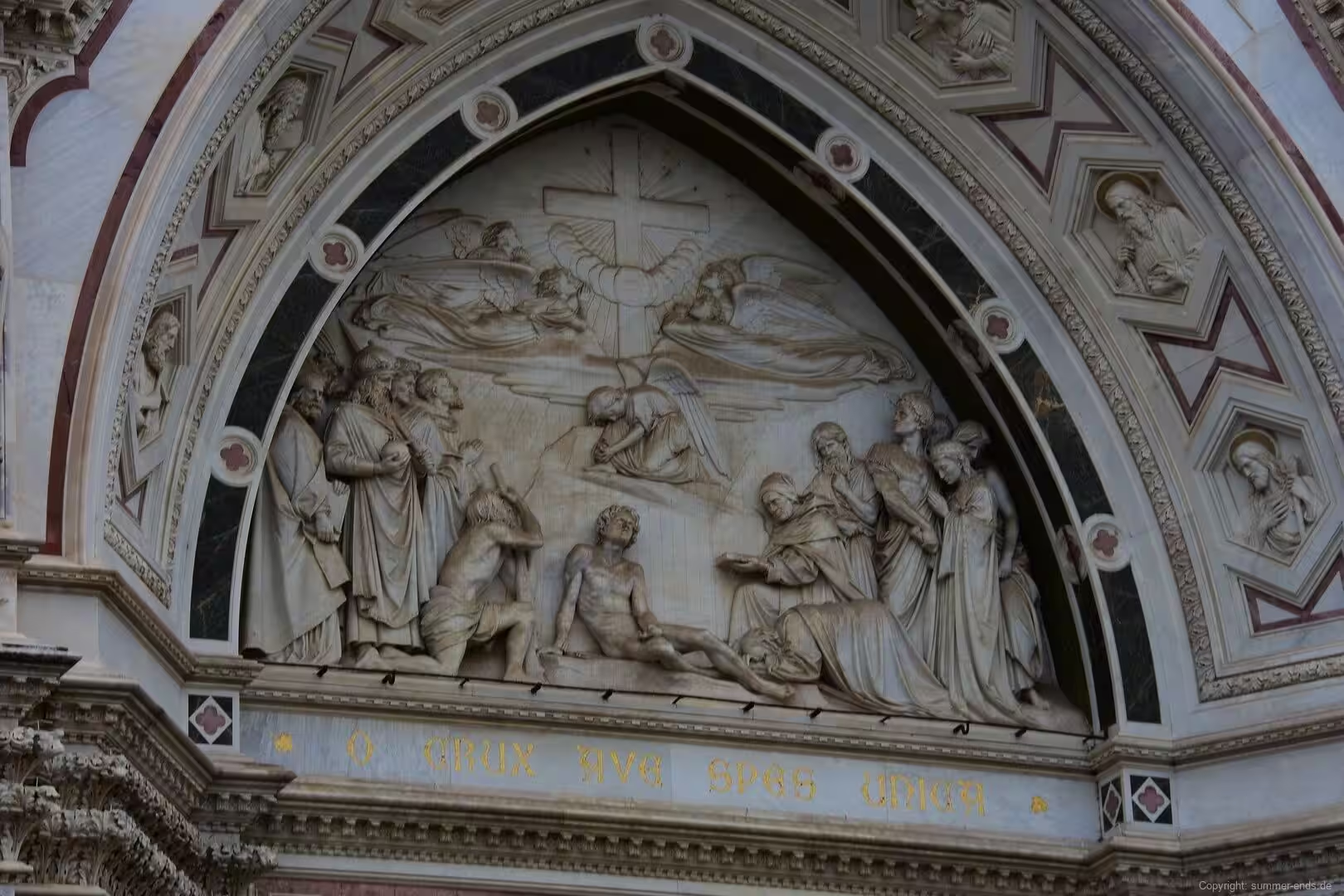
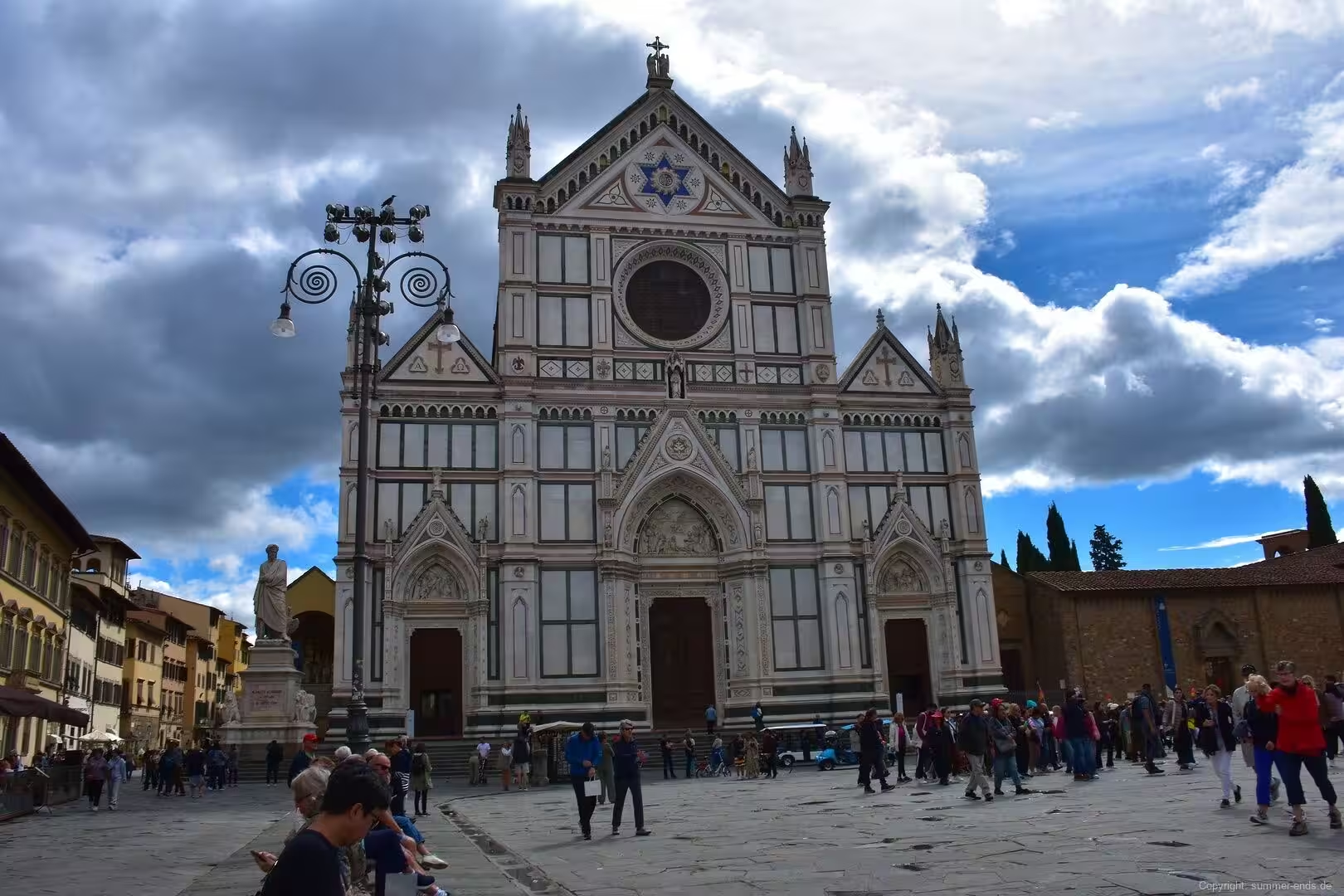
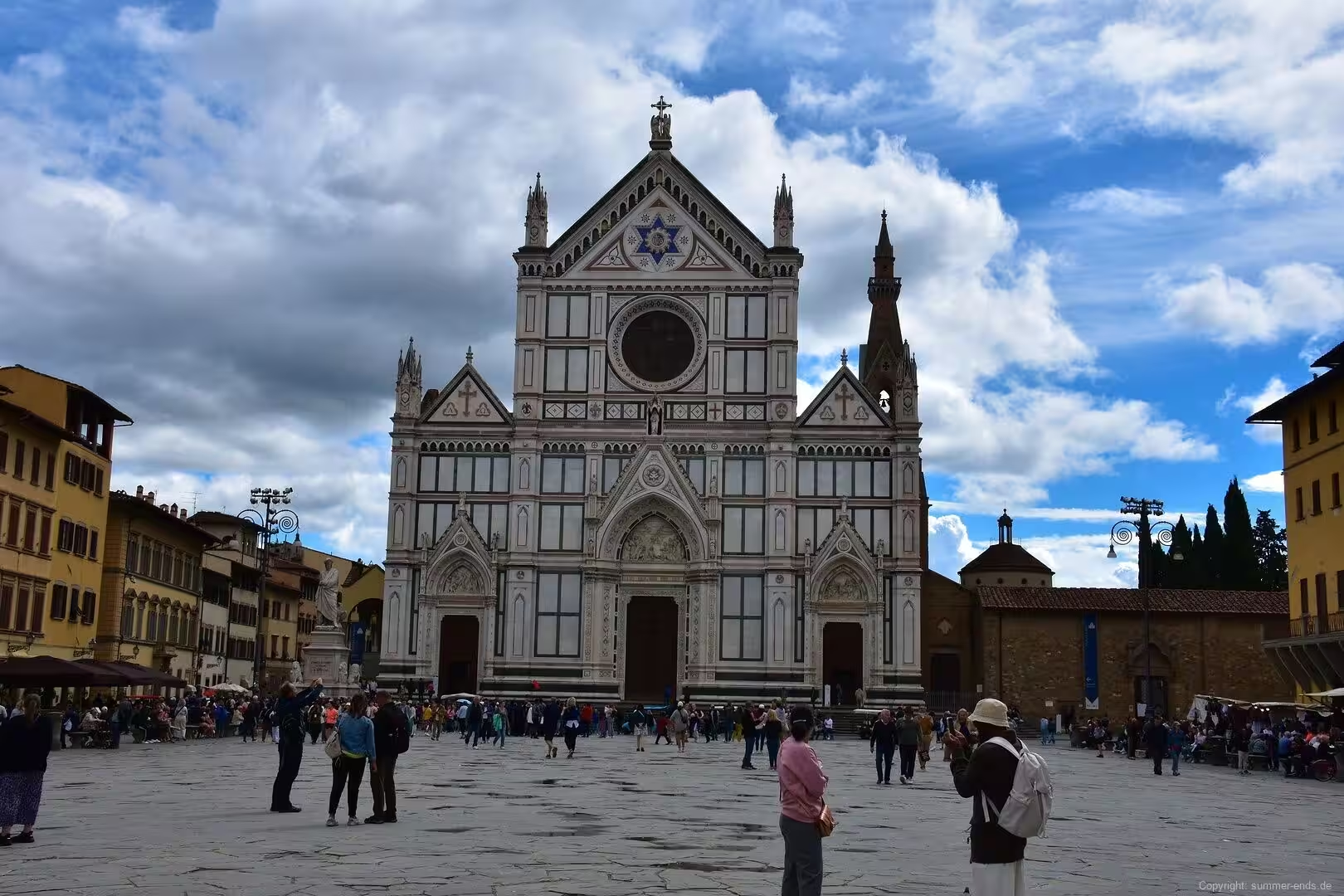
Across the centre, the Franciscan basilica of Santa Croce, begun in the late thirteenth century and fronted by a nineteenth-century marble facade, contains the tombs and memorials of Michelangelo, Galileo and Machiavelli and a large cycle of Giotto and fourteenth-century frescoes; a white statue of Dante stands in the square before the church, flanked by lions. South of the Arno, on a ridge rising above the city, stands the Romanesque basilica of San Miniato al Monte, begun in the eleventh century and noted for its marble facade, its mosaic apse and its commanding position over the city and the valley. The nearby Piazzale Michelangelo, laid out in the 1860s and reached from the river by stepped paths, gives a sweeping panorama across the terracotta rooftops toward the Duomo and the Palazzo Vecchio, with a bronze replica of David at its centre.
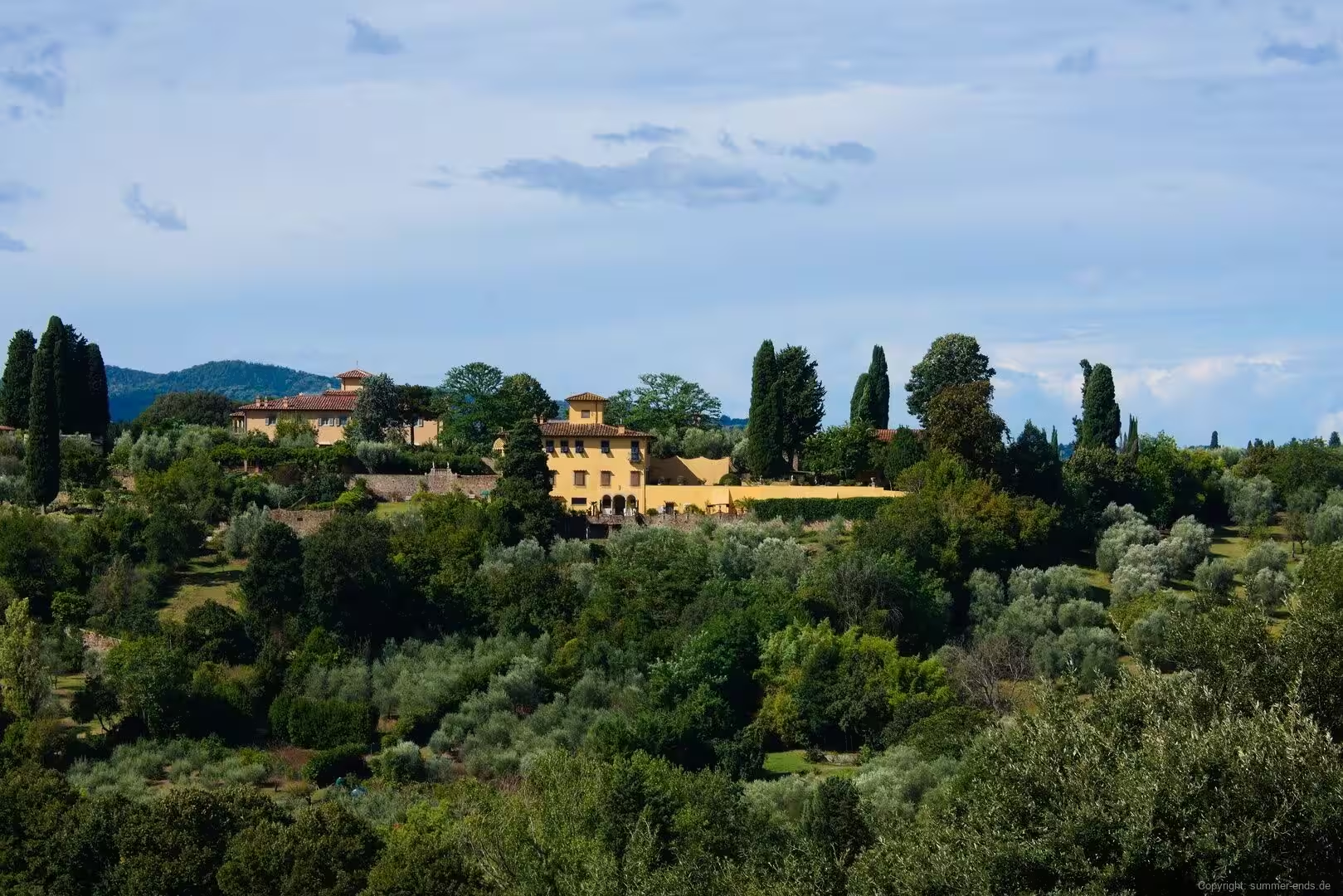
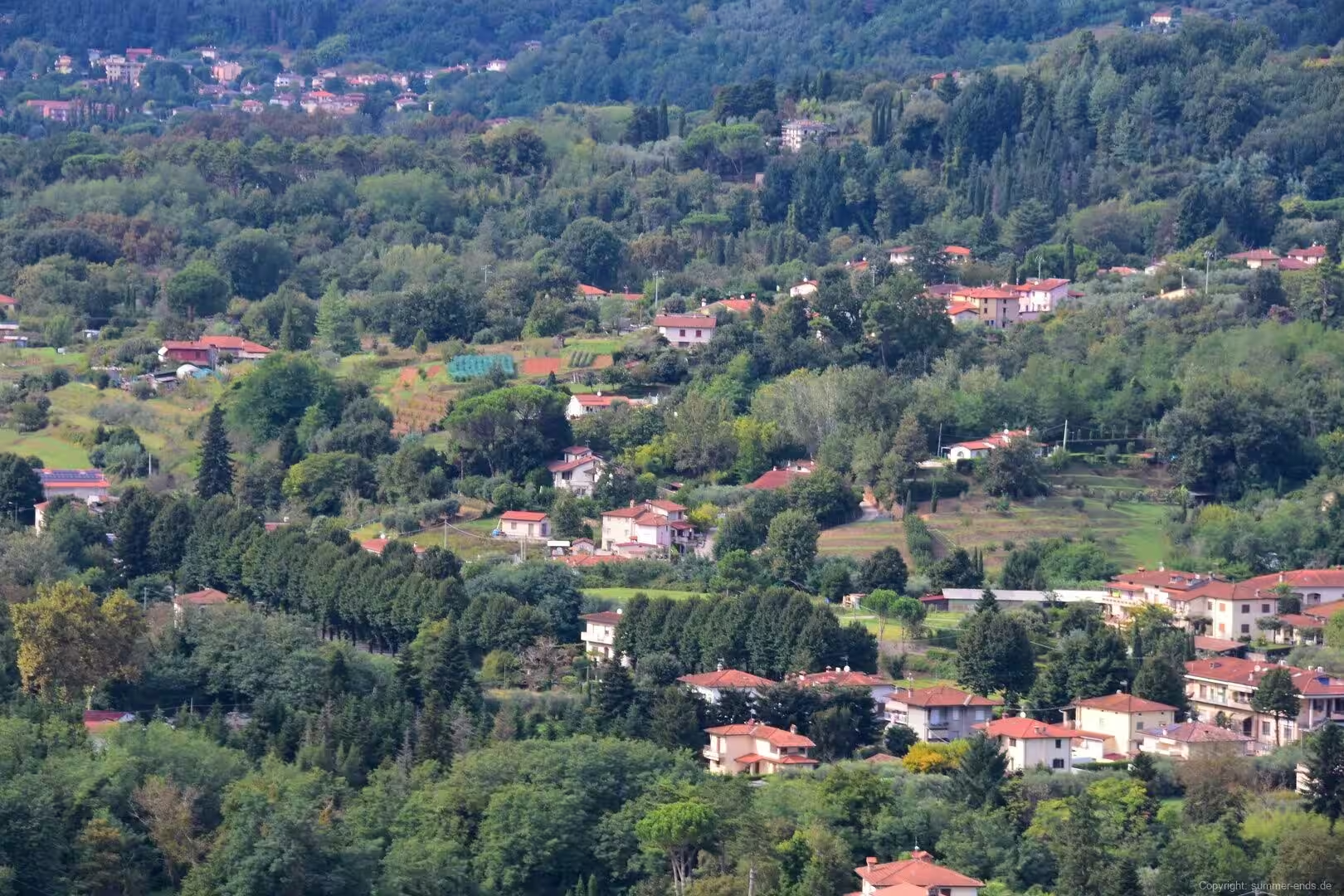
Beyond the monuments, the wooded slopes and the gardens of the hillsides, the villas of the Medici and the cultivated olive groves and vineyards of the surrounding countryside, as well as parks such as the Boboli behind the Pitti Palace, reflect the long relationship between the city and its agrarian hinterland. Museums, libraries and conservation workshops, together with the historic craft studios of furniture, leather and bookbinding, continue Florence’s enduring role as a centre of culture, learning and heritage preservation, and the maintenance of its architectural and artistic stocks remains a defining task of the city’s cultural life.
References
- Opera di Santa Maria del Fiore. duomo.firenze.it/en/discover/dome
- Gallerie degli Uffizi. www.uffizi.it/en
- Opera di Santa Croce. www.santacroceopera.it/en/
- UNESCO World Heritage Centre. Historic Centre of Florence. whc.unesco.org/en/list/174/
- Firenze Patrimonio Mondiale. About the World Heritage property. www.firenzepatrimoniomondiale.it/en/about-us/
- Visit Florence. Piazzale Michelangelo. www.visitflorence.com/florence-monuments/piazzale-michelangelo.html
- Wikipedia. Florence Cathedral. en.wikipedia.org/wiki/Florence_Cathedral
- Wikipedia. Florence Baptistery. en.wikipedia.org/wiki/Florence_Baptistery
- Wikipedia. Palazzo Vecchio. en.wikipedia.org/wiki/Palazzo_Vecchio
- Wikipedia. Piazza della Signoria. en.wikipedia.org/wiki/Piazza_della_Signoria
- Wikipedia. Loggia dei Lanzi. en.wikipedia.org/wiki/Loggia_dei_Lanzi
- Wikipedia. Ponte Vecchio. en.wikipedia.org/wiki/Ponte_Vecchio
- Wikipedia. Santa Croce, Florence. en.wikipedia.org/wiki/Santa_Croce,_Florence
- Wikipedia. San Miniato al Monte. en.wikipedia.org/wiki/San_Miniato_al_Monte
- Wikipedia. Piazzale Michelangelo. en.wikipedia.org/wiki/Piazzale_Michelangelo
- Wikipedia. Arno. en.wikipedia.org/wiki/Arno
- Wikipedia. History of Florence. en.wikipedia.org/wiki/History_of_Florence
- Wikipedia. Medici family. en.wikipedia.org/wiki/Medici_family
- Wikipedia. Uffizi. en.wikipedia.org/wiki/Uffizi
- Wikipedia. Accademia di Belle Arti di Firenze. en.wikipedia.org/wiki/Accademia_di_Belle_Arti_di_Firenze