Day 11 - Around Taormina
Journal Notes
General
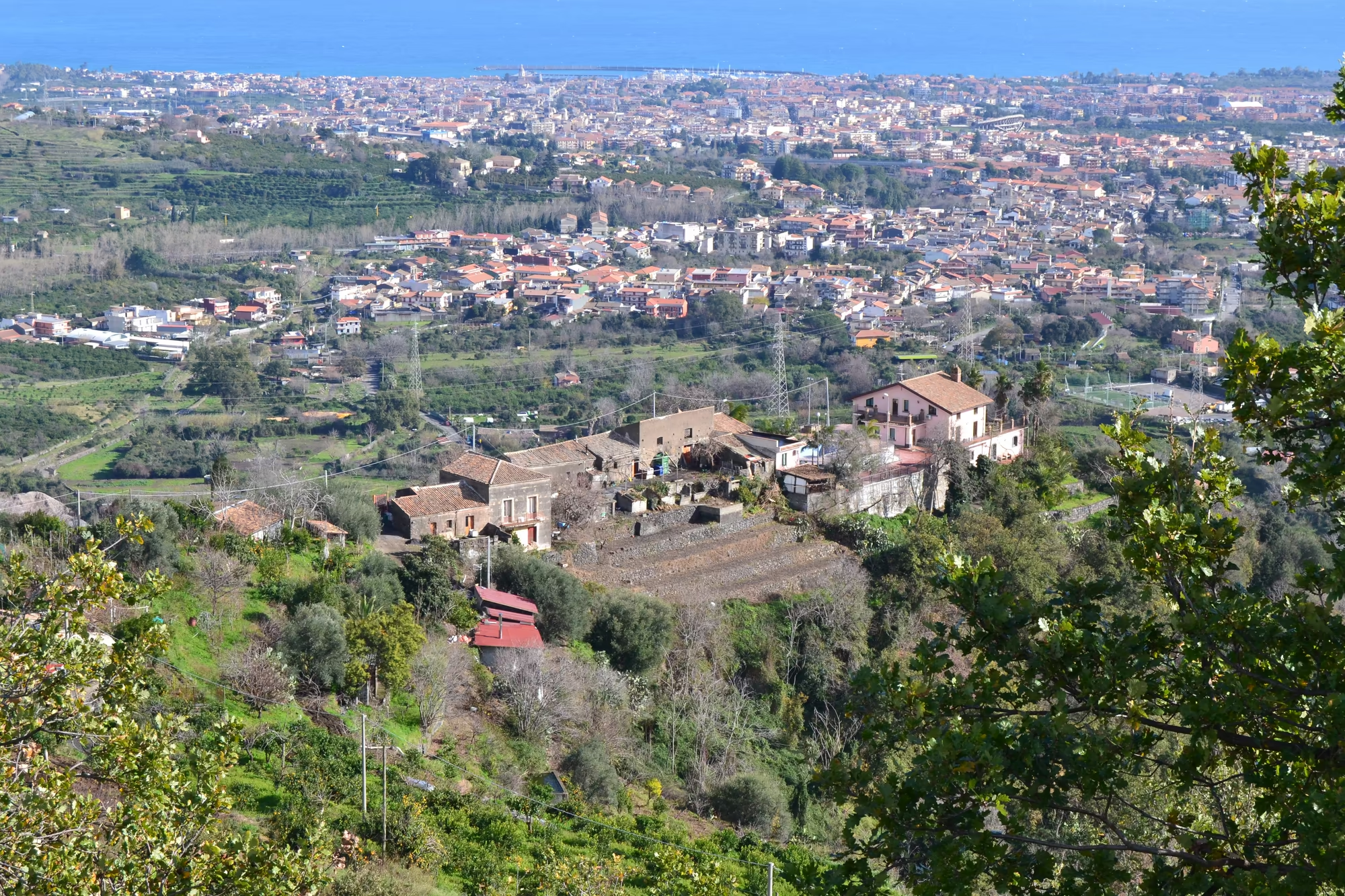
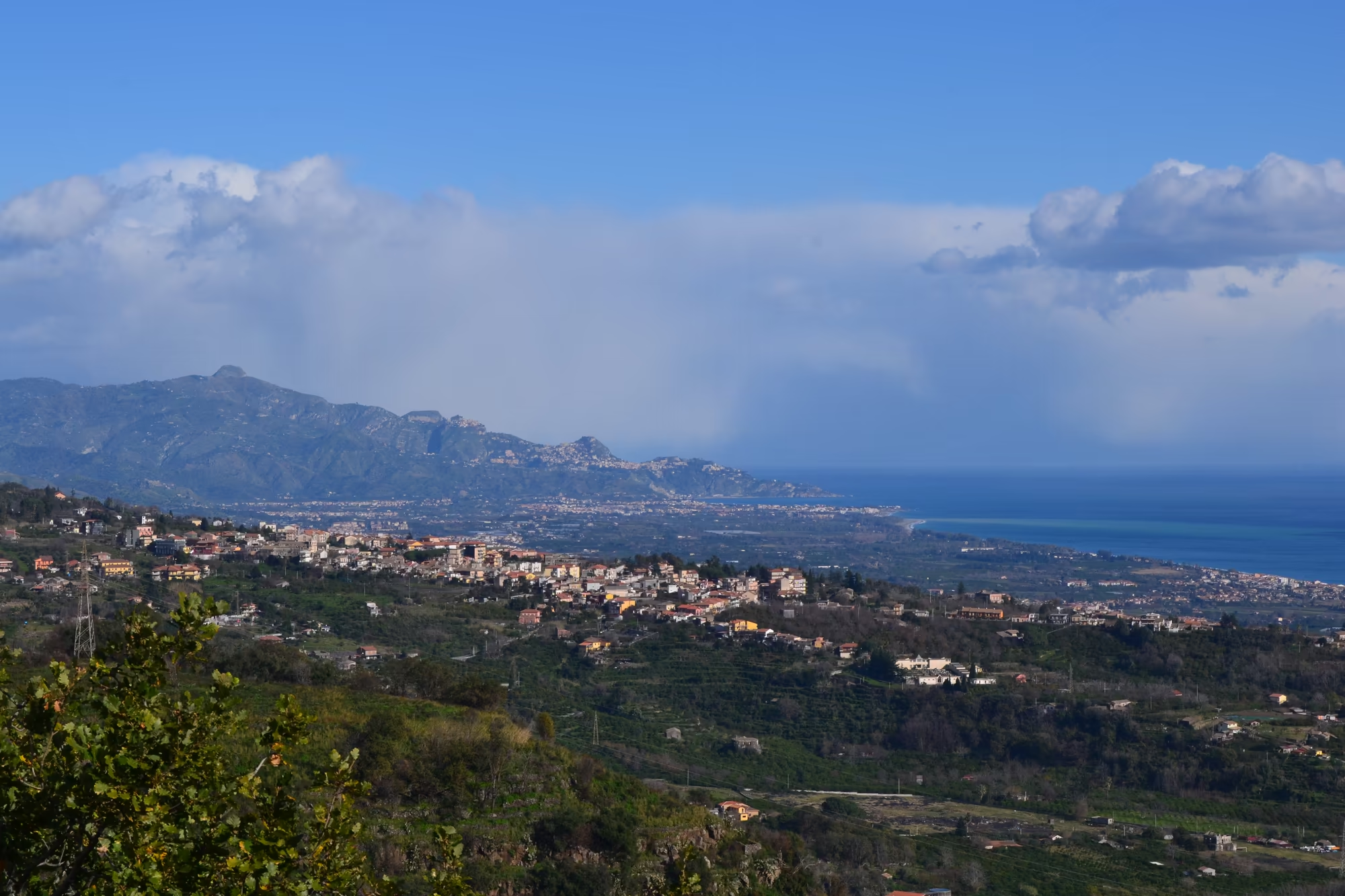
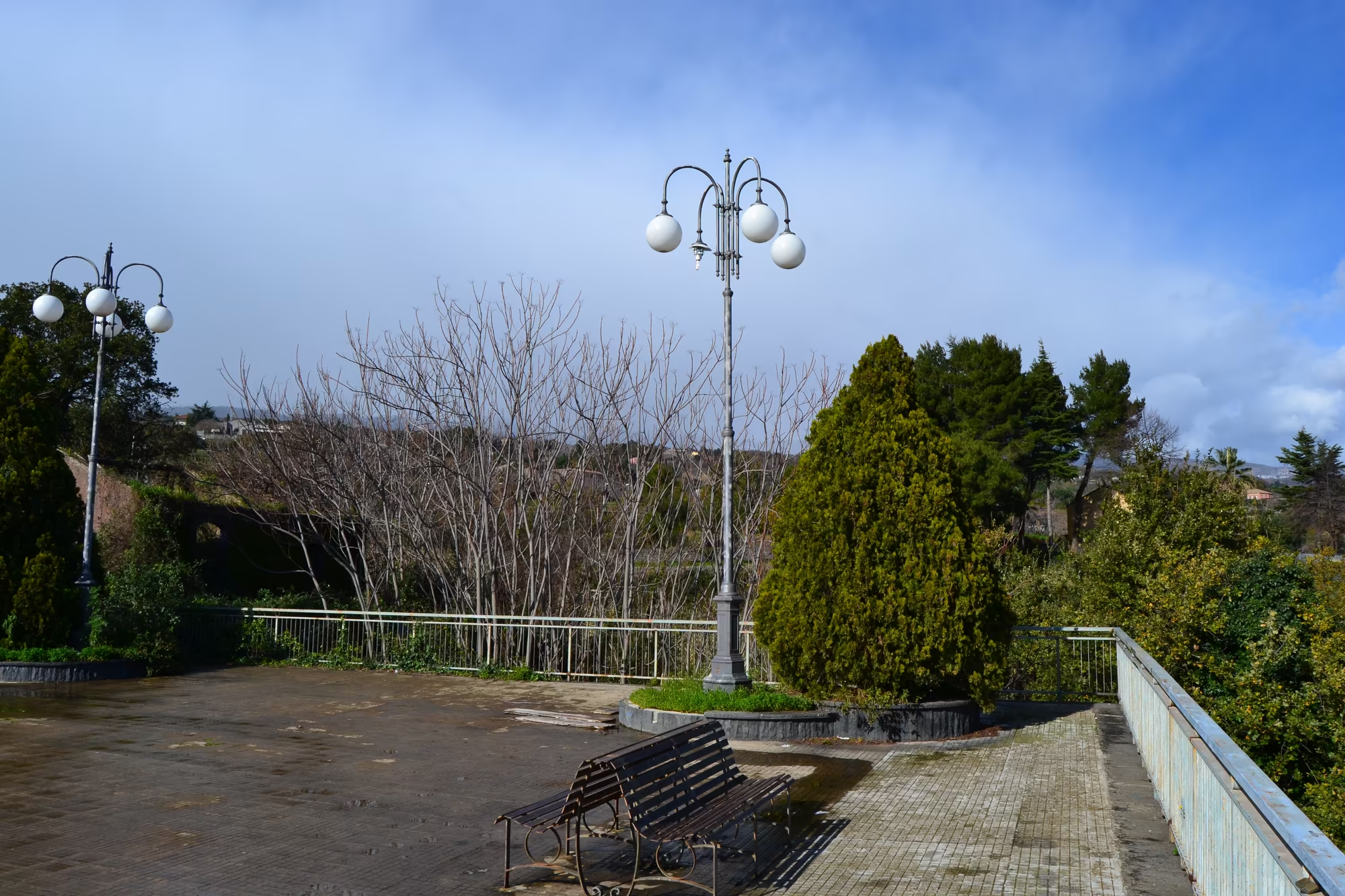
The eleventh day stays in the hills above the Ionian coast and looks at the towns rather than walking through them. An elevated view looks down over the red roofed houses of a coastal town with green slopes behind it, a hillside village spreads across the slopes below a rugged mountain, and a paved terrace with two ornate lamp posts, a metal bench and planted shrubs gives the same landscape a frame. This is the country around Taormina, in the Metropolitan City of Messina, seen from above on a quiet winter day.
The structure of the coast here is a series of shelves and shoulders. The Peloritani mountains fall towards the sea in ridges, and the towns sit on whatever level ground each ridge offers: Taormina on its shelf above the water, smaller villages on the shoulders below, and the resort settlements at the shore where the roads and the railway run. From the upper roads the whole arrangement is visible at once, which is why the belvederes and terraces along the ridge are the main feature of a day like this.
Winter gives the views their colour. In February the light is low and clear, the roofs of the towns read as bands of terracotta against the green slopes, the snow of Etna stands above the bay to the south, and the streets of the villages are almost empty. The terraces and public gardens are quiet, the benches are unoccupied, and the ornamental lamps and planters stand without anyone around them, which is exactly how this day looks.
The practical way to do it is to drive or walk the ridge between the towns and stop wherever the view opens. Almost every bend in the upper road gives a view down over a town and along the coast, and the villages on the shoulders connect to each other by lanes that are easily walked. Because the season is quiet and the distances are short, a day of looking from terraces and village squares covers more of the coast than a day of visiting individual attractions.
History
The towns of this coast are older than any of the roads that now connect them. Taormina itself is a municipality of the Metropolitan City of Messina whose site was already occupied when the Greeks established their first colony on Sicily in 734 BCE; the town was known as Tauromenion in Greek and Tauromenium in Latin, and after the fall of the Western Roman Empire it remained one of the more important towns of the island. Every settlement on the slope between the mountain and the sea has a history of the same length, and the reason is the position: a place on this coast has both a harbour and a defensible height within a short distance.
Power over the coast changed hands repeatedly. The island was ruled in turn by Greeks, Carthaginians, Romans, Byzantines, Arabs and Normans, and after the Sicilian Vespers of 1282 by the Crown of Aragon and then by the Spanish monarchy, before the Kingdom of the Two Sicilies was formed in 1816. In 1860 the expedition led by Giuseppe Garibaldi and the plebiscite that followed brought Sicily into the newly unified Italy, and in 1946 the island was given special status as an autonomous region. The towns of this coast grew, declined and grew again with each of those changes.
The twentieth century left its own marks. Taormina became the headquarters of the German Wehrmacht command in Sicily during the Second World War, and on 9 July 1943, the feast day of its patron saint Bishop Pancras, it suffered two devastating bombing raids by Allied aircraft. The villages around it were damaged in the same campaign, and the roads and railway along the coast were cut repeatedly. The rebuilding that followed the war produced much of what the towns look like today, and the older quarters that survived became the object of restoration.
Since the middle of the twentieth century the economy of the coast has been built on visitors. Tourism had begun in the nineteenth century, when northern European travellers came for the climate and the ruins, and it expanded after the war with the arrival of mass travel; the cableway down to the beach at Taormina, built in 1992, belongs to that period, as do the hotels and the promenades that line the lower coast. The villages on the ridge, meanwhile, went on living from agriculture and from the services that visitors need, which is why the terraced slopes above them are still worked.
The lower coast is younger than the ridge. The settlements at the water, Giardini Naxos among them, belong to a different period of the area’s history than the hill towns above them: the Greek colony founded on this coast in 734 BCE was the first on the island, and the modern resorts along the shore grew in the twentieth century around the railway, the road and the beach. The villages on the ridge, by contrast, were placed for defence and for farming, and their older quarters still show it.
Geology
The coast is a meeting place of two different kinds of rock. The Peloritani mountains behind Taormina are made of old, hard rock, with steep ridges, deep gorges and cliffs; the volcanic mass of Etna lies to the south, built of layered lava and pyroclastic material; and the coast between them is a mixture of hard headlands and softer ground where valleys reach the sea. The towns occupy the few generous shelves of this profile, which is why they are all at similar heights above the water.
Etna is the reason a great deal of the local material exists. It is an active stratovolcano on the east coast of Sicily in the Metropolitan City of Catania, between Messina and Catania, standing above the convergent margin between the African and Eurasian plates, and it is the highest ground in Italy south of the Alps at about 3,403 metres, a figure that changes with eruptions. Since the year 1600 there have been at least 60 flank eruptions and countless summit eruptions, nearly half of the flank eruptions since 1900, and its ash and lava have been spread across the coast and the plain repeatedly.
The terraces are the human answer to the slope. Where the ground rises too steeply to plough, the hillside is cut into steps and each step is held by a dry stone wall, and these walls drain as well as retain: water passes between the stones rather than running over the surface, which reduces erosion on the olive and vine slopes. The same technique is used in the gardens of the towns, where small platforms of level ground support citrus, ornamentals and vegetables, and the result is a landscape in which almost no usable slope is left unworked.
The sea in front of the coast is deep close in, because the mountains continue under the water rather than giving way to a wide shelf. That is why the water turns dark blue a short distance from the shore, why there are rocky islets and sea stacks along the coast, and why the pebble beaches are narrow: the material moved by the waves comes from the cliffs behind them rather than from a river delta. In winter the swell reaches the sea walls of the coastal road, and the whole shore feels like the edge of the mountains rather than a beach resort.
The road between the towns follows the structure of the slope. Where the ridge runs out towards the sea the road turns inland around it, and where a valley reaches the coast the road drops to cross it, so that a drive along this coast is a sequence of climbs and descents rather than a straight line; the views come at the bends, which is why so many of them are marked by a belvedere, a lay-by or a chapel. The terraced slopes above the road continue the same pattern on a smaller scale.
Things to See
The first view of the day is the town from above. An elevated panoramic view looks down over many red roofed houses of a coastal town, with green slopes around them, the sea beyond and the mountain behind; the roofs, the church towers and the cypresses are the only things distinguishable at that distance, and the town reads as a single object arranged around its harbour. This is the classic view of the Ionian coast in winter, and it is best in the middle of the day when the haze has lifted.
The second view is the hillside village. Houses scattered across green slopes in warm colours, a rugged mountain behind them and terraced fields below are the ordinary landscape of the ridge, and the villages here are smaller and quieter than Taormina. Walking through one of them takes half an hour and passes the church, the small piazza, the bars and the lanes that lead out to the fields, which is where the agricultural life of the ridge is easiest to see.
The terraces themselves deserve attention as a sight rather than as scenery. A paved terrace with two ornate multi globe lamp posts, a metal bench and planted shrubs is the formal version of the same idea, and the hillsides around it are the working version: dry stone walls holding narrow strips of cultivation on slopes that would otherwise be bare. In winter the walls and the olive trees are the only structure in the landscape, and the pattern they make is clearer than it is in summer, when the growth hides it.
The last part of the day is the light. Because the coast faces east and the ridge faces south, the afternoon sun moves across the villages and the sea, and towards evening the roofs turn from terracotta to orange and the snow on Etna takes a faint pink from the sky. Standing on a terrace above a town with the lamps unlit and the benches empty, the whole coast is laid out below: a shelf of houses, a green slope, a road at the water and the mountain behind everything, which is what this part of Sicily looks like when it is not being visited.
The villages themselves are the best part of the day. Each has a small piazza with a church, a bar and a shop, and lanes that lead out to the fields; in February the shutters are closed, the wood for the winter is stacked against the walls, and the only traffic is local. Walking through one of them for half an hour gives a clearer picture of how this coast lives than any viewpoint, because the houses, the small terraces behind them and the paths between are all still in use.
References
- Tusa, S. (2019). Cultural and ethnic dynamics in Sicily during Greek colonization. In: Greek Colonization in Local Contexts. doi.org/10.2307/j.ctvh9w120.7
- Wikipedia contributors (2026). Ancient theatre of Taormina. en.wikipedia.org/wiki/Ancient_theatre_of_Taormina
- Wikipedia contributors (2026). Giardini Naxos. en.wikipedia.org/wiki/Giardini_Naxos
- Wikipedia contributors (2026). Greek colonization. en.wikipedia.org/wiki/Greek_colonization
- Wikipedia contributors (2026). Ionian Sea. en.wikipedia.org/wiki/Ionian_Sea
- Wikipedia contributors (2026). Isola Bella (Sicily). en.wikipedia.org/wiki/Isola_Bella_(Sicily)
- Wikipedia contributors (2026). Magna Graecia. en.wikipedia.org/wiki/Magna_Graecia
- Wikipedia contributors (2026). Mount Etna. en.wikipedia.org/wiki/Mount_Etna
- Wikipedia contributors (2026). Naxos (Sicily). en.wikipedia.org/wiki/Naxos_(Sicily)
- Wikipedia contributors (2026). Peloritani. en.wikipedia.org/wiki/Peloritani
- Wikipedia contributors (2026). Sicily. en.wikipedia.org/wiki/Sicily
- Wikipedia contributors (2026). Taormina. en.wikipedia.org/wiki/Taormina