Stage 4 of 10
Day 4 - Shanghai Pudong Airport
Journal Notes
General
The fourth day was spent between two flights, which is the least rewarding and most characteristic kind of day that travelling in China produces. The journey went from Suzhou back through Shanghai to Pudong International Airport and then north, and it consisted of a terminal, a meal, a departure lounge and a seat. There are two records of it, and both of them are documents of transit.
Pudong International Airport is the newer of the two airports serving Shanghai and the one built on the east bank of the Huangpu as part of the Pudong development. The terminal complex is large, glazed and efficient, with elevated access roads feeding the departure levels, rooftop solar panels on the roofs and a subway and maglev connection to the city. The maglev line that links it to the centre is thirty kilometres long and takes eight minutes and ten seconds, and until 2021 it ran at 431 kilometres an hour, which made it the fastest train in commercial service anywhere at the time.
For a traveller the airport is a good place to notice how China moves people. Domestic aviation in the country is a mass system rather than a luxury one, the security and boarding processes are quick, and the terminals are built for volume. Air China, the flag carrier, is one of the largest airlines in the world and carried more than a hundred million passengers in a normal year, most of them on domestic routes, and the same is true of the railways that bring people to the airport in the first place.
The day was also a lesson in distances. Shanghai and Suzhou are less than an hour apart and belong to the same continuous city of the delta, but the flight north to Dalian crosses a country: from the humid subtropical coast of the Yangtze to a peninsula in the Yellow Sea where the climate is temperate, the water is cold and the cooking changes. Nothing about the two ends of that flight is alike except the aircraft.
The airport is also a lesson in how the country connects its cities. Pudong handles the intercontinental traffic while Hongqiao in the west of the city takes the domestic routes, and the high speed railways absorb a large share of the traffic that would otherwise fly. A traveller can therefore choose between a train that takes a few hours and a flight that takes one, and both run at a frequency that has no European equivalent.
History
Pudong is the youngest large district of Shanghai and its history is compressed into a single generation. The name means simply the east bank of the Huangpu, and until the 1990s the area across the river from the Bund was farmland, warehouses and low housing. The decision to develop it as a financial and commercial district was taken in 1990, and the result is the Lujiazui skyline with its three supertall towers: the Jin Mao Building at 420 metres, the Shanghai World Financial Center at 494 metres and the Shanghai Tower at 632 metres, the first trio of adjacent supertall skyscrapers anywhere.
The airport belongs to the same period. Shanghai had an international airport at Hongqiao in the west of the city, but the growth of the 1990s required a second and larger one, and Pudong International opened in 1999 on reclaimed and prepared ground on the coast. Its runways, its satellite buildings and its transport links were built to a plan that assumed continued growth, and the assumption turned out to be correct: with Hongqiao now serving domestic traffic and the railways taking the short haul, Pudong became the intercontinental gateway of the city.
The wider history behind both the airport and the district is the reform era. The policy of reform and opening that began in December 1978 changed the Chinese economy from a state directed system into the world’s largest manufacturer: between 1978 and 2018 the country reduced extreme poverty by 800 million people, the economy grew from about 150 billion dollars to 18.74 trillion, and China became the second largest economy in the world in 2010. Shanghai, with its port and its foreign trade, was one of the chief beneficiaries, and a terminal full of passengers going about their business is the visible result.
There is another side to the same history, and a traveller notices it in the terminals. The airports, railways and skyscrapers were built in thirty years rather than in a century, and the pace shows in the way the country works: everything is modern, everything is in use, and everything is still being extended. The advantage of a visa regime that permits transit and the density of the domestic network means that a journey like this one, between four cities in a week, is unremarkable here and would be exhausting almost anywhere else.
The district around the airport grew at the same speed as the airport itself. Pudong was farmland and low housing until 1990, when the decision was taken to develop the east bank of the Huangpu as a financial and commercial area, and within a generation it contained the Lujiazui skyline, the stock exchange, the airport and the maglev line. The three supertall towers of Lujiazui, at 420, 494 and 632 metres, were the first adjacent trio of their kind anywhere, and they stand on ground that was fields when the people who built them were children.
Geology
The airport stands on the same delta as the city it serves, and its geology is the reason why it was built where it was. The Yangtze Delta is a low, flat plain of silt and clay, and the coastline east of Shanghai has been prograding for millennia as the river deposits its sediment in the estuary. Land in this part of the world is not so much a fixed quantity as a process, and the ground on which the runways stand is a continuation of the same process, prepared and drained for the purpose.
Building on it is a matter of piles and of water. The silt and soft clay of the delta carry very little load by themselves, so the structures stand on piles driven or bored to firmer layers below, and the groundwater has to be managed because pumping it out makes the ground sink. Subsidence across the Yangtze Delta is a documented phenomenon rather than a surprise, and it is the reason why groundwater abstraction in the region is controlled and why surface water is brought in to replace it.
The tide and the estuary dominate the coast. The Huangpu, on which the city sits, is a tidal river about 113 kilometres long, 400 metres wide and nine metres deep, and the Yangtze estuary into which it flows is wide enough to be a sea. The water in both is laden with suspended sediment, which is why it is brown, and the same sediment is what built the delta, what silts up the channels, and what has to be dredged continuously to keep the port of Shanghai working.
Flood defence is accordingly a permanent feature of the landscape. Levees, embankments and sea walls protect the city and the airport, and the combination of a low plain, a rising river and the storm surges of the typhoon season means that the defences are engineered rather than merely built. On a day of ordinary summer weather none of this is visible, which is the point: the geology of the delta is present in the form of works that keep it from being noticed.
The air above the delta also has a geological signature. The haze that sits over Shanghai for much of the year is a mixture of industrial emissions, vehicle exhaust and dust, and the dust component comes from far away: the loess and desert soils of northern China, lifted by wind and carried east. The same material built the plain over geological time, and on a bad day it is still arriving.
Beyond the estuary the sediment has another destination. A large part of the load carried by the Yangtze is carried away along the coast and deposited on the shelf of the East China Sea, and the plume of brown water that extends from the river mouth is visible from the air for hundreds of kilometres. The Yellow Sea and the Bohai Sea further north receive the discharge of other rivers, among them the Yellow River, and together they form one of the most sediment rich coastal systems on earth.
Things to See
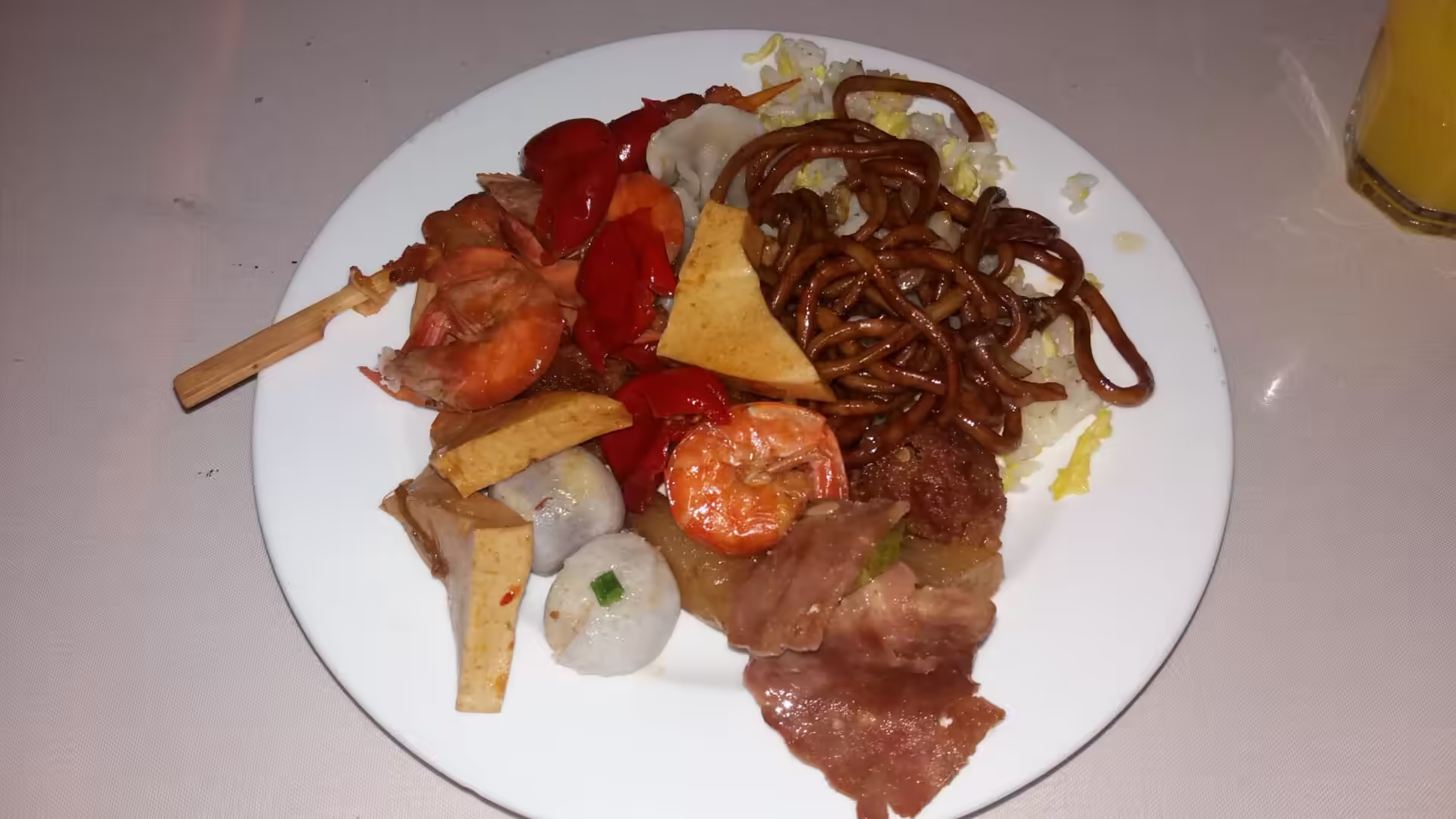
The day began with a meal, because airports are places where one eats at the wrong hours. The plate was a mixed buffet: dark noodles, shrimps, slices of meat, cubes of tofu, dumplings, red peppers and vegetables, all of it arranged by the traveller rather than by a kitchen. A Chinese airport buffet is usually better than its European equivalent, and the reason is simply that the food is cooked in the same idiom as the restaurants outside, with the same soy, chilli and sesame.
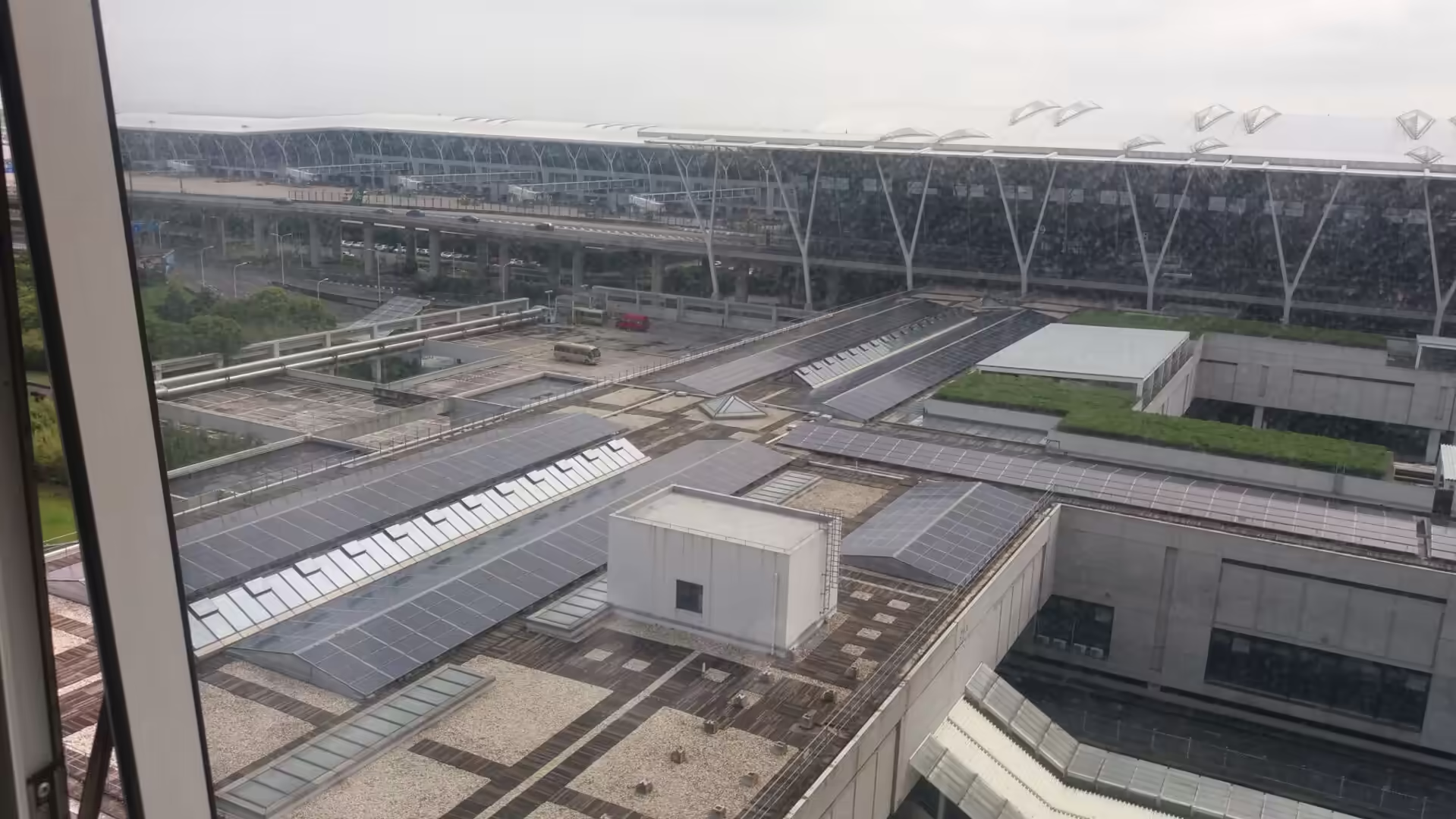
The terminal itself was the second sight of the day and the only one that stayed in the memory. Seen from the access road, Pudong is a composition of glass façades, curved metal roofs and elevated roadways, with solar panels covering large areas of the roofs and rows of windows reflecting a grey sky. The building is designed to be looked at from a car on the way in, and it works: it reads as a machine for handling people, which is exactly what it is.
Then came the part of the day that no one records, the hours spent waiting and the flight itself. A domestic flight in China is a short interval in which a very large country is crossed: the aircraft climbs out over the delta, with the estuary and the sediment plume below, and comes down an hour or two later over a different landscape entirely. On this occasion that landscape was the Liaodong peninsula, which will be described in the next part of this account.
Two pictures are little enough to show for a day, and that is a fair summary of what a transit day is worth. The value of such a day is that it establishes the geography: how far apart the cities are, how the country is connected, and how quickly the coast of the Yellow Sea replaces the delta. Everything that follows in this account depends on that distance being understood, and one flight is the quickest way to understand it.
The last part of a transit day is always the same: the gate, the queue, the bus or the bridge to the aircraft, and then the view from the window as the city slides away underneath. In Shanghai that view is worth having, because the whole delta opens out below: the estuary, the channels, the reclaimed land and the patchwork of fields and building sites that the river has been assembling for thousands of years.
References
- Wikipedia contributors (2026). Pudong. en.wikipedia.org/wiki/Pudong
- Wikipedia contributors (2026). Shanghai. en.wikipedia.org/wiki/Shanghai
- Wikipedia contributors (2026). Air China. en.wikipedia.org/wiki/Air_China
- Wikipedia contributors (2026). Beijing Capital International Airport. en.wikipedia.org/wiki/Beijing_Capital_International_Airport
- Wikipedia contributors (2026). Shanghai maglev train. en.wikipedia.org/wiki/Shanghai_maglev_train
- Wikipedia contributors (2026). Yangtze Delta. en.wikipedia.org/wiki/Yangtze_Delta
- Wikipedia contributors (2026). Yu Garden. en.wikipedia.org/wiki/Yu_Garden
- Wikipedia contributors (2026). Shanghai Museum. en.wikipedia.org/wiki/Shanghai_Museum
- Wikipedia contributors (2026). Nanjing Road. en.wikipedia.org/wiki/Nanjing_Road
- Wikipedia contributors (2026). The Bund. en.wikipedia.org/wiki/The_Bund
- Wikipedia contributors (2026). Yangtze. en.wikipedia.org/wiki/Yangtze
- Wikipedia contributors (2026). Huangpu River. en.wikipedia.org/wiki/Huangpu_River
- Wikipedia contributors (2026). Chinese economic reform. en.wikipedia.org/wiki/Chinese_economic_reform
- Lau S.h.C. The role of the port of Shanghai in the economic development of the Yangtze River Delta Region. doi.org/10.5353/th_b3195208
- Lou S., Lei B., Feng C., Xu J., et al. (2016) In vitro toxicity assessment of sediment samples from Huangpu River and Suzhou River, Shanghai, China. Environmental Science and Pollution Research. 23. 15183-15192. doi.org/10.1007/s11356-016-6683-4
- (ohne Angabe) (2009) 7. Shanghai and Yangtze River Delta: A Revolving Relationship. Regional Economic Development in China. 123-154. doi.org/10.1355/9789812309426-012