Stage 7 of 10
Day 7 - Dalian / Beijing
Journal Notes
General
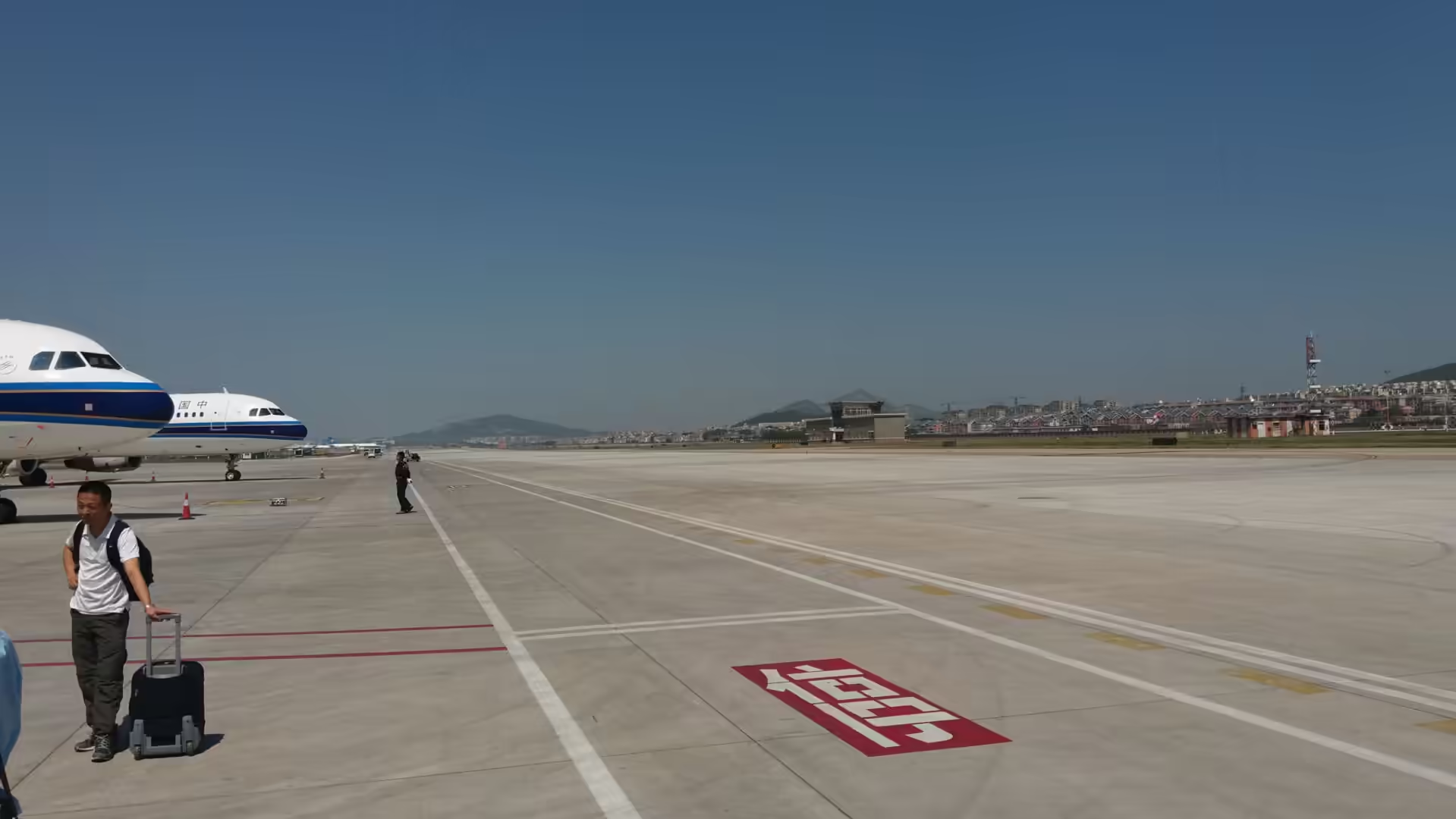
The seventh day was a flight from Dalian to Beijing, and it marks the point at which the journey left the coast and entered the capital. Dalian Zhoushuizi International Airport lies about ten kilometres north west of the city centre and is the busiest airport in northeast China, with close to twenty million passengers a year, so the departure was a busy but orderly affair: the apron, the buses to the aircraft, the walk across the tarmac to the steps.
Beijing is a different order of city. With more than 21.8 million residents it is the most populous national capital in the world and the second largest city in China after Shanghai, and it is governed as a provincial level municipality with sixteen districts. It has been the capital of the country for most of the last eight centuries and was for much of the second millennium the largest city in the world, and the evidence of that history is in the plan of the city rather than in any single building.
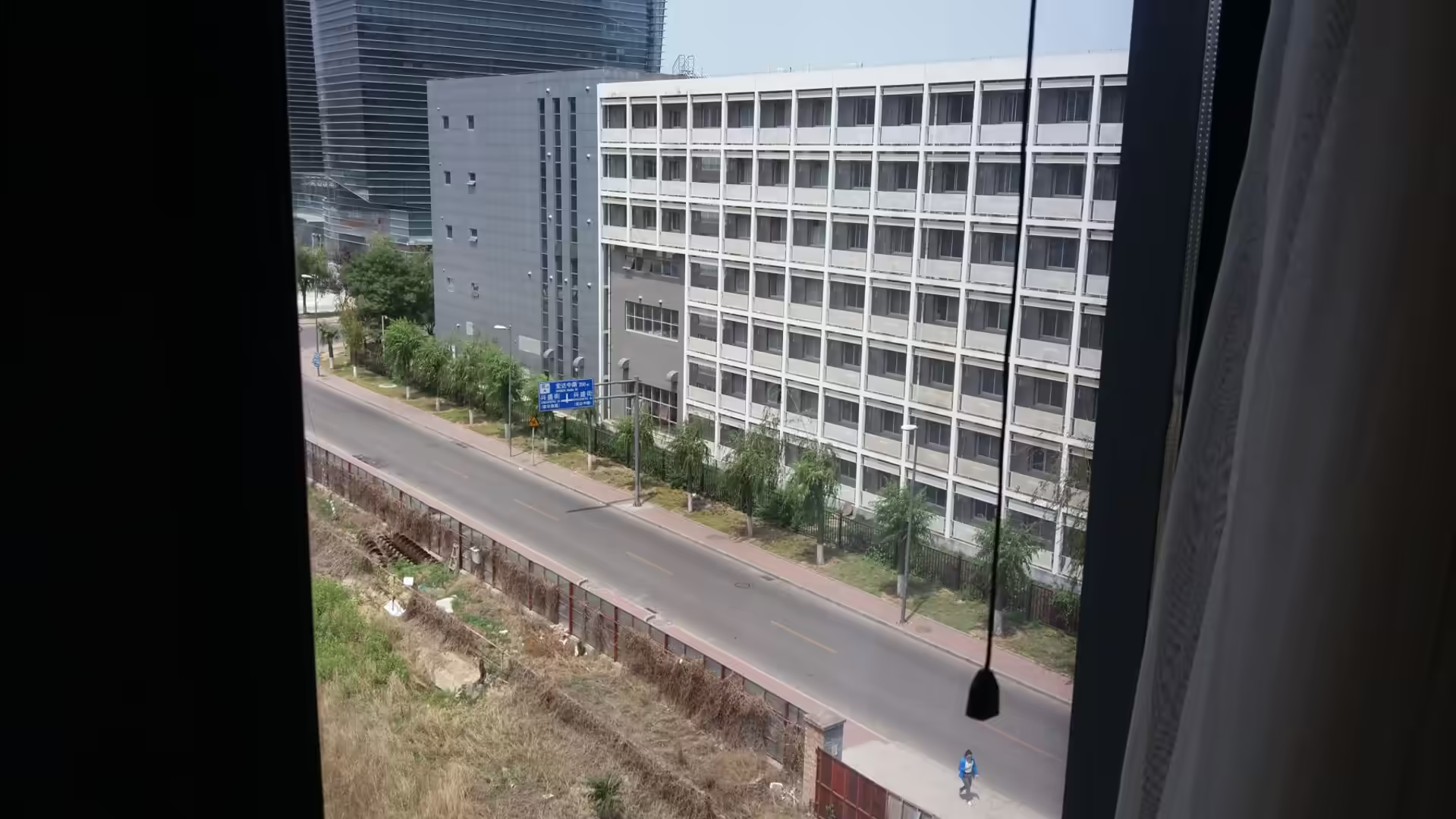
The arrival itself was quiet. The first view of Beijing recorded on this day was from a window: a street with modern institutional and office buildings, wide pavements, few pedestrians and a little traffic, which is what a Chinese capital looks like away from the tourist districts. Beijing is a city of broad roads and set back buildings, and its scale is designed to be read from a distance rather than at close quarters.
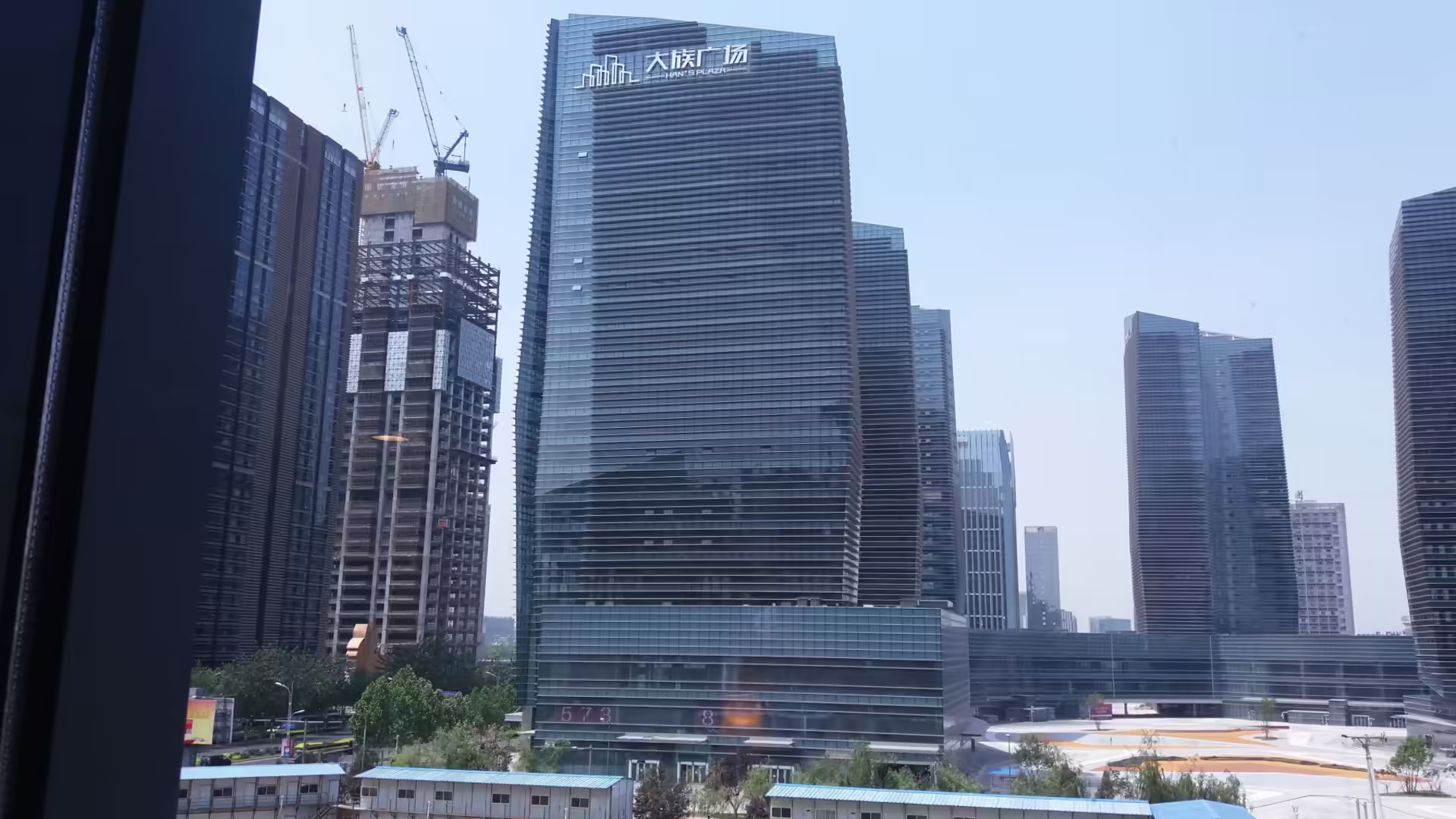
The day ended among office towers in the central business district, at a place called Han’s Plaza, where modern glass buildings stand beside a high rise still under construction and a broad paved plaza opens in front of them. It was a first impression of the Beijing that has been built in the last thirty years, and it set up the following days, which were spent among the monuments of the older city on the other side of the centre.
Beijing is organised by ring roads, and that is the first thing to understand about moving in it. The second ring follows the line of the old city wall where it was demolished in the 1960s, and successive rings have been added as the city has grown, so that the address of a place is often given by the ring it lies between. The central business district, where this day ended, sits between the third and the fourth ring roads on the east side, and the traffic on those roads is the ordinary condition of the city.
History
Beijing has had many names in three thousand years, and the present one means simply the northern capital. Human occupation of the area goes back far further: the caves at Zhoukoudian in Fangshan district produced the fossils known as Peking Man, dated to between 230,000 and 250,000 years ago, and Palaeolithic modern humans lived there about 27,000 years ago. What became the capital was always a strategic site, with mountains on three sides and a plain opening to the south and east.
The city as it is known today was laid out under the Ming and Qing dynasties. The walls, gates and the central north south axis that still organises the centre were built then, and the imperial palace complex at the middle of it all gave the city its structure. The Qing kept the same plan, and by the nineteenth century Beijing was both the seat of government and a city of temples, markets, courtyards and crowded lanes outside the walls.
The twentieth century demolished much of that fabric and kept the axis. The imperial system ended in 1912, the capital moved and returned, and after 1949 the new government rebuilt the centre at a larger scale than anything the emperors had attempted. In the 1950s the city expanded beyond the old walled area, with heavy industry to the west and residential districts to the north, and in the 1960s large parts of the city wall were pulled down to make room for the subway and the second ring road.
The reform era transformed the rest. Beijing acquired the office districts, ring roads and high rise housing that define it now, and its population grew by millions. The expansion brought the problems that large Chinese cities share and that Beijing experiences more sharply than most: heavy traffic, poor air quality, the loss of historic neighbourhoods, and a large influx of migrant workers from the countryside. A visitor who sees only the monumental city misses half of what the place is.
The central business district belongs to this newest layer. It occupies about four square kilometres of the Chaoyang district on the east side of the city, between the third and the fourth ring roads, and it is the primary area for finance, media and business services in the capital, with several thousand companies, more than sixty per cent of the overseas funded companies in Beijing, and most of the foreign embassies nearby. Han’s Plaza, where this day ended, stands in the middle of it, and the tower crane beside the finished buildings is the ordinary condition of the district.
The airport at Dalian has its own history, which is the history of the city in miniature. It began as an airfield of the imperial Japanese navy, used more for military than for civil traffic, with aircraft of the type that served the whole of northeast Asia at the time, on a field about eight hundred metres long. After 1945 it passed through Soviet hands and into the new Chinese state, and it has since become the busiest airport in the northeast, with a terminal and a passenger number that would have been unimaginable when the field was built.
Geology
Beijing sits at the northern edge of the North China Plain, and that position explains both its history and its present difficulties. The plain is the largest alluvial plain in China and one of the largest in the world: a downfaulted rift basin formed in the late Palaeogene and Neogene, later filled and smoothed by the deposits of the Yellow River. It is bordered by the Yanshan mountains to the north, the Taihang to the west and the Dabie mountains to the south, and it opens eastwards to the Bohai Sea.
The plain is the cradle of Chinese civilisation. The central portion around the middle and lower Yellow River is the region from which the Han Chinese people emerged and where the capitals of several dynasties stood, and it remains the country’s most important agricultural region, producing wheat, maize, sorghum and cotton on a very large scale. Beijing lies on its north eastern margin, at the point where the plain meets the mountains, and the mountains on three sides are what made the site defensible and what protected the agricultural heartland from the desert steppes beyond.
The plain itself is deep sediment: sands, silts and clays laid down by rivers that have shifted their courses repeatedly, in particular the Yellow River, whose historical changes of course have moved its mouth hundreds of kilometres. Under the silt lie aquifers, and it is these that the cities of the plain have drawn on. The consequence is well known: where groundwater is pumped faster than it is replaced, the ground compacts and the surface subsides, and land subsidence from groundwater extraction is a documented problem in the plains and deltas of eastern China.
Water is therefore the central environmental question of northern China. Beijing consumes far more than the rainfall of its region provides, and the shortfall has been met by drawing on aquifers, by reservoirs, and in recent years by transfers of water from the Yangtze basin in the south. The same shortage explains the region’s agriculture and its vulnerability to drought, and it is the reason why the canals and channels of the plain are managed as infrastructure rather than left to the rivers.
The atmosphere is the other geological inheritance. The plain lies downwind of the deserts and loess plateaus of the north west, so mineral dust arrives on the wind in spring as it has for millennia, and the same material built the soil of the plain in the first place. Modern air quality adds the products of industry and traffic to that natural dust, and the characteristic colour of a Beijing sky is the result of both. On the day of this arrival the sky was clear, which is not something that can be assumed.
The agriculture of the plain belongs to the same account as its geology. The sediments of the North China Plain are fertile, and the region is one of the country’s most important farming areas, producing wheat, maize, sorghum and cotton. That productivity depends on irrigation, which in turn depends on the rivers and on the aquifers below the plain, and the balance between what is taken out and what comes back is the central question of water management in northern China.
Things to See
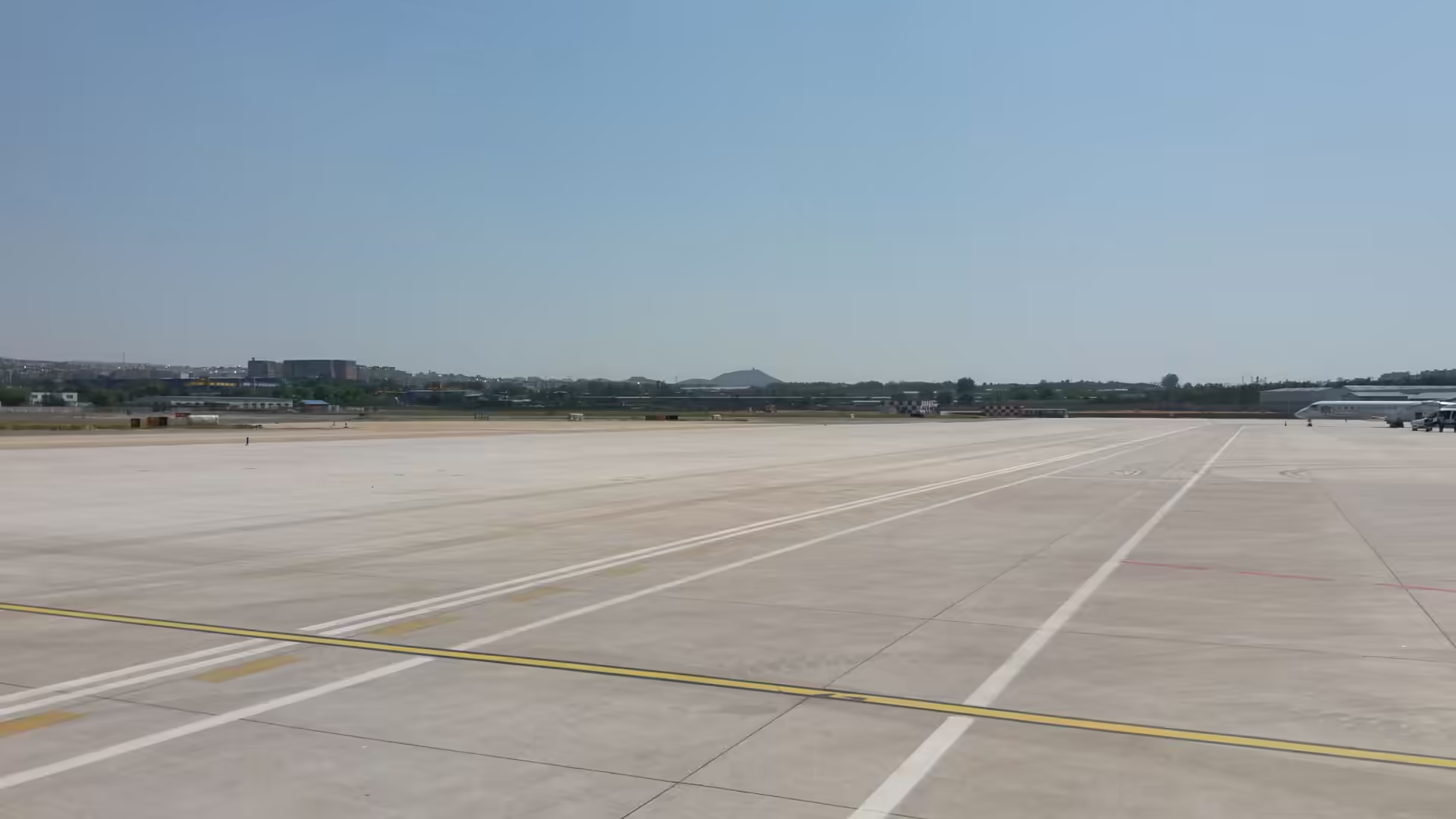
The first sight of the day was the airport apron at Dalian: a wide expanse of concrete and taxiway under a clear blue sky, with terminal buildings and parked aircraft in the distance, and passengers walking across the tarmac to their aircraft in the ordinary way of Chinese domestic aviation. Zhoushuizi Airport began life as an airfield of the imperial Japanese navy, mostly used for military traffic with Douglas DC-3 aircraft, on a field about eight hundred metres long; the modern airport has grown out of that beginning into the busiest in the northeast.
The flight south west to Beijing takes about an hour and a half, crossing the Bohai Sea and the northern edge of the North China Plain. From a window the change is abrupt: from the green peninsula to the pale brown of the plain, and then, long before landing, the grey of a very large city spreading to the horizon.
The first street seen in Beijing was empty by the standards of the Shanghai days: a quiet road with modern office and institutional buildings, some sparse traffic and a few pedestrians, which is what the city looks like on a weekday in a district that is mostly offices. The scale is different from Shanghai as well; the roads are wider, the buildings set further back, and the pavements emptier.
The evening in the central business district completed the impression. Han’s Plaza is a group of modern office towers with a broad plaza in front of them and a high rise under construction behind, and around it are the glass office buildings and hotels of the Chaoyang district. Beijing is a city in which the capital’s business district is a recent invention, built on land that was fields and villages within living memory, and it looks it: everything is clean, large and slightly provisional.
That is enough for a day of moving. It is worth noting, though, how much of this journey has consisted of exactly this: airports, roads, offices and the view from a window. In a country of 1.4 billion people and cities of twenty million, the travel itself is part of the subject, and the ordinary spaces of a Chinese city are as revealing as its monuments, which the following day would provide in quantity.
References
- Wikipedia contributors (2026). Dalian Zhoushuizi International Airport. en.wikipedia.org/wiki/Dalian_Zhoushuizi_International_Airport
- Wikipedia contributors (2026). Air China. en.wikipedia.org/wiki/Air_China
- Wikipedia contributors (2026). Beijing Capital International Airport. en.wikipedia.org/wiki/Beijing_Capital_International_Airport
- Wikipedia contributors (2026). Dalian. en.wikipedia.org/wiki/Dalian
- Wikipedia contributors (2026). Beijing. en.wikipedia.org/wiki/Beijing
- Wikipedia contributors (2026). Beijing central business district. en.wikipedia.org/wiki/Beijing_central_business_district
- Wikipedia contributors (2026). Chinese economic reform. en.wikipedia.org/wiki/Chinese_economic_reform
- Wikipedia contributors (2026). North China Plain. en.wikipedia.org/wiki/North_China_Plain
- Wikipedia contributors (2026). Tiananmen Square. en.wikipedia.org/wiki/Tiananmen_Square
- Wikipedia contributors (2026). Tiananmen. en.wikipedia.org/wiki/Tiananmen
- Wikipedia contributors (2026). Hutong. en.wikipedia.org/wiki/Hutong
- Wikipedia contributors (2026). Zhengyangmen. en.wikipedia.org/wiki/Zhengyangmen
- Wikipedia contributors (2026). CCTV Headquarters. en.wikipedia.org/wiki/CCTV_Headquarters
- Wikipedia contributors (2026). National Museum of China. en.wikipedia.org/wiki/National_Museum_of_China
- Wikipedia contributors (2026). Great Hall of the People. en.wikipedia.org/wiki/Great_Hall_of_the_People
- (ohne Angabe) (2014) Beijing Central Business District. The Urban Masterplanning Handbook. 248-259. doi.org/10.1002/9781118941188.ch19
- Zhang P., Kou L., Zhao Y. (2021) Three periods of gold mineralization in the Liaodong Peninsula, North China Craton. International Geology Review. 64. 2922-2940. doi.org/10.1080/00206814.2021.2009046