Stage 9 of 10
Day 9 - Beijing
Journal Notes
General
The ninth day was an ordinary day in Beijing, and it was all the better for it. Instead of monuments the day produced a public dining complex with a large red star above its entrance, a leafy residential area with tiny electric vehicles parked along it, and a restaurant whose interior was full of carved Buddhist figures. None of that is in a guidebook, and all of it is what the city is like for the people who live in it.
A day like this is useful because it shows the layers of the capital that the monuments hide. Beijing is not only the ceremonial city of the square; it is also a city of residential compounds built in different decades, of neighbourhood canteens and small businesses, of institutions that keep their socialist era names, and of courtyards, temples and shrines that survived the century in which so much else was demolished.
The pace of the day was slow. There was a long walk through streets with bicycles and small electric vehicles, a meal in a dining hall, and an afternoon in a restaurant with an interior full of statues. In a week of flights and cities, a day without a destination is a necessary part of the business of looking, and Beijing, with twenty one million people and an enormous number of ordinary streets, is a good city to spend one in.
It is also the day on which the food was the best. The cooking of the capital is a cuisine in its own right, influenced by the whole country because the country has been governed from here for centuries, and the restaurants that the locals use are frequently better than the ones that a visitor is taken to. The day produced two of those meals and a street full of small electric cars, and that was enough.
History
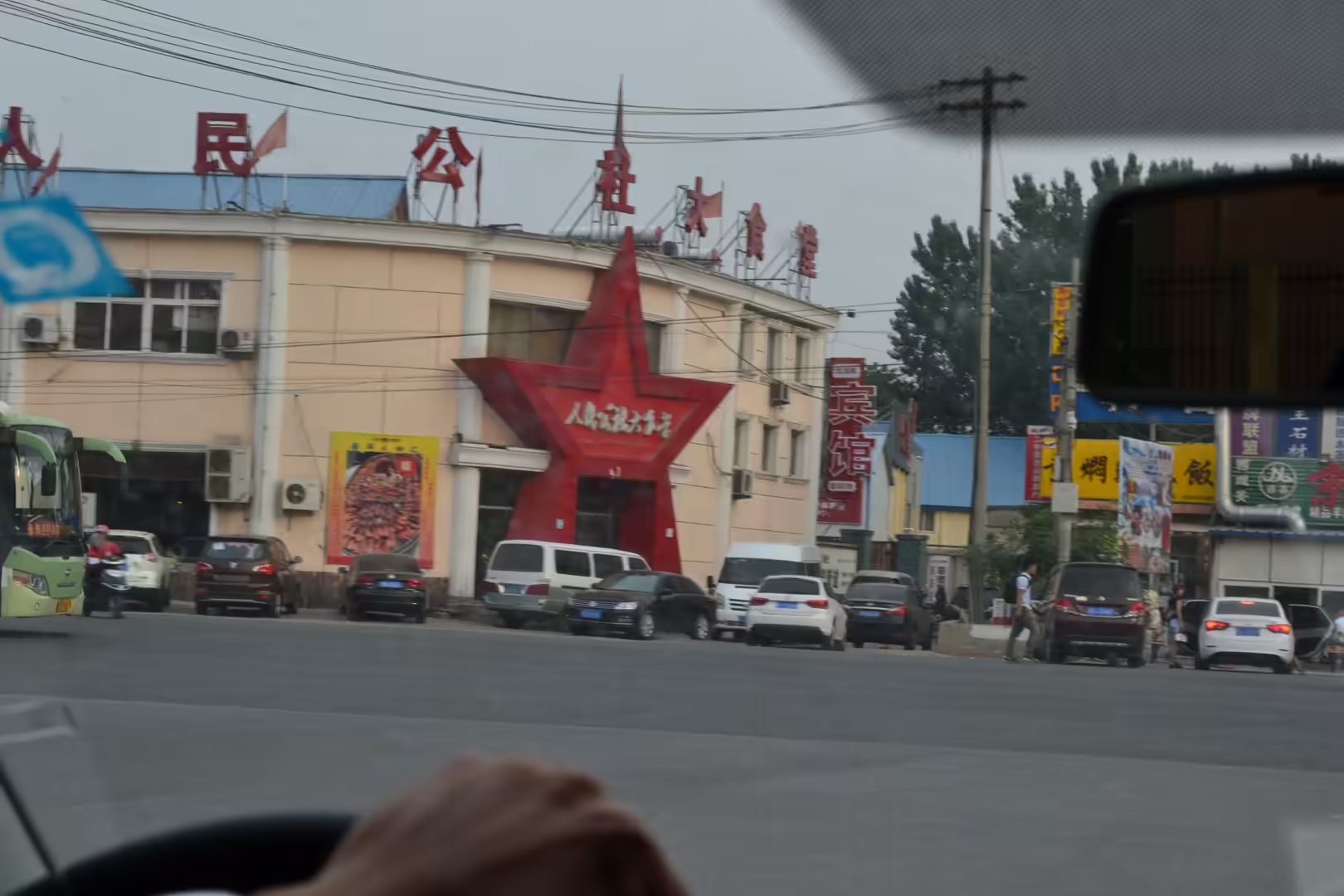
The institutions of the middle twentieth century are still visible in Beijing, and the public dining complex with a red star above the door is one of them. The canteen was a central institution of the socialist city: a place where the employees of a work unit, a danwei, took their meals, alongside the housing, the school, the clinic and the shop that the same unit provided. Many of those canteens have become restaurants open to the public, and the architecture and the signage often survive the change of function.
The residential streets of the city have a different history. Beijing’s traditional housing is the siheyuan, a courtyard house, and the alleys formed by lines of siheyuan are the hutongs. Since the middle of the twentieth century many hutongs have been demolished, and the city wall went in the 1960s to make way for the subway and the second ring road. Where the courtyards survive they are protected, and where they have been redeveloped residents are entitled to apartments of at least the same size in the new buildings, a compensation scheme that many of them accept and many complain about, because the sense of community and street life of a hutong cannot be rebuilt in a tower.
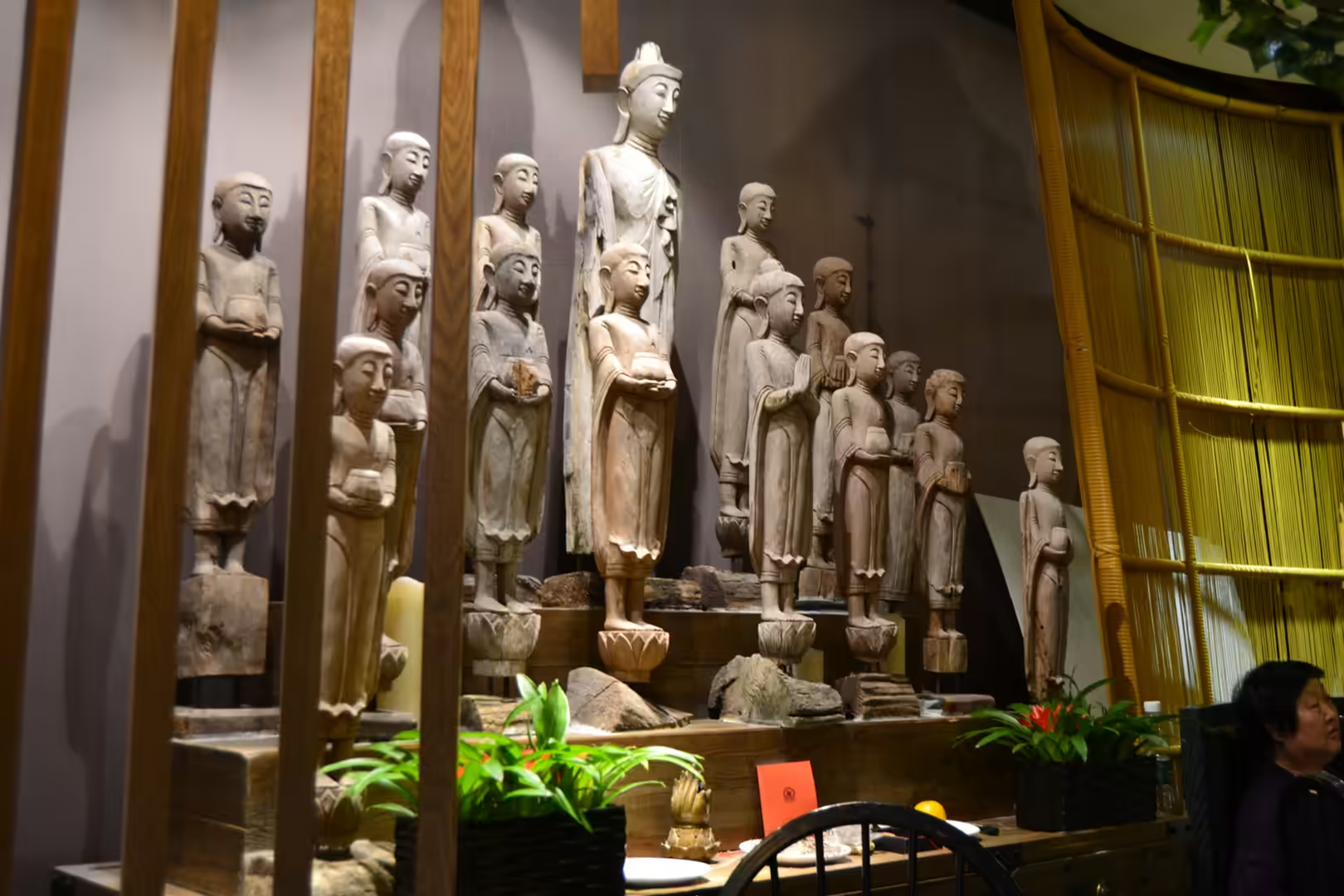
Religion is the third layer of the day. Buddhist figures are not unusual in Chinese restaurants, and the temples of Beijing, many of them small and local, survived the twentieth century in larger numbers than the city’s walls did. The carved figures seen here were part of the decoration of a restaurant rather than of a place of worship, which is a fair illustration of how completely Buddhist imagery has become part of ordinary commercial life in the country.
The background to all of it is the migration that has changed the city’s population. Beijing has grown by millions in a single generation, largely through the arrival of workers from less developed rural areas, and the result is a city in which the traditional neighbourhood, the work unit canteen and the new apartment block all stand within a few streets of each other. The day was spent moving between precisely those three kinds of place.
The ordinary day also has its own historical value as a record. Records of monuments will be taken by thousands of people every day and will look the same in fifty years, but a street of small shops and electric vehicles, a canteen with a red star, or a restaurant full of carved figures will not look like that for long. A city that rebuilds itself at Beijing’s speed loses the ordinary faster than it loses the monumental, which is a reason for recording both.
The temples of Beijing are the quietest part of its inheritance. The city has had Buddhist, Daoist, Confucian, Islamic and Christian places of worship for centuries, and many of the smaller ones survived the twentieth century in the middle of residential districts, where they are used by the neighbourhood rather than visited by tourists. A restaurant decorated with carved Buddhist figures is not a temple, but the imagery in it belongs to a city in which religion has been part of ordinary life for a very long time.
Geology
The ground of Beijing is the ground of the North China Plain: a deep sequence of river sediments in a downfaulted basin, laid down since the late Palaeogene and smoothed by the deposits of the Yellow River over the last few thousand years. The plain is the largest alluvial plain in China, and Beijing sits at its north eastern corner, where the flat land runs into the Yanshan mountains. Walking through the city one is always on sediment, and the hills that occasionally appear at the end of a street are the edge of the basin.
The sediments under the city are layered: sands and gravels through which water moves, alternating with clays that hold it. Those sands are the aquifers from which the city has drawn its water, and the clays are the reason why pumping has effects that reach across whole districts. Where groundwater is extracted faster than it is replenished, the water table falls, the fine material in the aquifer compacts, and the ground surface subsides. This is a documented effect in the plains and deltas of eastern China, and it is one of the reasons why the water supply of northern China has been reorganised in recent decades, including by transferring water from the Yangtze basin in the south.
Water is visible in the city in a way that surprises visitors. Beijing has lakes, canals and moats, some of them surviving from the imperial city, and the rivers that once supplied them have been regulated into channels. The management of water in the capital is an old problem: the city has always needed more than its own rainfall provides, which is why reservoirs were built in the surrounding hills over the last century and why the canals are maintained as engineering works rather than left as streams.
Dust and air complete the picture. Spring winds from the north west carry mineral dust from the deserts and loess plateaus onto the plain, as they have for millennia; the same material contributed to the soil on which the city stands. In a modern city that natural dust is mixed with the emissions of industry, heating and traffic, and the result is the air quality that Beijing is known for. Even on the ordinary days, the atmosphere above the city is a mixture of geology and industry, and the sky is the best instrument for reading it.
There is one more geological theme worth noting on a day like this one, and it concerns the materials of the streets. The grey bricks of the older courtyards, the stone of the kerbs and the paving of the pavements are all products of the plain and its surrounding hills: clay fired into brick, limestone and granite quarried within a few dozen kilometres of the city. Even the most ordinary street in Beijing is built out of the geology of northern China, which is a thought worth having while walking along one.
Water in Beijing is an old problem with a modern solution. The city has always needed more water than its own rainfall supplies, and over the centuries that need was met by canals, lakes and reservoirs, several of which still structure the centre of the city. In recent decades the shortfall has been met on a much larger scale by transferring water from the Yangtze basin in the south, and the capital now depends on that transfer for a substantial part of its supply.
Things to See
The public dining complex stood behind a large red star entrance, with Chinese signage, parked cars and buses in front of it and overhead utility lines crossing the street. It is the kind of building that every Chinese city has and no guidebook lists: a canteen grown into a restaurant, usually cheap, usually busy, and usually serving the food of the region rather than the dishes designed for visitors.
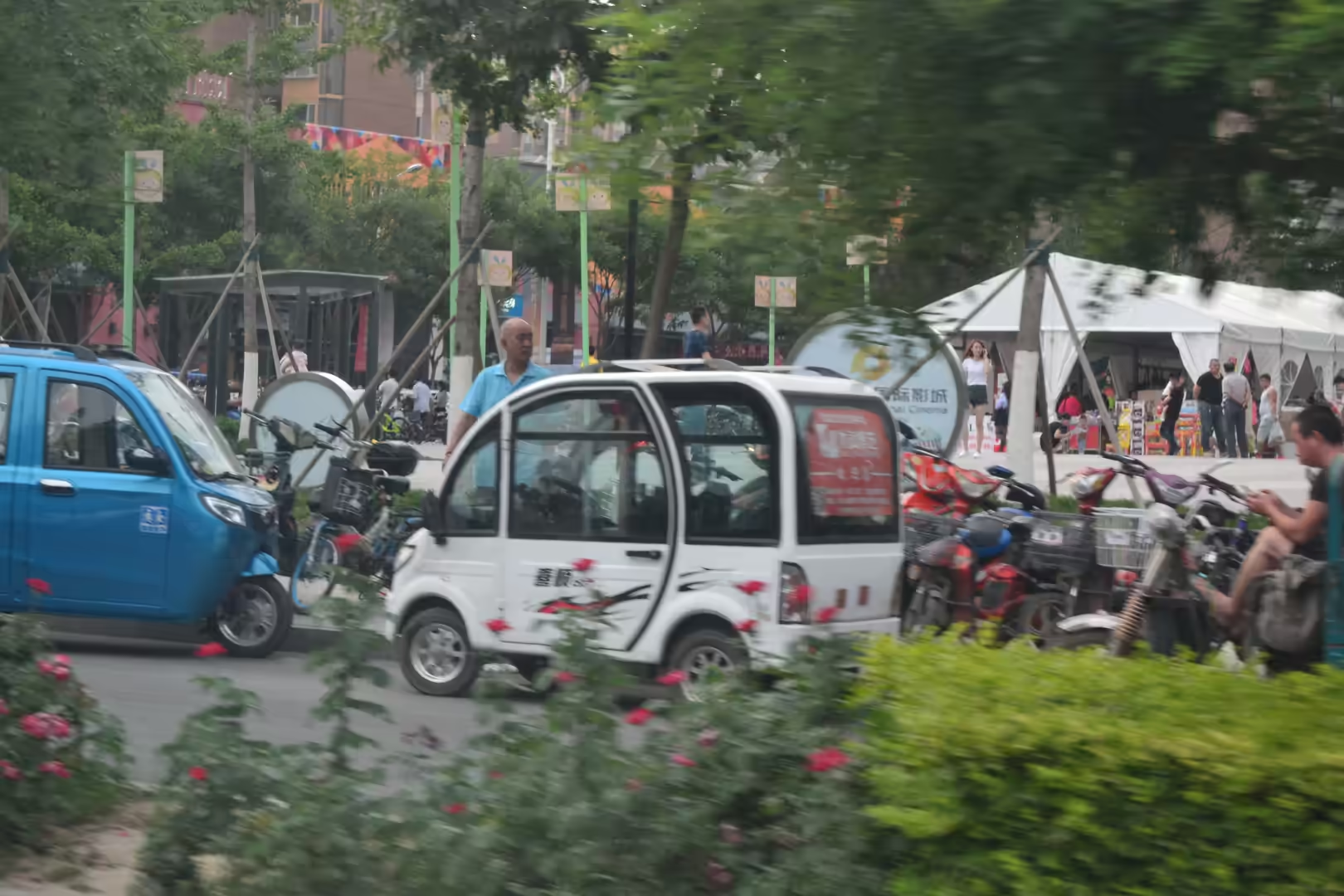
The residential area was quieter. Small electric vehicles and parked bicycles stood in a leafy street with pedestrians and a temporary community tent in the background, and the whole scene had the settled quality of a neighbourhood that is used rather than visited. The small electric cars are a Chinese speciality: cheap, slow, unlicensed in some cases, and used for exactly the kind of short errand that this street was built for.
The restaurant was the third sight of the day. Inside, in warm light, a collection of carved Buddhist figures was displayed, with a tall central statue surrounded by smaller standing figures, arranged as decoration along a wall of the dining room. Chinese restaurants frequently keep such figures, sometimes as an altar and sometimes simply as an ornament, and the combination of a working kitchen and a row of carved saints is entirely ordinary here.
The two meals of the day belong to the same record. Beijing cooking is the cuisine of a capital, which means that it has absorbed influences from all over the country, above all from Shandong on the eastern coast, and it has in turn influenced the food of the rest of China. In practice a good neighbourhood restaurant in Beijing serves northern food: wheat rather than rice as the staple, dumplings, noodles, braised dishes, and a good deal of mutton and pork.
The value of a day like this one is that it is repeatable. Monuments are visited once; an ordinary street is the sort of thing that a traveller could see on any day of a week in the city, and its ordinariness is the point. Beijing contains an enormous amount of ordinary life, and a day spent looking at it explains more about the country than another palace would.
The meals of the day were the best evidence of how the city eats. A neighbourhood canteen turned restaurant serves northern food in quantity and at low prices: dumplings, noodles, braised dishes, vegetables in season and rice or wheat as the staple. The cooking is not designed to be admired, it is designed to be eaten every day, and that is precisely what makes it worth recording.
References
- Wikipedia contributors (2026). Beijing. en.wikipedia.org/wiki/Beijing
- Wikipedia contributors (2026). Beijing cuisine. en.wikipedia.org/wiki/Beijing_cuisine
- Wikipedia contributors (2026). Hutong. en.wikipedia.org/wiki/Hutong
- Wikipedia contributors (2026). Chinese cuisine. en.wikipedia.org/wiki/Chinese_cuisine
- Wikipedia contributors (2026). Chinese economic reform. en.wikipedia.org/wiki/Chinese_economic_reform
- Wikipedia contributors (2026). Jiangsu cuisine. en.wikipedia.org/wiki/Jiangsu_cuisine
- Wikipedia contributors (2026). North China Plain. en.wikipedia.org/wiki/North_China_Plain
- Wikipedia contributors (2026). Beijing central business district. en.wikipedia.org/wiki/Beijing_central_business_district
- Wikipedia contributors (2026). Zhengyangmen. en.wikipedia.org/wiki/Zhengyangmen
- Wikipedia contributors (2026). Shanghai. en.wikipedia.org/wiki/Shanghai
- Wikipedia contributors (2026). Tiananmen Square. en.wikipedia.org/wiki/Tiananmen_Square
- Wikipedia contributors (2026). Great Hall of the People. en.wikipedia.org/wiki/Great_Hall_of_the_People
- Wikipedia contributors (2026). Mausoleum of Mao Zedong. en.wikipedia.org/wiki/Mausoleum_of_Mao_Zedong
- Wikipedia contributors (2026). Chinese Civil War. en.wikipedia.org/wiki/Chinese_Civil_War
- Wikipedia contributors (2026). Air China. en.wikipedia.org/wiki/Air_China
- (ohne Angabe) (2013) The Social Impacts of Tourism in a Beijing Hutong-A Case of Environmental Change. Urban Tourism in China. 101-121. doi.org/10.4324/9780203722282-10
- Liu R. (2024) Urban Village Redevelopment in Beijing. Urban Village Redevelopment in Beijing, China. 133-184. doi.org/10.1007/978-3-031-61664-8_4