Day 3 - Dubai Gold Market



Journal Notes
General
The third day of the journey stayed in the city and went to the gold market. The Dubai Gold Souk stands in Deira, on the northern side of the creek, in the quarter called Al Ras, and it is not a single building but a street and a network of covered lanes in which more than three hundred and eighty retailers sell jewellery, most of them gold. Platinum and silver are sold beside it, so are bullion and coins, and so are loose diamonds and coloured stones. The market is bordered on its northern side by the fish and vegetable market and by the Deira Corniche near Baniyas Square on Sikkat al-Khali Street, within a short walk of the Deira bus stand, and the Textile Souk lies across the creek on the Bur Dubai side.
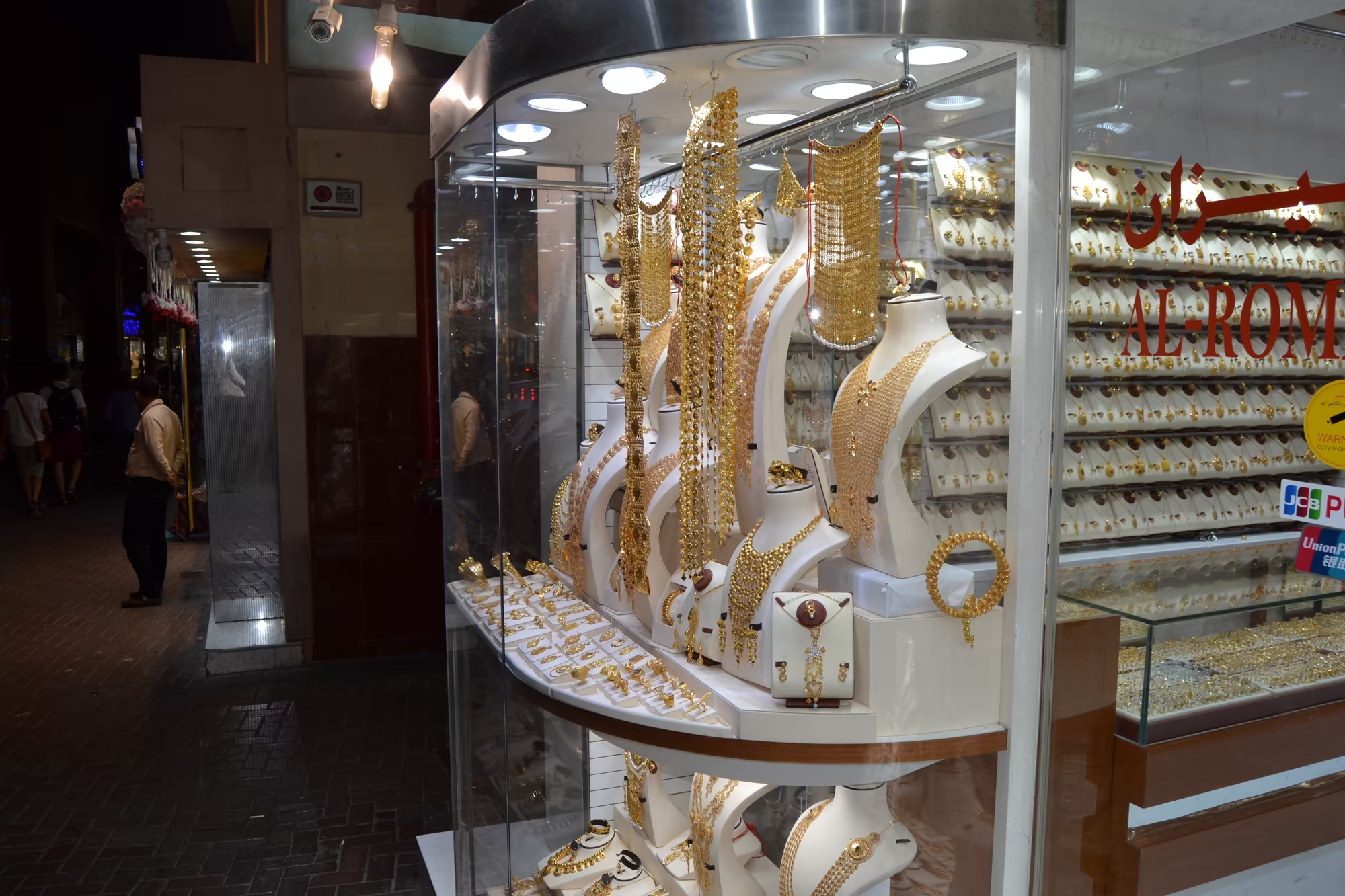
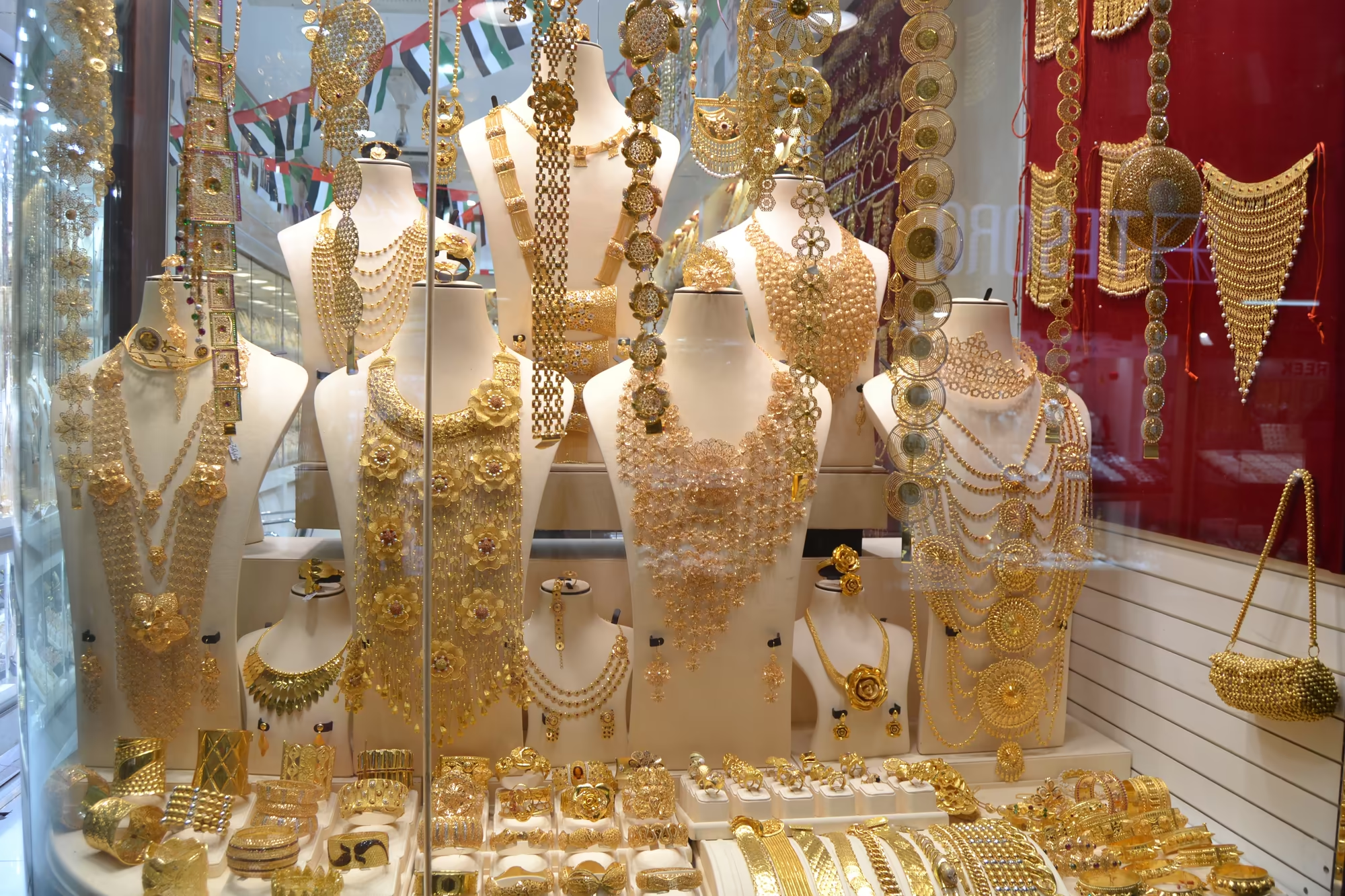
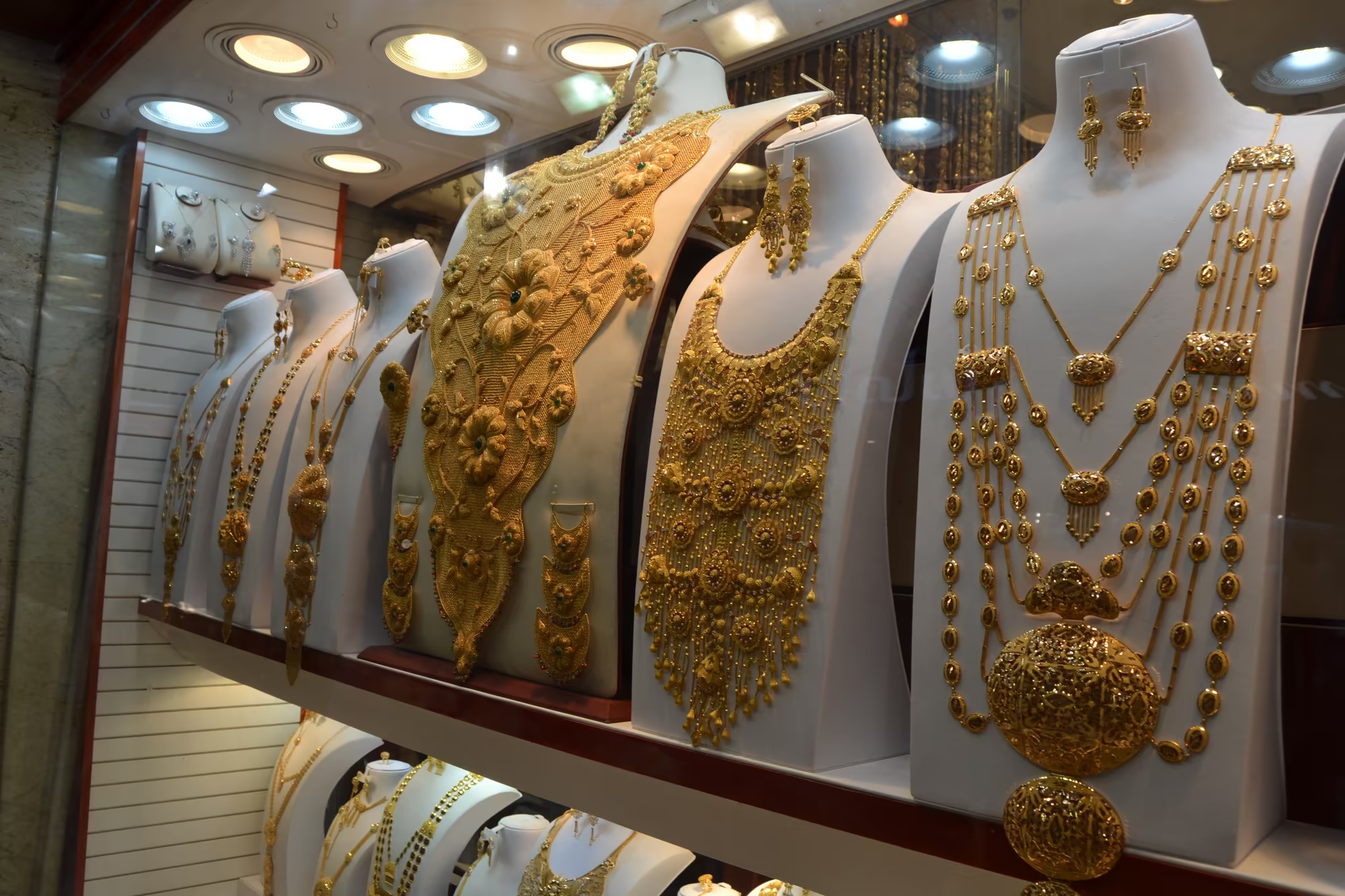
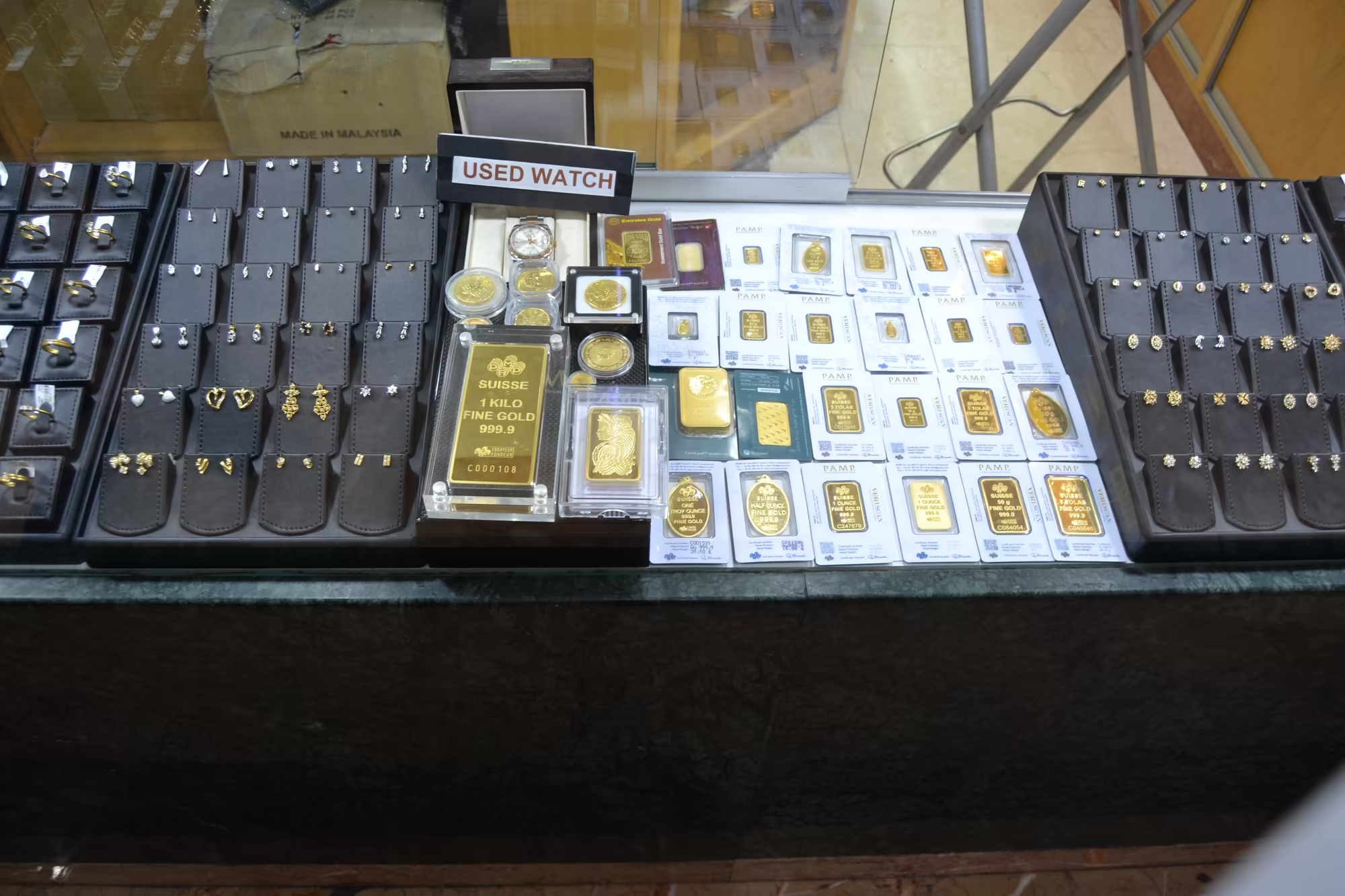
The day was spent walking the lanes rather than visiting any single shop. The windows follow one another in a dense sequence, each lit from inside with a warm light, each filled with more gold than a European jeweller would keep in a safe: necklaces on white display busts, racks of bangles packed shoulder to shoulder, bridal sets of considerable weight, and in one window a tray of bullion bars and small coins, among them a one kilo bar of fine gold and a handful of sovereigns.
What one notices first is not the value but the density. This is a market for gold by weight, and the price of almost everything in the window is quoted as a rate for the metal plus a charge for the work, which is posted daily and understood by everyone in the street. Haggling is expected and unhurried. The shops are family businesses, many of them four decades old, and some of the oldest are run by families who came from India and Iran and whose grandchildren now stand behind the same counters.
The walk out of the souk leads to the water. The creek is a few minutes away, and the abras, the small wooden ferries that have crossed it for generations, still run between the two banks for a fare of one dirham. Bur Dubai on the far side has its own souks, the textile market first among them, and beyond them the old houses of the Al Fahidi quarter and the fort that now holds the city museum. It is a morning that can be spent entirely on foot, which is the best way to see it, and the contrast between the gold windows and the working boats on the water is the honest picture of Dubai.
History
Dubai began as a fishing and pearl diving village at the mouth of a creek, and for a long time that is all it was. The creek gave it a natural harbour, sheltered and deep enough for the boats of the Gulf trade, and the beds of the shallow sea beyond it gave it pearls. The Al Maktoum family took over the settlement in 1833, and the town grew slowly through the nineteenth century as a small port that lived from the sea and from the carrying trade between the Gulf, the Indian coast and East Africa.
The pearl fishery was the foundation of the whole coast, and its collapse was the making of Dubai in a way that nobody could have foreseen. Pearl divers worked from dhows, staying at sea for months, diving without equipment to depths of twenty metres and more, and the season was regulated by custom and by debt. When Japanese cultured pearls reached the market in the 1930s, natural pearls became almost worthless within a few years, and the coastal towns of the Trucial States were left without an economy at the worst possible moment.
The gold souk as it exists today grew out of that emptiness. From the 1940s the trading policies of the rulers made Dubai attractive to merchants from India and Iran, who were allowed to set up shops and to trade with little interference, and the gold trade was one of the first to take advantage of it. Three events then confirmed the market: the dredging of the creek in 1963, which allowed larger vessels to enter; the discovery of oil in 1966, which brought money into the town; and the formation of the United Arab Emirates in 1971, after which trade and travel became easier still.
For the rest of the twentieth century the souk held the centre of the gold trade in the emirate. That began to change in 2002, when the Dubai Multi Commodities Centre was formed, and then with the Dubai Gold and Commodities Exchange, which took over the wholesale and derivatives side of the business and left the Deira lanes with the retail trade. The souk adapted, as markets do, by becoming a destination in its own right rather than only a place of business, and in 2024 the municipality announced a renovation and an expansion into what is being called the Dubai Gold District. Its share of the trade has changed; its position in the city has not.
What has not changed at all is the relationship between the market and its buyers. Gold in this part of the world is not bought as decoration alone. It is bought as savings, as a dowry, as a gift at a wedding or a birth, and as a form of insurance that can be carried and that holds its value in a way that currency may not. That is why the windows are full and why the shops are busy, and why the gold trade of the Gulf survived the loss of the pearl trade so easily: a region that saves in metal needs a market to buy it in.
Geology
Dubai stands on a coastal plain of sand, gravel and salt, and the geological history of the place is written in the materials of the plain itself. The creek, which looks like a river mouth and is not one, is a natural inlet cut into the sediments, and it has been silting and shifting for as long as anyone has been there to notice. The engineering of its entrance, dredged and trained to take ships, was a coastal work of some subtlety in the 1960s, because the inlet behaves like an estuary with a tide of its own and a channel that moves when it is not held in place.
Behind the creek the ground is sabkha, the salt flat that forms wherever the water table lies close to the surface in a hot, dry climate. Water is drawn upwards through the sand by capillary action, evaporates in the sun, and leaves its salts behind in a crust of halite and gypsum above a mud of carbonate. The sabkha of the coastal regions of eastern Arabia, and of Sabkha Matti in Abu Dhabi, has been studied as a model of evaporite formation for decades, and the microbial mats and dolomites that form in these flats are the subject of a literature of their own. Underneath the city, that process is still going on.
Below the recent sand lies the sequence that made the country rich. The shallow sea that covered this area for hundreds of millions of years left a stack of limestone, shale, sandstone and evaporite thousands of metres thick, and in the pores and fractures of the carbonate rocks it left oil and gas. The petroleum geology of the United Arab Emirates is one of the best documented in the world, and while the greatest reserves lie under Abu Dhabi, Dubai found its own fields in the 1960s and used the income to build the port and the roads that turned a trading town into a city.
The gold, by contrast, has no geological connection to this place at all. Nothing glitters in the ground under Deira except gypsum and salt. Gold is not mined anywhere in the Emirates; every gram of it in those windows was flown in, mostly from refineries and markets elsewhere, and will be flown or driven out again, because a great part of the trade is between the Gulf and the Indian subcontinent. The metals that the country does produce come from the mountains on the other side: copper and chromium from the ophiolite of the Hajar range, worked here since the Bronze Age and still visible in the rock.
One more geological feature deserves a sentence, because it lies under the water a few hundred metres from where the shops stand. The Gulf is shallow, warm and rich in the small organisms on which pearl oysters feed, and the banks of Pinctada radiata that produced the pearl trade of Arabia lie just offshore. The ecology of those banks is now studied for a different reason, the restoration of a fishery that was destroyed twice over, by the cultured pearl on one side and by the effects of coastal development on the other. The jewellery in the windows and the oysters on the sea floor belong to the same story, told twice.
Things to See
The souk is best seen as a sequence of shop windows, and each window is a small display of the goldsmith’s trade. In the first of them a row of necklaces hangs on white mannequin busts, the metal draped in several strands with a pendant worked into the centre. In the next, the window is packed from the floor upwards with bangles threaded on racks, so that the whole pane is a wall of gold with the wooden frame showing at the edges. A third shows a single heavy set on four busts beneath a strip light, and a fourth is dark except for the windowsill, where the light catches the loop of a chain.
The displays change character as the lanes continue. Some windows are set up for weddings, with matched sets of necklace, earrings, bangles and rings for a bride, and these are the heaviest pieces in the market. Others are for everyday wear, thin chains and small pendants arranged by size, and a few belong to the bullion trade, where the display is nothing more than a tray on a dark cloth: bars, ingots and coins, a one kilogram bar of fine gold among them, priced by the day. On the glass of one window a small printed disc marks the direction of Makkah, so that a shopkeeper can tell the time for prayer without leaving the counter.
The trade around the corner is worth walking through on the way to the water. The fish and vegetable market borders the souk on the north, and the smell of it, diesel and fish and coriander, is a useful corrective to the air conditioning of the jewellery lanes. A little further on stands the spice market, with sacks of dried limes, cardamom, saffron and frankincense in open bowls, and then the creek itself, wide and brown and busy with wooden cargo boats that have been loading and unloading on this bank for a century.
Crossing the creek costs a dirham and takes five minutes. The abra is a flat bottomed wooden ferry with a canopy and a diesel engine, it holds perhaps twenty people, and it leaves when it is full, which on a weekday morning is often. From the water the city shows both of its faces at once: on the Deira side the low, dense fabric of the older town and the minarets of its mosques, and beyond them, rising above everything, the towers of the modern city, with the tallest of them, the Burj Khalifa, standing over the whole skyline at eight hundred and twenty eight metres.
On the Bur Dubai side the lanes of the textile souk sell cloth by the roll, and behind them the Al Fahidi quarter preserves a small area of the old town, with wind towers, narrow passages and the fort that has stood there since the late eighteenth century and now houses the Dubai Museum. The walk back across the creek in the afternoon light, with the gold souk behind and the abras coming and going below the road bridge, is the best half hour that the city offers for the price of a ferry ticket.
References
- Wikipedia contributors (2026). Dubai Gold Souk. en.wikipedia.org/wiki/Dubai_Gold_Souk
- Wikipedia contributors (2026). Deira, Dubai. en.wikipedia.org/wiki/Deira,_Dubai
- Wikipedia contributors (2026). Dubai Creek. en.wikipedia.org/wiki/Dubai_Creek
- Wikipedia contributors (2026). History of Dubai. en.wikipedia.org/wiki/History_of_Dubai
- Wikipedia contributors (2026). Pearl hunting. en.wikipedia.org/wiki/Pearl_hunting
- Wikipedia contributors (2026). Souk. en.wikipedia.org/wiki/Souk
- Wikipedia contributors (2026). Gold as an investment. en.wikipedia.org/wiki/Gold_as_an_investment
- Wikipedia contributors (2026). Emirati cuisine. en.wikipedia.org/wiki/Emirati_cuisine
- Wikipedia contributors (2026). Al Ras. en.wikipedia.org/wiki/Al_Ras
- Wikipedia contributors (2026). United Arab Emirates. en.wikipedia.org/wiki/United_Arab_Emirates
- F. Broeze, Dubai: From Creek to Global Port City, in: Harbours and Havens (1998). doi.org/10.5949/liverpool/9780968128862.003.0008 doi.org/10.5949/liverpool/9780968128862.003.0008
- H. Ridehalgh, Dubai Creek Entrance, Coastal Engineering (1969) 1258-1266. doi.org/10.1061/9780872620131.079
- Gold market stability will improve in Dubai, Emerald Expert Briefings (2024). doi.org/10.1108/oxan-es288887
- A. Kirkham, Halite, sulphates, sabkhat and salinas of the coastal regions and Sabkha Matti of Abu Dhabi, United Arab Emirates, in: Quaternary carbonate and evaporite sedimentary facies (2010) 265-276. doi.org/10.1002/9781444392326.ch13
- F. N. Sadooni, F. Howari, A. El-Saiy, Microbial dolomites from carbonate-evaporite sediments of the coastal sabkha of Abu Dhabi, Journal of Petroleum Geology 33 (2010) 289-298. doi.org/10.1111/j.1747-5457.2010.00480.x
- History of Dubai. Wikipedia. doi.org/https://en.wikipedia.org/wiki/History_of_Dubai
- United Arab Emirates. Wikipedia. doi.org/https://en.wikipedia.org/wiki/United_Arab_Emirates