Skip to content

Egypt · 2025

Day 9 - Valley of The Kings and Valley of the Queens

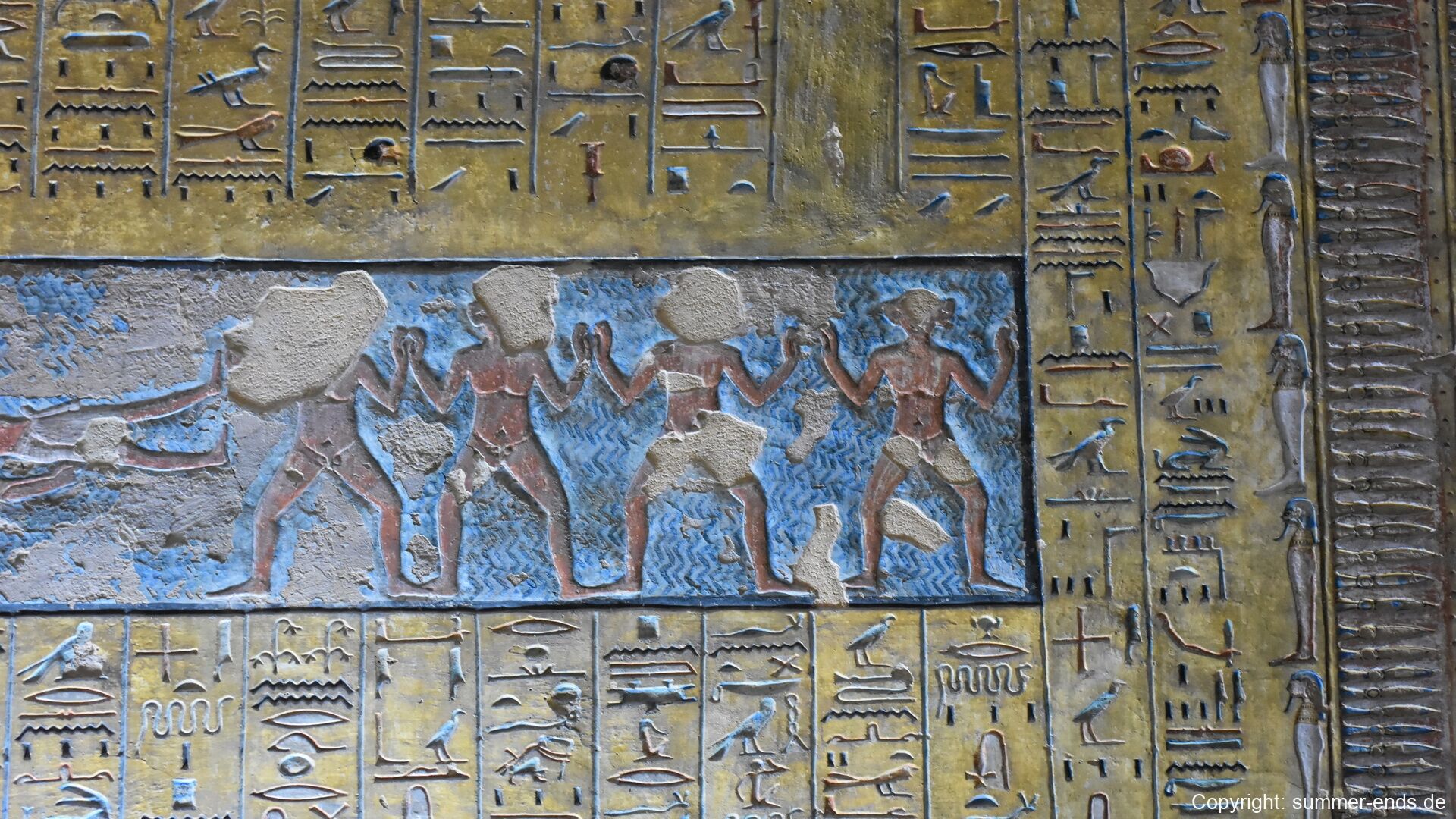
A close-up of an ancient carved stone wall brimming with painted hieroglyphs and bird figures.
Journal Notes

General

The Valley of the Kings and the Valley of the Queens are the two royal burial grounds of the Theban Necropolis, cut into the limestone massif on the west bank of the Nile opposite Thebes, the modern Luxor. For nearly five hundred years, from the early Eighteenth Dynasty to the end of the Twentieth (c. 1539-1075 BC), the pharaohs of the New Kingdom were buried in the secluded wadis behind the bay of Deir el-Bahari, beneath the natural pyramid of el-Qurn. The kings’ valley, Ta-sekhet-ma’at, the Great Field, held the royal house and nobles; the queens’ valley, Ta-Set-Neferu, the Place of Beauty, held the royal women and their children.

The Valley of the Kings has two branches: the East Valley, where most royal tombs lie, and the smaller West Valley, the Valley of the Monkeys. The site contains sixty-five tombs and chambers, from the pit of KV54 to the vast complex of KV5, prepared for the sons of Ramesses II with more than 120 chambers; only about twenty tombs actually held kings. Ringed by el-Qurn and the sheer Theban cliffs, the necropolis was easy to guard, and the Medjay protected it; the tombs were cut by the workmen of Deir el-Medina.

The Valley of the Queens lies south-west of the kings’ valley at the foot of the same cliff wall, close to the workmen’s village and to the sacred grotto of Hathor at its entrance. Its main wadi holds ninety-one numbered tombs and the subsidiary valleys nineteen more. The earliest burials belong to princesses and nobles of the Thutmosid period; from the Nineteenth Dynasty the valley served almost exclusively royal women. Its most celebrated tomb, QV66, was prepared for Nefertari, the great royal wife of Ramesses II.

Together with the temples of Karnak and Luxor and the wider west-bank necropolis, the two valleys were inscribed on the World Heritage List in 1979 as Ancient Thebes with its Necropolis (ref. 87). They belong to the standard circuit of the modern west bank, reached by the desert road past the Colossi of Memnon. Only about eighteen of the sixty-five tombs can be opened, rarely at the same time, rotating for conservation; four to five thousand visitors pass through the main valley on most days, and the tomb of Tutankhamun requires a separate ticket. The visit is organised accordingly: numbered gates regulate the flow, flat-roofed shelters give shade at the waiting points, and modern ramps and stairways with wooden handrails carry the visitors through the rock-cut corridors.

History

The history of the royal valley begins with the reunification of Egypt after the expulsion of the Hyksos and the foundation of the New Kingdom by Ahmose I. The first kings of the Eighteenth Dynasty were still buried at Dra Abu el-Naga, but Amenhotep I and Thutmose I turned to the desolate wadi behind Deir el-Bahari, whose pyramid-shaped summit, el-Qurn, recalled the pyramids of the Old Kingdom. The architect Ineni records that he supervised the excavation of the king’s cliff tomb alone, no one seeing and no one hearing; the tomb itself, probably KV38 or an early version of KV20, has never been identified with certainty. The hidden valley answered a practical need: the Memphite pyramids had proved irresistible to robbers.

Through the Eighteenth Dynasty the royal tombs developed towards standardised forms. Thutmose III was buried in KV34, a bent-axis tomb high in the cliffs, decorated with the earliest complete copy of the Amduat; Hatshepsut’s KV20 twists more than 200 metres into the mountain; Amenhotep III built WV22 in the West Valley. After the return to orthodoxy under Tutankhamun, Ay and Horemheb, KV57, with its jogged axis and scenes from the Book of Gates, marks the transition to the fully decorated tombs of the Ramesside age.

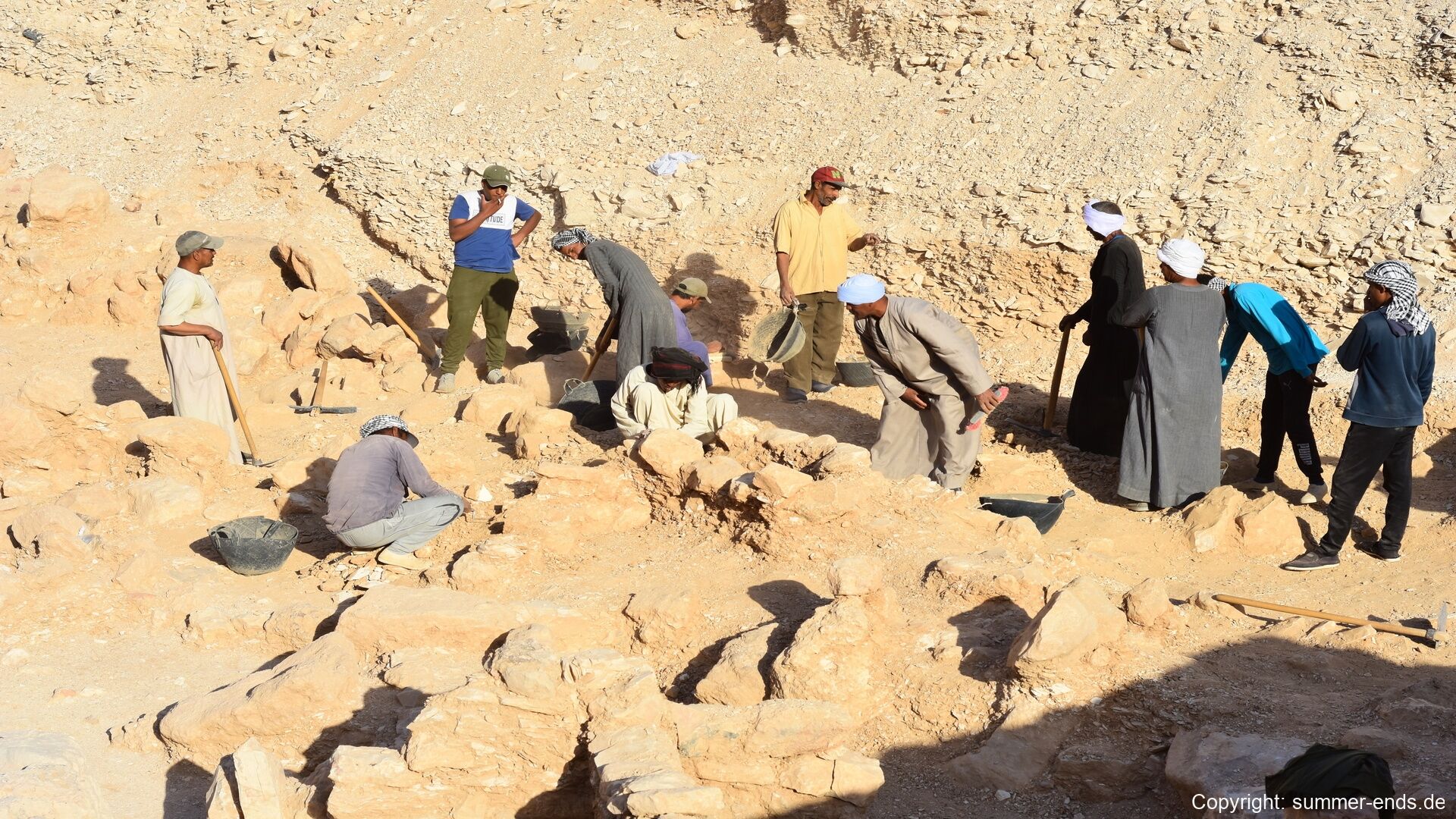
On 4 November 1922 Howard Carter, working for Lord Carnarvon, uncovered the first step of the entrance staircase of KV62, the tomb of Tutankhamun, buried beneath the debris of the tomb of Ramesses VI and the huts of its workmen. On 26 November Carter broke through the sealed doorway and saw, in his own words, wonderful things. Robbers had entered twice shortly after the burial, but the restorers had resealed the tomb, and its 5,398 objects survived almost complete: the only largely intact royal burial ever found in the valley. The clearance lasted until 1932; the treasure is now in the Grand Egyptian Museum at Giza, the mummy remains in a climate-controlled case, and a facsimile burial chamber, completed in 2014, absorbs much of the tourist pressure.

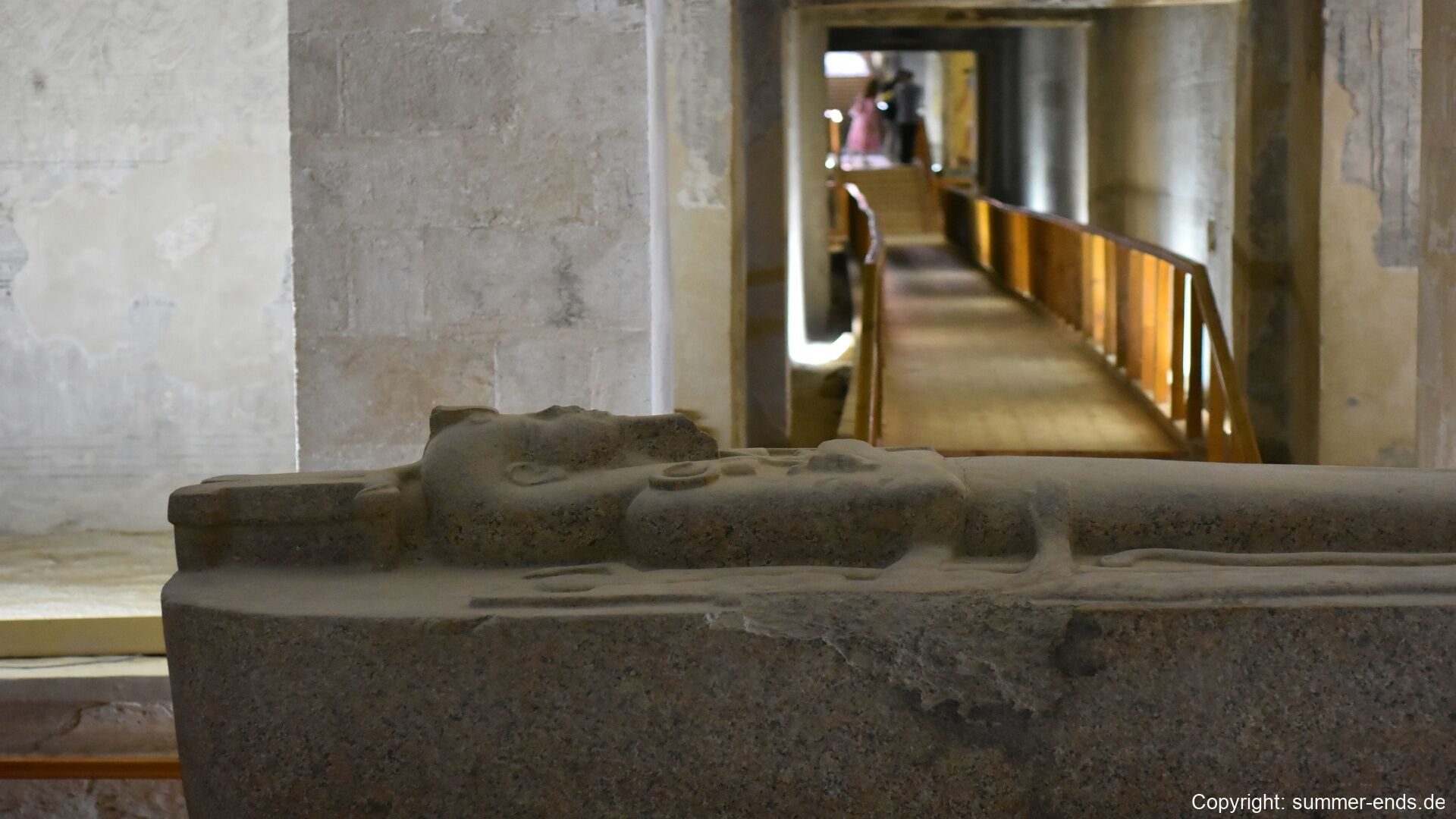
The Nineteenth Dynasty brought the valley to its fullest development. Seti I built KV17, discovered by Giovanni Belzoni in 1817 and long regarded as the finest tomb in Egypt: at 137.19 metres the longest known in the valley until the exploration of KV5, with seventeen chambers of painted relief, a vaulted burial chamber and an astronomical ceiling; his sarcophagus now rests in Sir John Soane’s Museum in London. Ramesses II constructed the vast KV7, ruinous today, and enlarged KV5 for his sons. The tomb of Merenptah, KV8, extends 160 metres and was built for four nested sarcophagi, the outer so large that door jambs had to be demolished and rebuilt around it; open since antiquity, it is the tomb whose gate and plan board stand at the entrance.

The Twentieth Dynasty continued the work. Setnakhte usurped the tomb of Twosret, KV14; his son Ramesses III extended KV11, begun by his father and abandoned when it broke into the earlier tomb of Amenmesse, KV10, the tomb known as Bruce’s Tomb and the Harper’s Tomb, whose corridors preserve the Litany of Re, the Book of Gates, the Amduat and the Book of the Earth. Ramesses V and Ramesses VI shared KV9, whose double image of the goddess Nut spans the ceiling of the pillared hall; in Graeco-Roman times this tomb, identified with the legendary Memnon, was a place of pilgrimage, and nearly a thousand Greek, Latin and Coptic graffiti cover its upper walls.

Most tombs were robbed in antiquity despite guards and concealed entrances. Papyri of the late Twentieth Dynasty record the trials of the thieves: Papyrus Mayer B describes the looting of the tomb of Ramesses VI, and Papyrus BM 10053 records how eight workmen of Deir el-Medina, caught robbing a royal tomb, were executed by impalement. In the Twenty-first Dynasty the priests of Amun gathered the mummies into great caches (forty royal mummies in the shaft of Deir el-Bahari, DB320, sixteen more in the tomb of Amenhotep II), stripping the burial equipment as they went; only tombs whose entrances had been lost, among them KV62, escaped. Exploration, from Napoleon’s savants to Wilkinson’s numbering of the tombs in 1827 and the work of Mariette and Loret, culminated in Carter’s discovery of 1922, and research continues under the Theban Mapping Project. In the Valley of the Queens, the tomb of Nefertari, found in 1904, was closed in 1950 because its paintings were flaking, restored between 1986 and 1992, and reopened under strict limits of time and number on a separate ticket; it was closed again for urgent renovation in 2024.

Geology

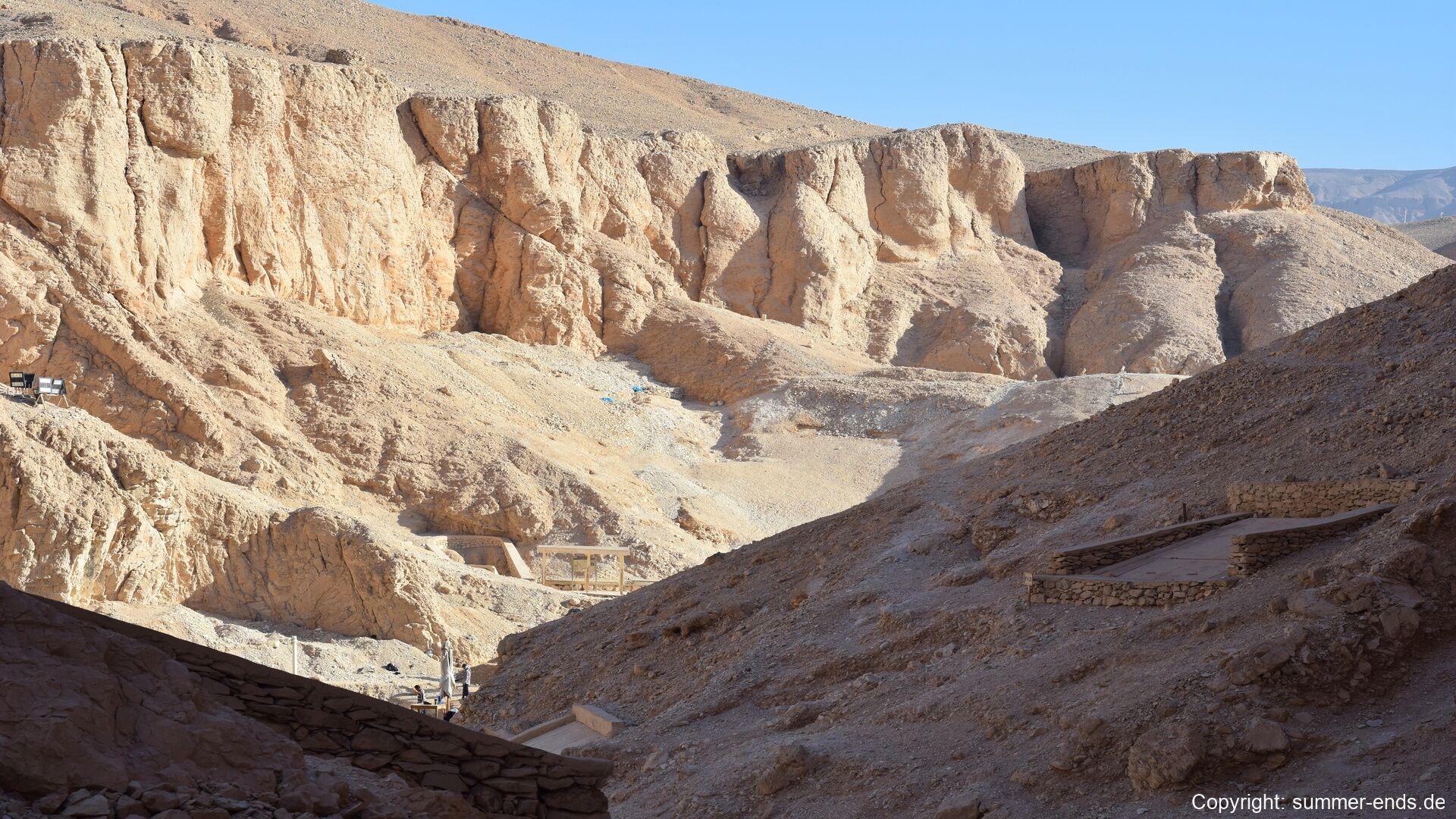
Both valleys are cut into the limestone massif of the Theban hills, the desert plateau that forms the western rim of the Nile valley at Luxor. The rock is a succession of limestones and softer interbedded marls, more than 300 metres thick in places, deposited between 35 and 56 million years ago, in the Eocene, when the sea of the Tethys sometimes extended as far south as Aswan. During the Pleistocene the wadis were carved out of the plateau under a wetter climate; today the valleys remain the channels of rare and violent flash floods, which can dump tonnes of debris into the open tombs in a single storm.

The quality of the rock in the kings’ valley is notoriously inconsistent, ranging from fine, sound limestone to coarse stone that is structurally unreliable, with layers of shale that swell in the presence of water. The builders adapted their plans: some tombs follow natural clefts, others were cut behind slopes of scree or at the edge of rock spurs left by ancient flood channels. Where the ground failed, the design was changed: KV7 returns to an old-fashioned bent axis, probably because of the rock after the Esna shale, and the workmen of Setnakhte abandoned KV11 when they broke into the tomb of Amenmesse. Survey by the Amarna Royal Tombs Project between 1998 and 2002 showed that the cliffs descend beneath the scree in a series of natural shelves down to the bedrock.

Hydrology is the great geological enemy of the necropolis. At least seven active flood stream beds lead into the central area of the kings’ valley, which appears to have been inundated at the end of the Eighteenth Dynasty: KV55, KV62 and KV63 are cut into the wadi bedrock at a level showing that the valley floor then lay about five metres lower than today. Later dynasties deliberately levelled the valley floor, and the buried tombs were forgotten until the early twentieth century; it was precisely such flood debris, together with the spoil of KV9 and the huts of its workmen, that protected the entrance of KV62 for more than three thousand years. The danger has returned: in 1991 a rainstorm flooded the tomb of Tutankhamun through a fault in the ceiling of the burial chamber.

The Valley of the Queens is geologically the more fragile of the two sites. Its rocks are limestones, marls, clays, chalks and shales, and the clays have undergone repeated expansion and shrinkage under recurrent flash floods, causing unstable tomb construction, rockslides and damage to the wall paintings. The landscape was formed by faulting and slumping during the Pliocene and Pleistocene, which tilted the original strata and exposed deposits of anhydrite, gypsum and halite. Salt from the halite, dissolved and recrystallised by seeping groundwater, is a principal agent of decay of the painted surfaces.

To these natural pressures the modern visitor adds humidity and carbon dioxide from breath, lint from clothing, the heat of light fixtures and the droppings of bat colonies in the open tombs. The conservators’ response is geological as much as artistic: in the tomb of Nefertari, the Getty Conservation Institute installed an air-circulation system, limited visits to fifteen minutes and required a separate ticket; other tombs of the queens’ valley are protected by plexiglass shields, wooden floors and walled paths. In the kings’ valley the mummy of Tutankhamun was moved in 2007 into a climate-controlled case, and a facsimile burial chamber absorbs visitors who would otherwise add their breath to the air of the original. The Theban massif has held the tombs for thirty-four centuries; the task is to keep it sound against water, salt and the crowd.

Things to See

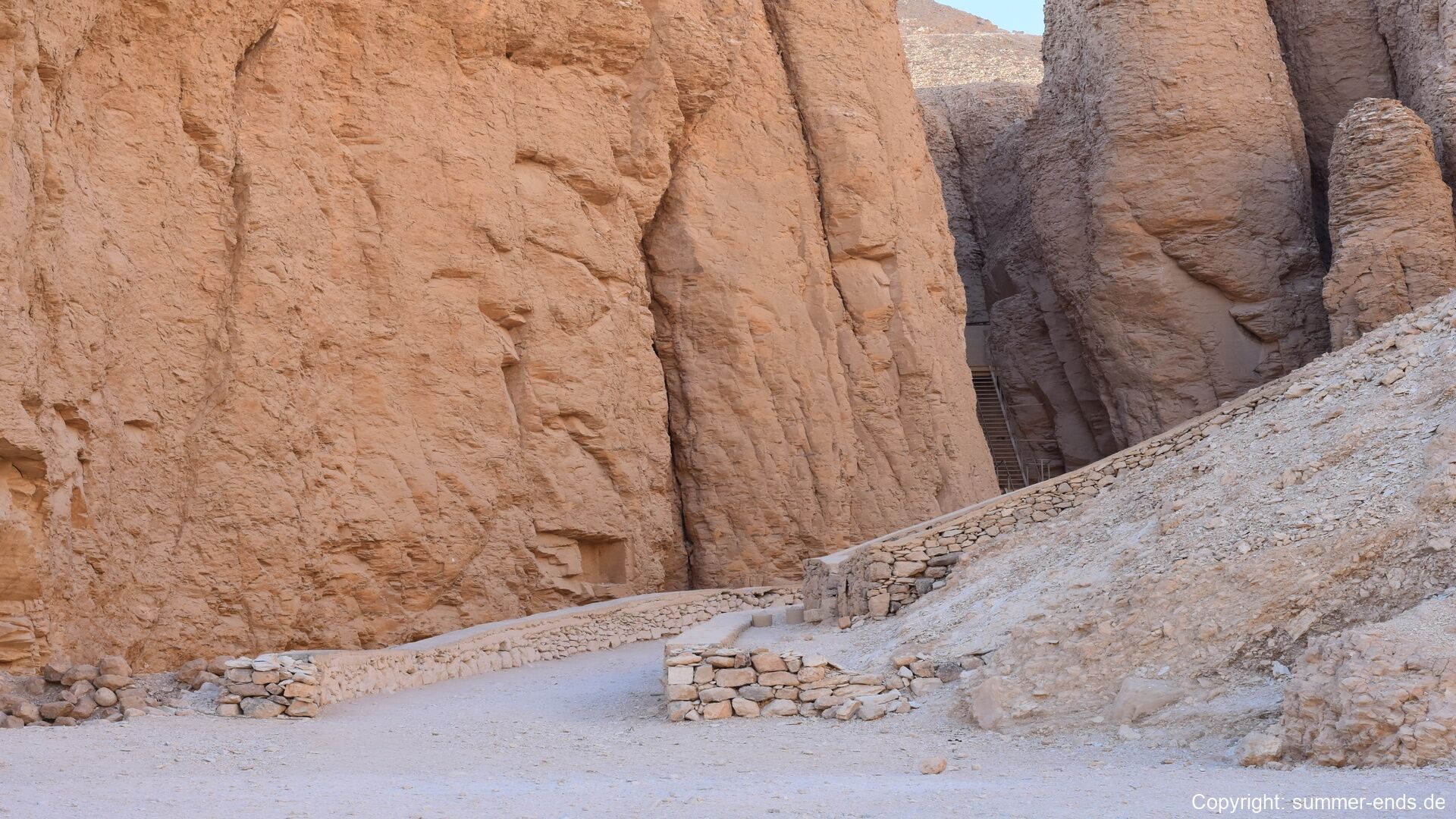
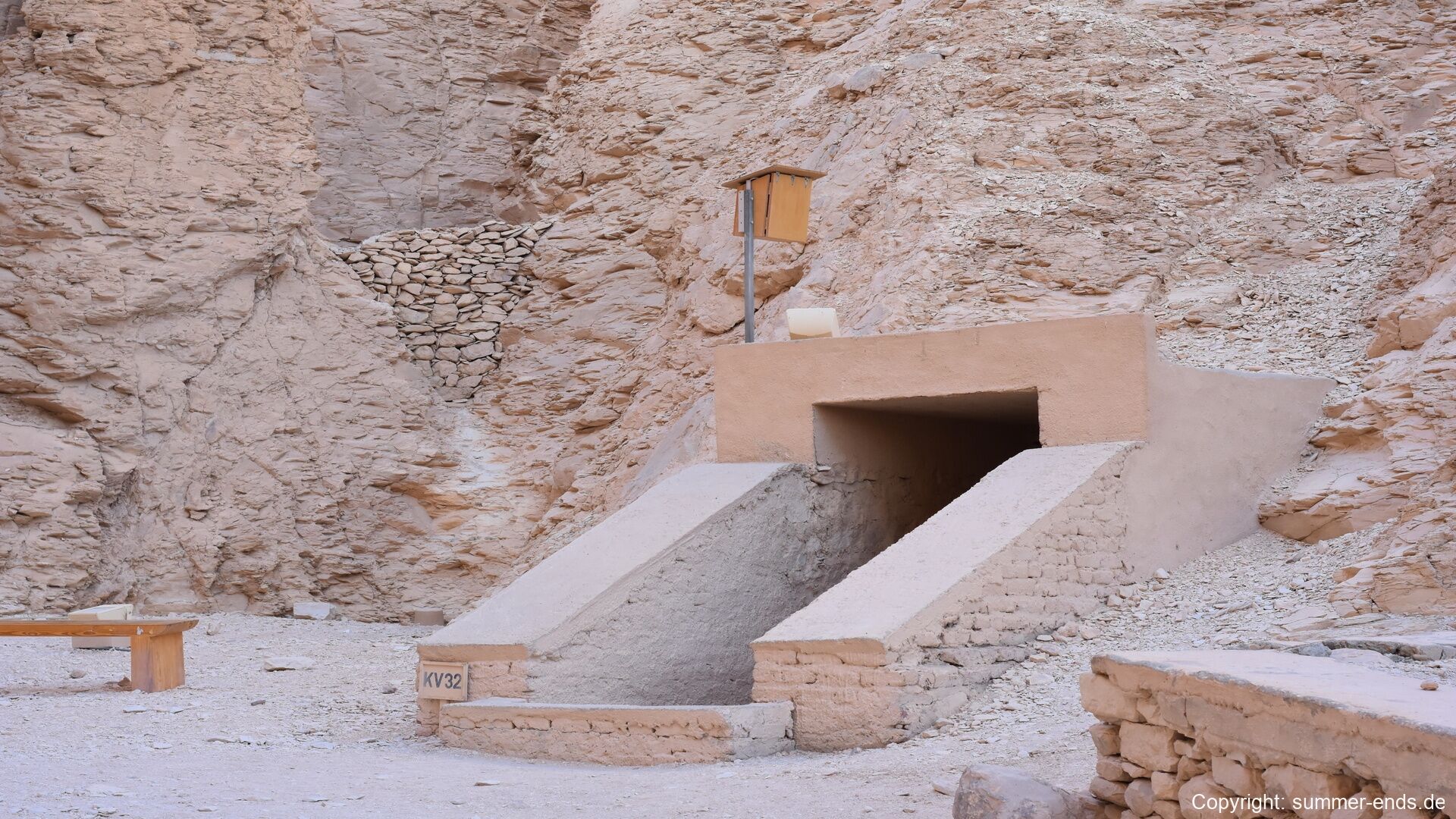
The East Valley opens as a narrow basin between the sheer limestone cliffs of the Theban massif, its floor strewn with boulders and its tomb entrances cut at the foot of the rock or high in the slopes. A modern entrance zone of plan boards, numbered gates and flat-roofed shelters stands at the head of the wadi, and above the whole basin rises el-Qurn, the solitary natural pyramid that gave the necropolis its sacred character. From the gates a stone-lined path leads along the valley floor towards the doorways of the open tombs.

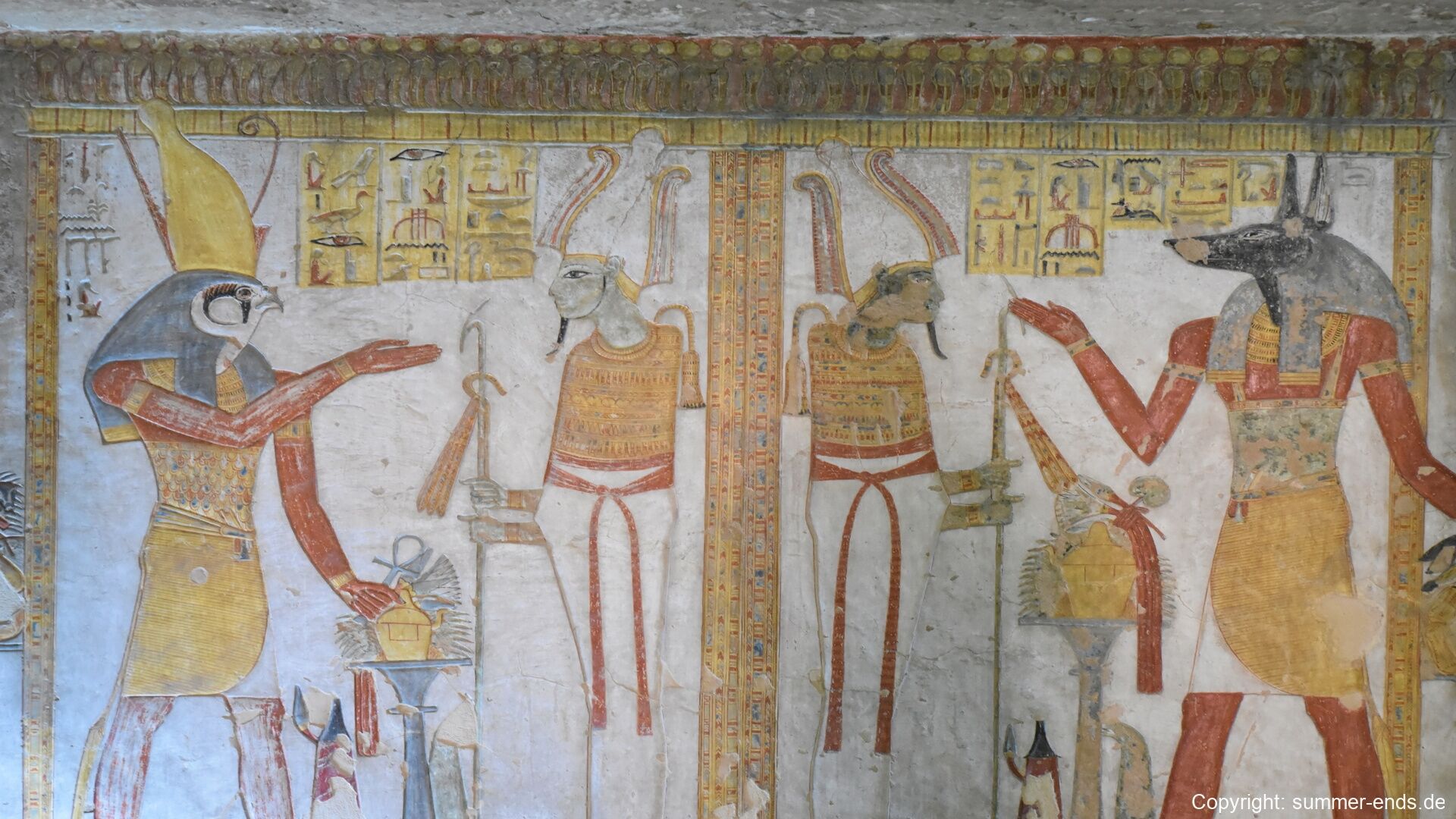
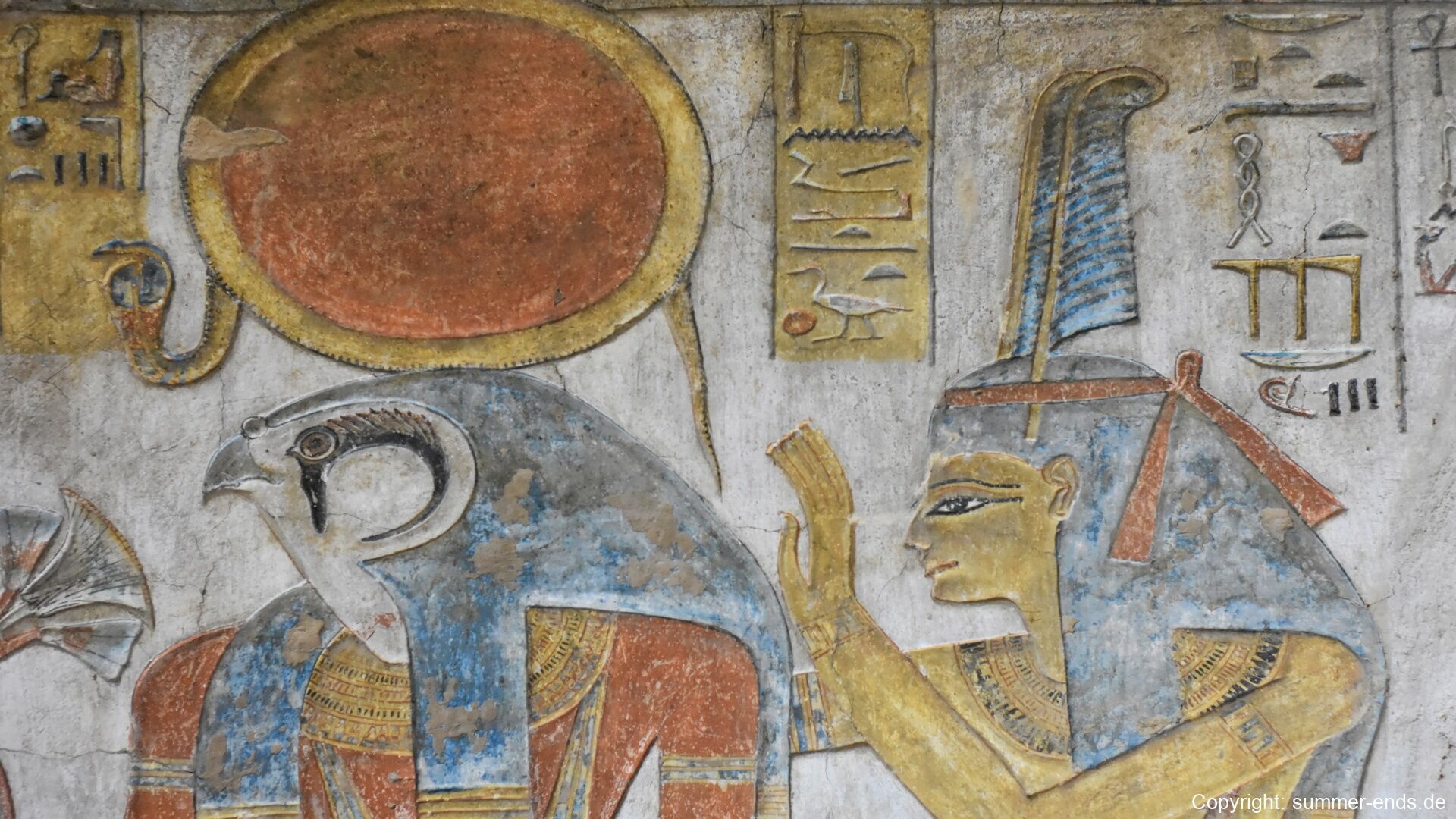
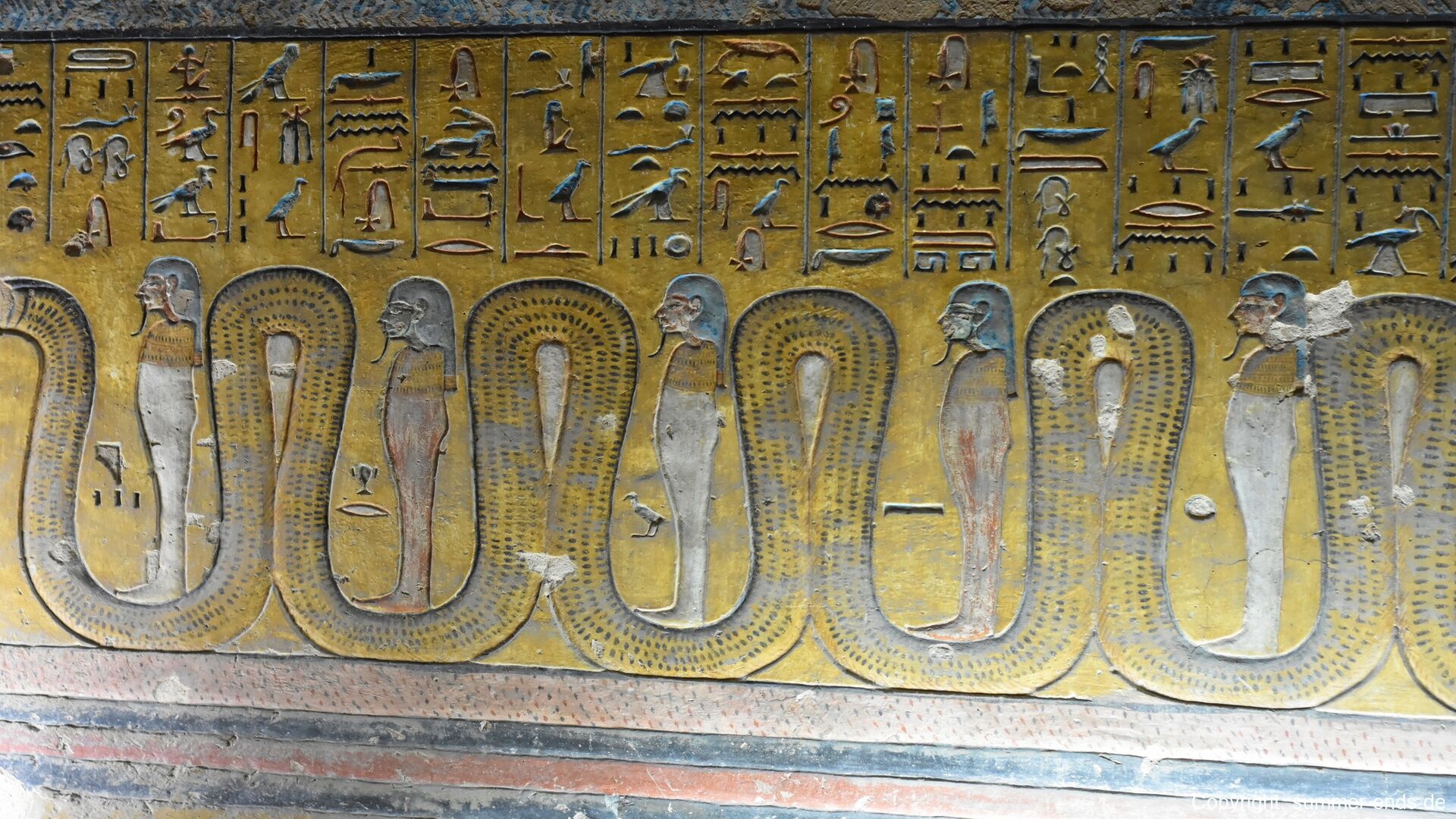
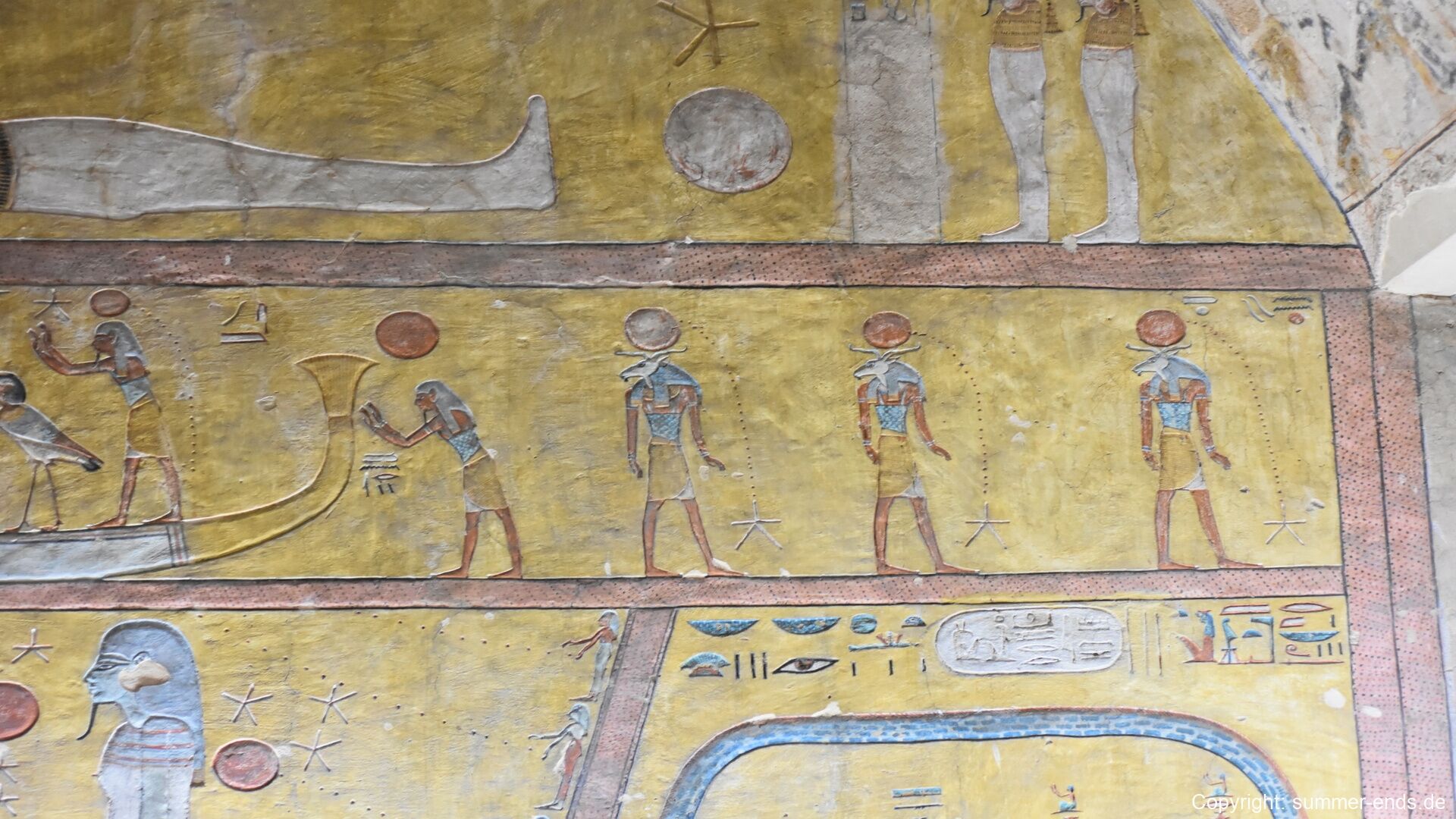
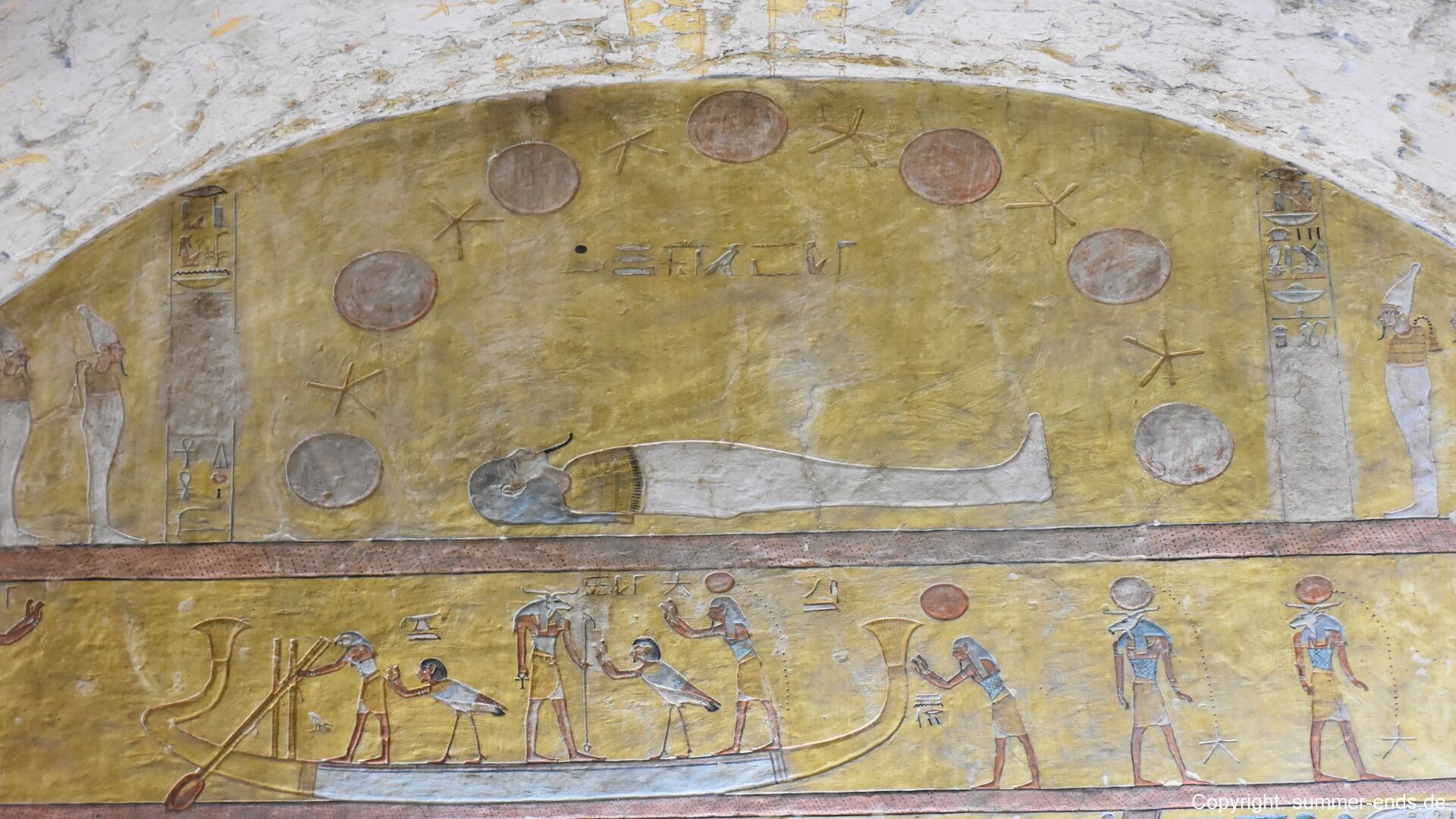
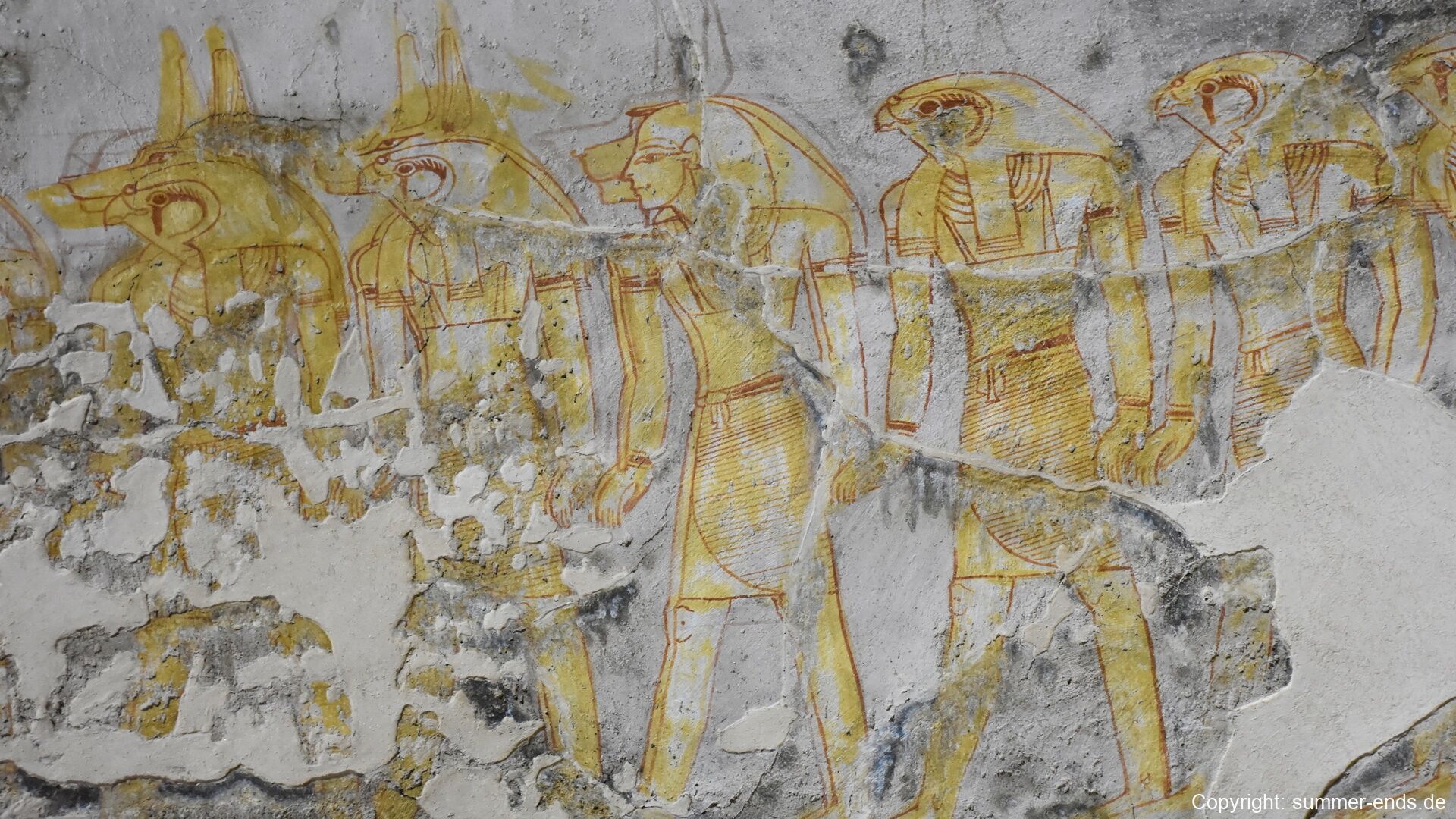
The tomb of Merenptah, KV8, announces itself at the threshold: a metal gate carries the sign K.V.8 Merenptah, and a plan board beside it shows the layout of the corridors. The tomb runs straight into the hillside for 160 metres, its walls covered with sunk relief and painted scenes: the falcon-headed god beneath a great ochre sun disk, the king standing before the deities, columns of hieroglyphs with their cartouches, friezes of rearing cobras and faded processions in worn plaster. The long descent ends in the chambers prepared for four nested sarcophagi, the outer so large that the door jambs had to be demolished and rebuilt around it.

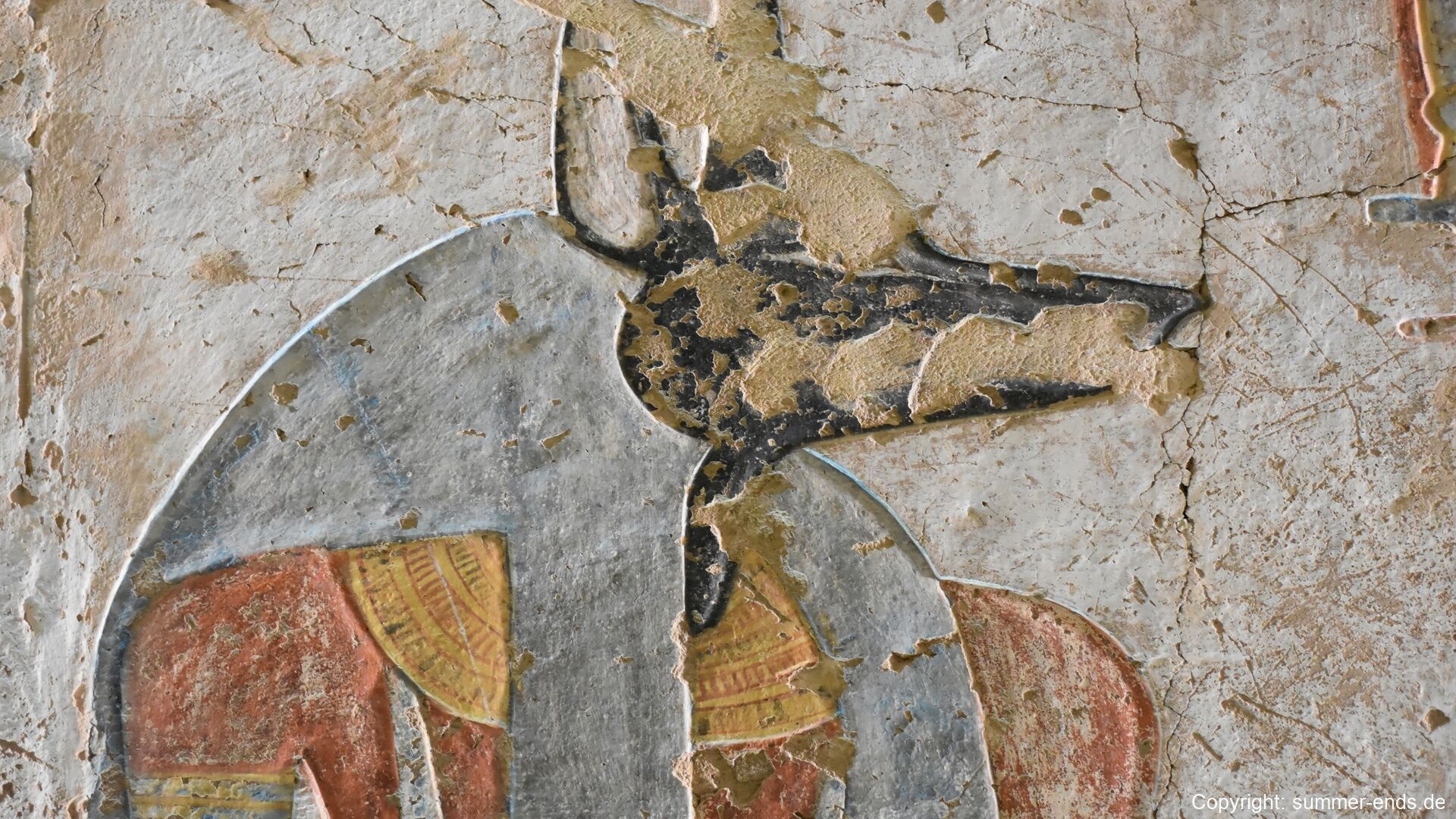
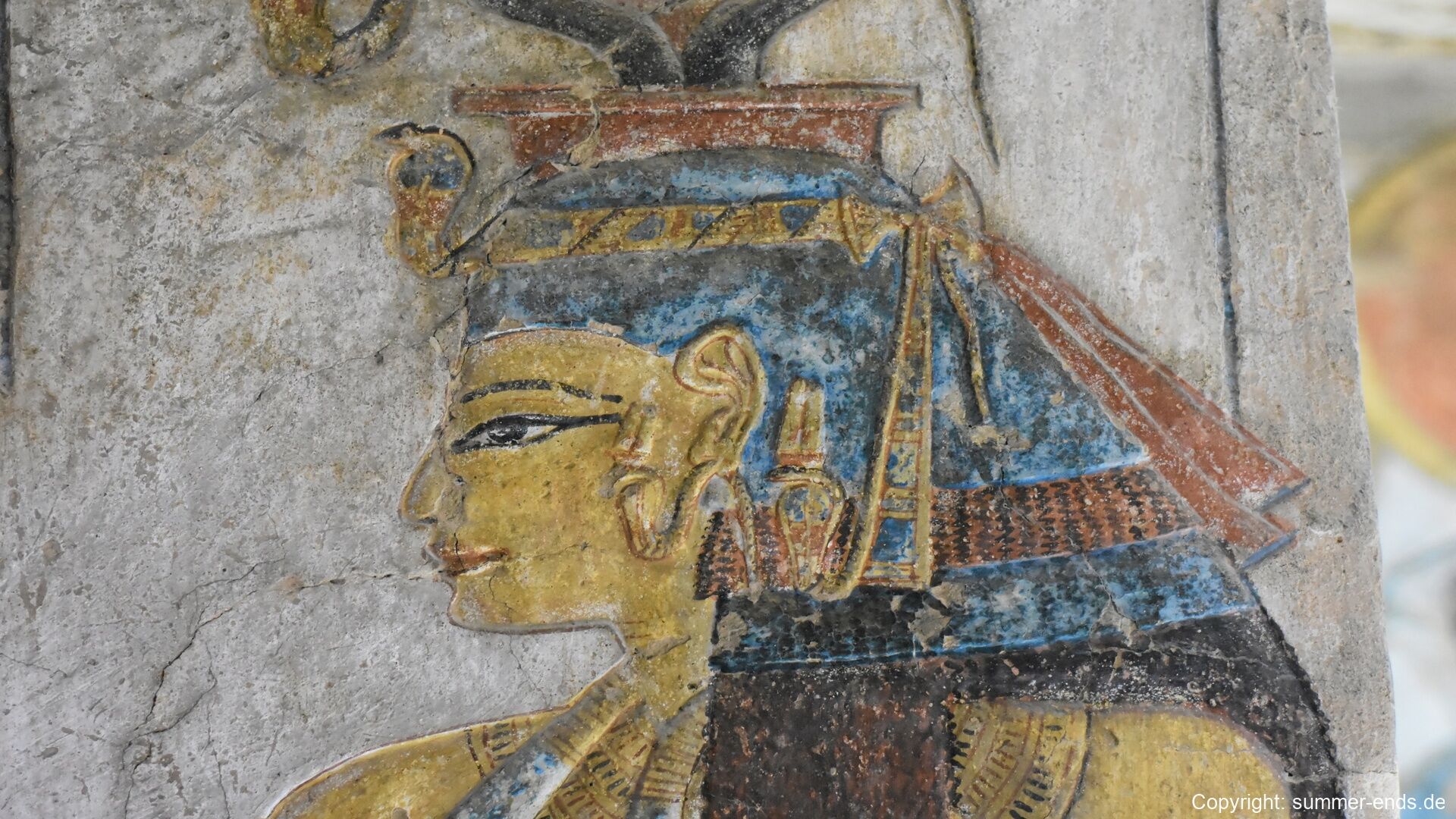
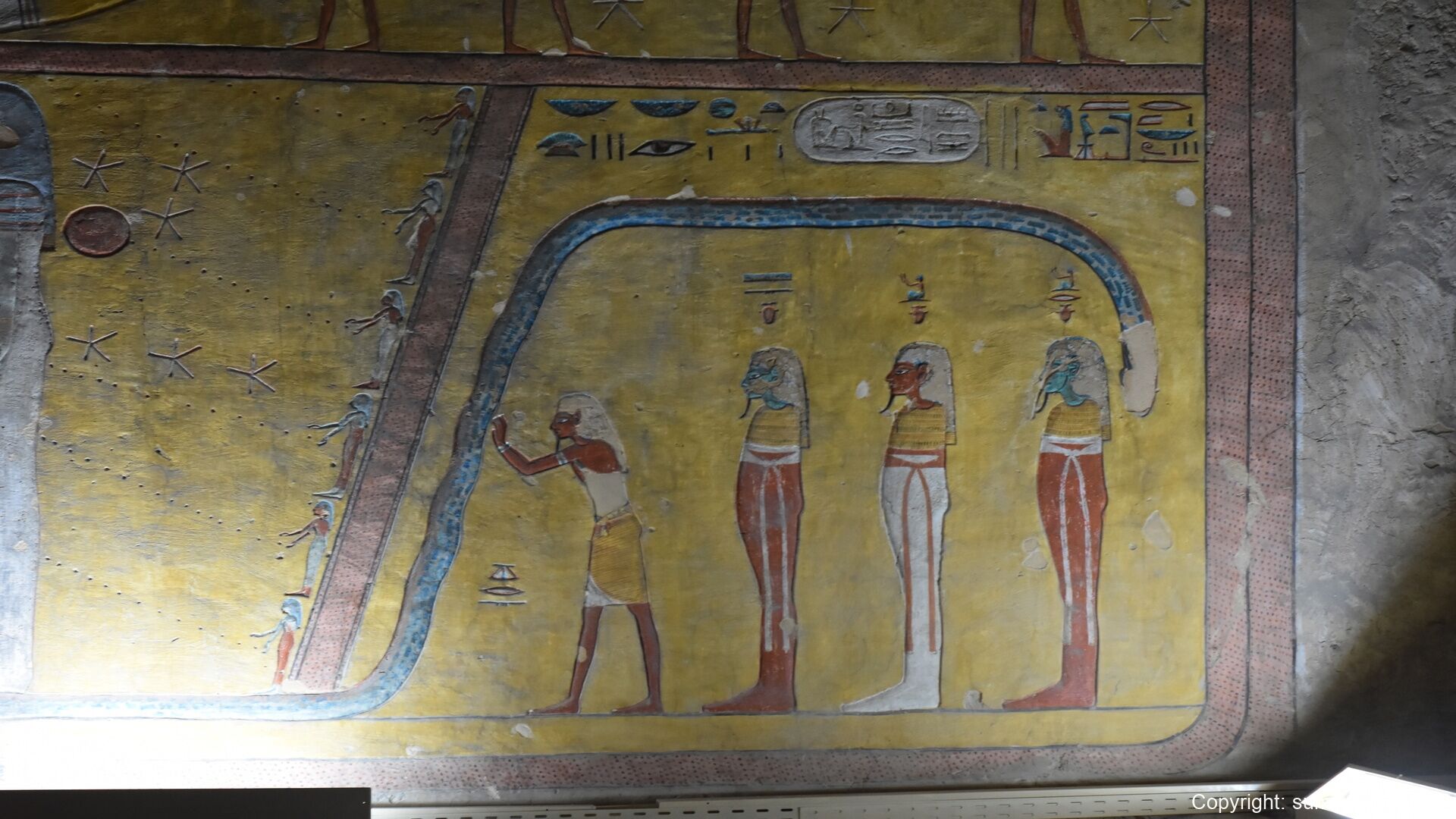
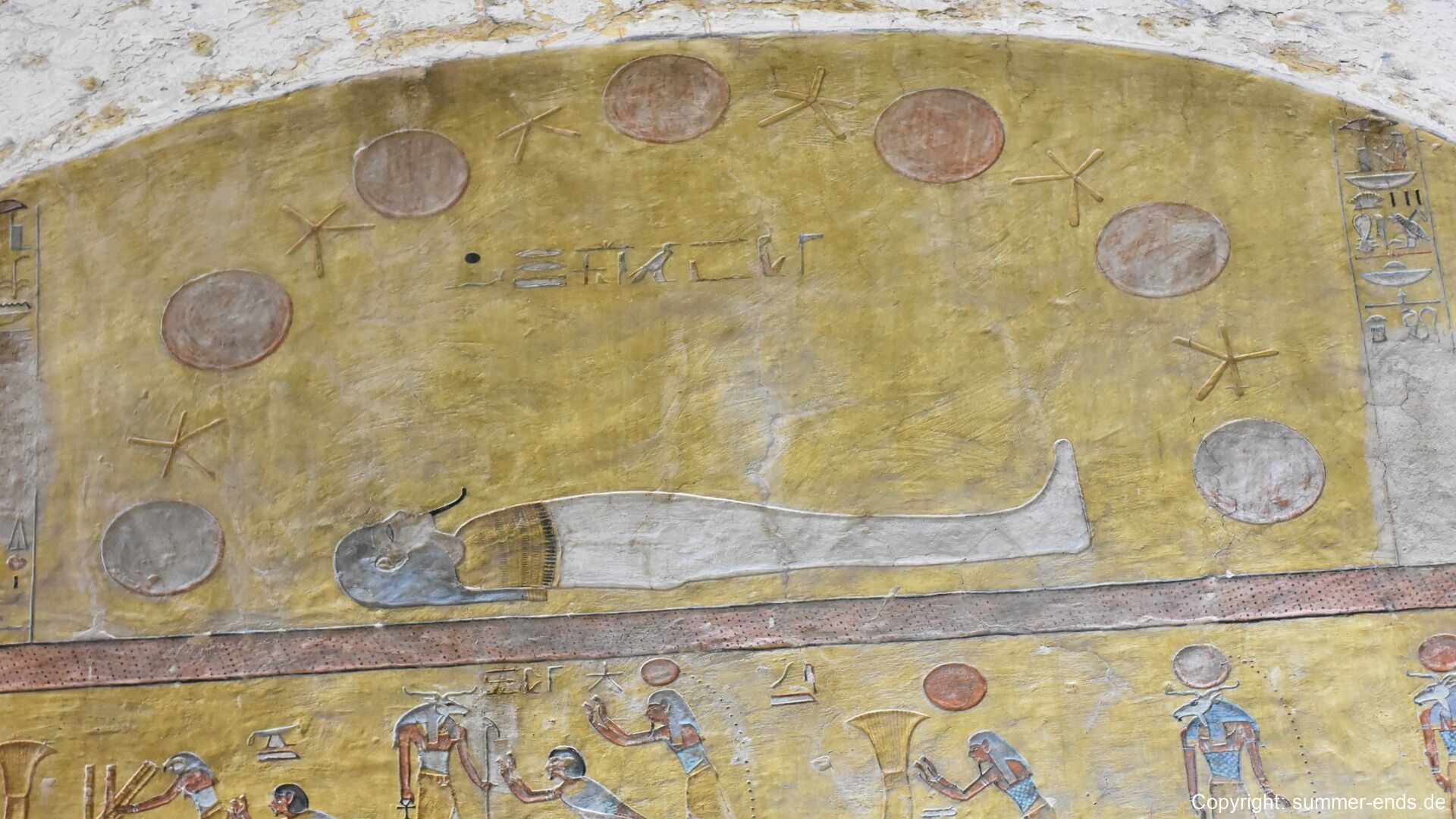
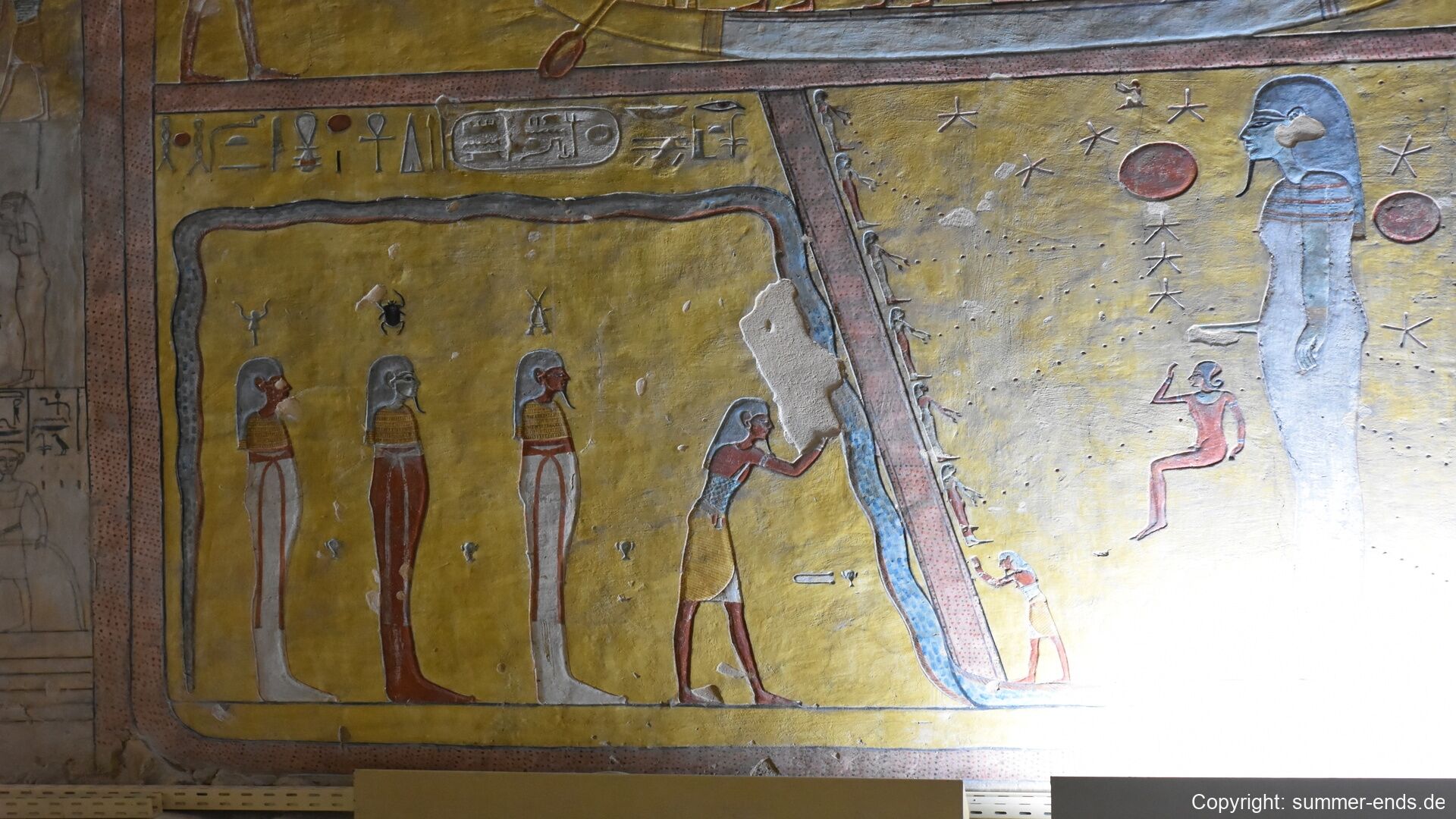
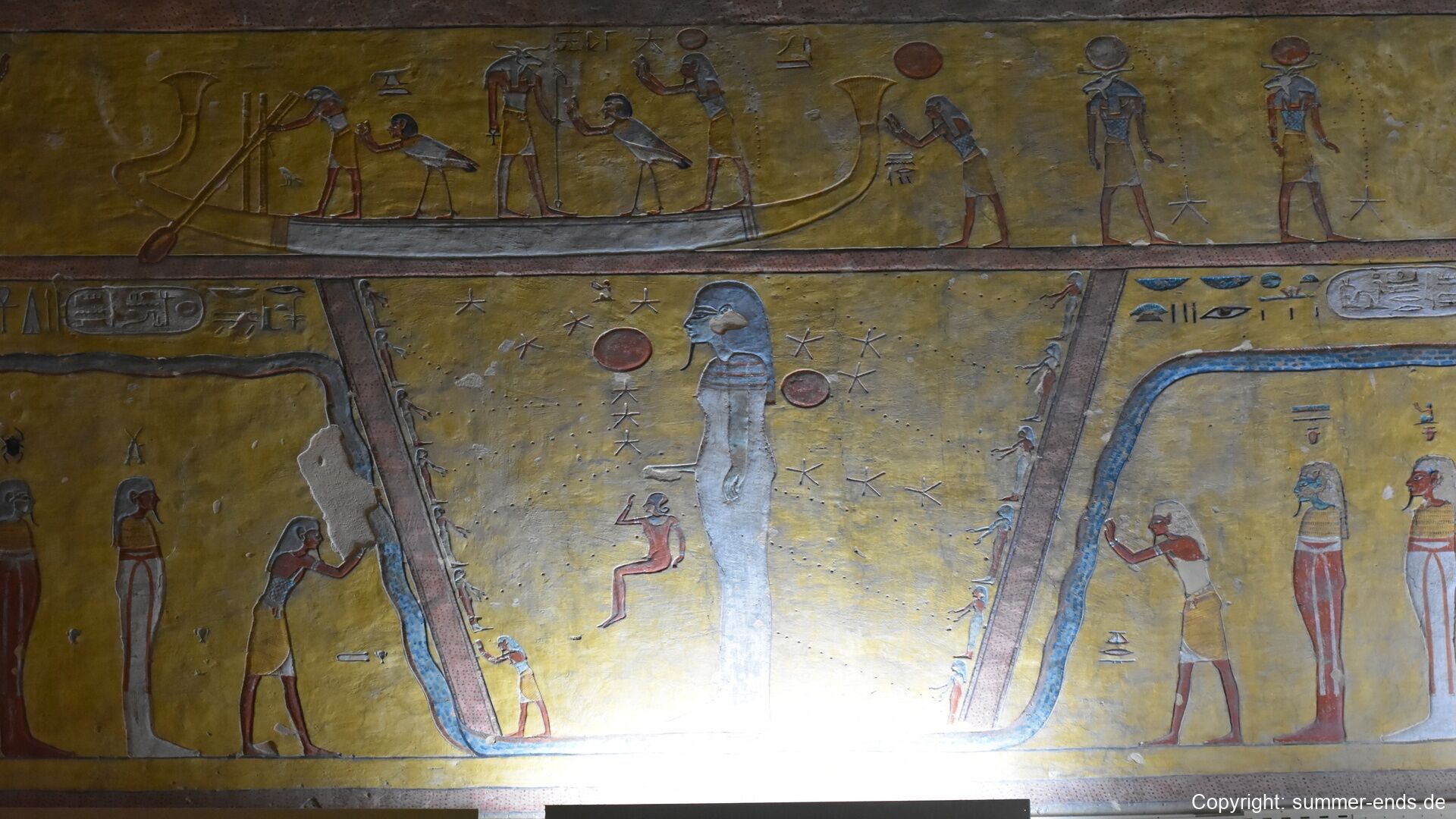
The other tombs open to visitors display the painted programme of the Ramesside age: arched ceilings filled by the winged vulture goddess, the scarab and the sun disk; falcon-headed gods riding in their solar barques above rows of kneeling worshippers; friezes of rearing cobras on gilded walls; Anubis painted in gold and blue beside the king; and dark blue vaults spangled with stars, sun discs and the great serpent of the night sky. The painted and carved scenes draw on the illustrated books of the underworld, among them the Litany of Re, the Book of Gates, the Amduat and the Book of the Earth, which the Ramesside tombs combine along their corridors in long sequences of deities, serpents and solar barques. Stone stairways with wooden handrails and modern ramps and platforms lead down through the rock and back to daylight through doorways that frame the desert cliffs.

The Ramesseum stands on the desert margin below the cliffs, the sandstone memorial temple that Ramesses II of the Nineteenth Dynasty built for his mortuary cult. Its pylon carries the carved battle scenes of the king, and beyond the ruined courts the great hypostyle hall rises on papyrus columns, some of whose flared capitals still show green pigment beneath the architraves. Osirid pillars with crossed arms line the second court, and the walls are covered with sunk relief crowded with processions and offering scenes. In the first court the fallen colossus of Ramesses II lies shattered on the ground, the statue that inspired Shelley’s Ozymandias; columns bear the chiselled names of nineteenth-century travellers, restoration scaffolding climbs the standing masonry, and modern information boards explain the plan of the temple, the royal palace and the virtual reconstruction of the colossal statues.

On the slopes that close the necropolis towards the cultivation, the entrances of rock-cut tombs open in the hillsides above excavated ruins, and weathered guardian figures, baboons with raised paws and a ram-headed sphinx, lie among the fallen stone at the desert edge. Below them the desert shelf narrows towards the flood plain, where palms and patchwork fields meet the hazy horizon. The two valleys, the memorial temples and the hillside tombs together form the strip of desert that separates the houses of the living from the houses of the dead.

References

  1. Reeves, N. & Wilkinson, R. H. (1996). The Complete Valley of the Kings: Tombs and Treasures of Egypt’s Greatest Pharaohs. London: Thames & Hudson.
  2. Hornung, E. (1990). The Valley of the Kings: Horizon of Eternity. New York: Timken Publishers.
  3. McDonald, J. K. (1996). House of Eternity: The Tomb of Nefertari. Los Angeles: Getty Conservation Institute.
  4. Said, R. (1990). The Geology of Egypt. Rotterdam: A. A. Balkema.
  5. UNESCO World Heritage Centre (1979). Ancient Thebes with its Necropolis. World Heritage List, ref. 87. whc.unesco.org/en/list/87/
  6. Wikipedia contributors (2026). Valley of the Kings. en.wikipedia.org/wiki/Valley_of_the_Kings
  7. Wikipedia contributors (2026). Valley of the Queens. en.wikipedia.org/wiki/Valley_of_the_Queens
  8. Wikipedia contributors (2026). Tomb of Tutankhamun. en.wikipedia.org/wiki/Tomb_of_Tutankhamun
  9. Wikipedia contributors (2026). Tomb of Seti I. en.wikipedia.org/wiki/Tomb_of_Seti_I
  10. Wikipedia contributors (2026). KV8. en.wikipedia.org/wiki/KV8
  11. Wikipedia contributors (2026). KV9. en.wikipedia.org/wiki/KV9
  12. Wikipedia contributors (2026). KV11. en.wikipedia.org/wiki/KV11
  13. Wikipedia contributors (2026). Tomb of Nefertari. en.wikipedia.org/wiki/Tomb_of_Nefertari
  14. Wikipedia contributors (2026). Ramesseum. en.wikipedia.org/wiki/Ramesseum
  15. Wikipedia contributors (2026). Deir el-Medina. en.wikipedia.org/wiki/Deir_el-Medina
  16. Wikipedia contributors (2026). Theban Necropolis. en.wikipedia.org/wiki/Theban_Necropolis