2021 Italy - Pisa
16 September 2021




Journal Notes
General
Pisa lies across the Arno a few kilometres before the river reaches the Ligurian Sea, and the water divides the town into two halves that have grown towards each other for two thousand years. The city is the capital of its province and has more than twenty historic churches and a long row of medieval and Renaissance palaces, most of them facing each other along the avenues that follow the river. Almost all of that architecture was paid for by the sea, by the trade of a republic that once controlled the western Mediterranean and by the plunder of a fleet that was feared as far as the Levant.
The name of the city is probably older than Rome’s account of it. Most scholars derive Pisa from an Etruscan word for mouth, because the settlement stood where the Arno meets the coastal lagoons, and excavations in the 1980s and 1990s found the tomb of an Etruscan prince of the fifth century BC together with imports from the eastern Mediterranean, which proved both the Etruscan origin of the city and its early role as a port. Roman authors already called Pisa an old town, and Virgil gave it the epithet of Alpheae in memory of colonists who were said to have come from Elis in Greece.
The river is the reason for the walk that most visitors make. The Lungarni on both banks follow the water past ochre facades, iron balconies and small quays where the boats are tied, and the bridges cross from one row of houses to the next with the gables reflected in the current. Away from the water the streets are ordinary and quiet, with parked cars under the balconies and brass doorbells in the entrances, and the university quarter lives in the same buildings as the rest of the town.
The famous square is at the northern edge of the centre, inside the old walls. It is a walled compound of about nine hectares, partly paved and partly grassed, and four buildings dominate it: the cathedral, the baptistery, the bell tower and the Camposanto, the monumental cemetery. Around them stand the old hospital of Santo Spirito and the museums that grew out of it, and the whole square has been a UNESCO World Heritage Site since 1987. The Italian writer D’Annunzio gave it the name by which everyone knows it, when he called the lawn the meadow of miracles.
In practice a day in Pisa shapes itself around the light. The riverside is at its best in the morning, when the facades are lit from the east and the bridges are still quiet; the square on the northern edge fills from mid-morning until evening, and the marble is at its brightest in the middle of the day, when the queues at the tower are longest. The town itself is small enough to be crossed on foot in half an hour, which is why the usual advice is to arrive early, walk the Lungarni first and leave the monuments for the hours when the groups have gone.
History
Pisa became one of the maritime republics of Italy and held that position from the eleventh century until the fifteenth. Its fleets dominated Mediterranean trade for a hundred years, its participation in the Crusades secured commercial bases for its merchants in the Levant, and it fought continuously with the Saracens for control of the sea; in alliance with Genoa it took Sardinia in 1016, and it expanded its reach along the Tyrrhenian coast as far as Corsica and Elba. The city was a rival of Genoa at sea and of Florence and Lucca on land, and it lost its independence to Florence only in 1406.
The turning point came at sea. The naval battle fought near the islet of Meloria in 1284 broke the power of the fleet, and the republic never recovered the position it had held; the rivalry with Genoa ended in defeat, and the silting of the coastal lagoons did the rest, closing the harbour approaches that had made the city rich. Pisa passed to Florence, kept its university and its river trade, and settled into the second rank of Tuscan towns while its palaces and its churches continued to be built by the families that still had money.
The medieval building campaign is visible in one square more than anywhere else. The cathedral, the baptistery, the bell tower and the cemetery were raised in succession on the same meadow, and the style that emerged from those building sites developed at the end of the tenth century and spread from Pisa into Corsica, Sardinia and Elba and across northern Tuscany as far as Lucca and Pistoia. Every one of the four buildings is faced in the same bichromatic marble, white with horizontal bands of blue-grey stone, which is why they look like members of one family rather than four separate monuments.
The baptistery gives the clearest picture of how long the work took. Its construction began in 1152 under the direction of Diotisalvi, whose name and date are signed on the building, and it was finished in 1363 in the Gothic manner, so the lower storeys are Romanesque with round arches and the upper parts are Gothic with pointed canopies and a dense figure programme. With a height of almost fifty-five metres and a diameter of thirty-four it is the largest baptistery in Italy, and it stands a few steps from the cathedral door, which is where the two styles meet in the same field of view.
The tower is the youngest of the four and the most famous, and its story is a story of construction stopped and resumed. Begun in 1173, it started to lean while the third storey was going up, because the ground beneath it was too soft to carry the weight; work halted, was taken up again in the following century, and the bell chamber was only completed between 1360 and 1372, in three stages spread over 199 years. The architect is disputed among Guglielmo, Bonanno Pisano and, according to a study of 2001, Diotisalvi, who signed the baptistery and the bell tower of San Nicola in the same town.
Geology
The inclination of the tower is a matter of geology rather than of design. The ground under the square is a stack of soft alluvial layers, clays, silts and sands deposited by the Arno and by the coastal lagoons that once reached the walls, and a foundation only a few metres deep could not spread the load of 14,500 tonnes evenly. The campanile began to tilt almost as soon as it was built, and by 1990 the lean had reached 5.5 degrees, more than three metres out of plumb.
The stabilisation that followed is one of the best known engineering operations in the world. Between 1993 and 2001 the tower was secured with temporary counterweights and cables, the bells were silenced, and the foundation was corrected by extracting small quantities of soil from beneath the raised side, a method known as under-excavation; the result brought the lean back to 3.97 degrees and the monument was reopened to visitors in 2001. The engineers expect the correction to hold for the coming decades, which is a cautious way of saying that the tower continues to move.
The river that built the ground has its own geography. The Arno rises on Monte Falterona in the Casentino and runs 241 kilometres westwards through Arezzo, Florence, Empoli and Pisa before it reaches the Tyrrhenian Sea at Marina di Pisa; its basin covers more than 8,200 square kilometres and collects water from the Val di Chiana, the upper Valdarno and the valleys of the Sieve, the Bisenzio and the Pesa. It is the largest river in Tuscany and the second most important of central Italy after the Tiber.
The hills behind the city are the other half of the picture. The Monte Pisano range to the north supplies the limestone and the marble that the medieval builders used, and the plain between the hills and the sea is a former wetland: the Val di Chiana was drained in the eighteenth century, the lagoons and marshes along the coast were reclaimed in the same period and later, and the pine woods and dunes of the coastal strip are the remains of that landscape. What looks like natural flatland is in fact land that had to be made.
Water remains the natural hazard of the whole region. The Arno is famous for the floods that have damaged Florence and Pisa repeatedly, most recently and most destructively in 1966, and the embankments along the Lungarni are part of the city’s infrastructure rather than its decoration. The same soft ground that makes the tower lean makes the plain settle, and the balance between the river, the sea and the land continues to be managed in a way that no medieval engineer could have imagined.
Things to See
The walk usually begins on the Lungarno. The river moves slowly past the bridges, the rows of ochre houses on the banks keep their gables in the water, and the small quays below the streets carry moored boats and a few fishermen. On the northern bank a tall brick campanile rises beside a weathered building close to the water, one of the many churches that the city built with the profits of its fleets, and at the ends of the bridges the traffic gives way to pedestrians going nowhere in particular.
Behind the river the streets are as ordinary as they are handsome. A residential lane runs between wrought-iron balconies with cars parked along one side, and in an old stucco entryway a panel of brass doorbells carries the engraved names of the families that live behind it. Somewhere near the university quarter a stone facade is lettered Scuola Medico-Chirurgica, with an arched balcony above the door and the Italian and European flags hanging over the street, and an old public telephone, its red handset still in its scratched shelter, survives on a wall that has been written over.
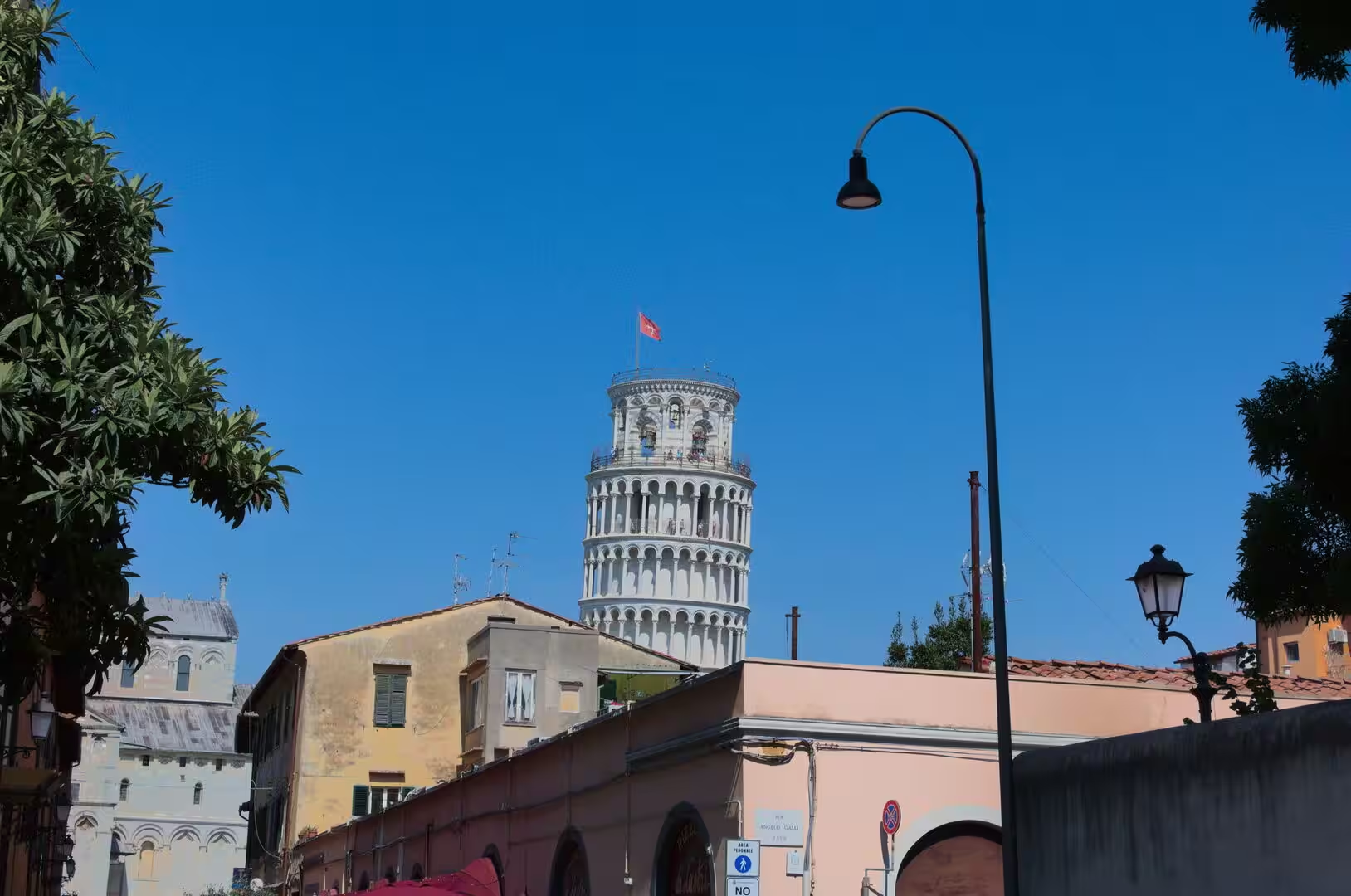
Then the square opens, and everything changes. The tilted bell tower rises past the terracotta roofs of the town on the way in, and inside the walls the white marble of the cathedral and the round baptistery stands on a wide lawn under a sky that seems to belong to the buildings. The four monuments are set far enough apart to be seen together in one view: the striped cathedral, the baptistery with its tiers of arches, the campanile behind them and the long wall of the cemetery on the far side.
The cathedral repays a slow approach. Bronze doors open under a carved lunette, the apse curves in two tiers of marble arches that catch the light from the south, and in the portals above the lintels there are sculptures of saints and a Madonna and Child in her niche. Visitors queue at the tower and pass the cathedral on the way, but the details that make Pisan Romanesque recognisable are on the outside, in the blind arcades, the lozenges and the bichromatic bands that run right around the buildings.
The leaning tower itself is best seen from a few metres away. Tourists gather at its foot on the grass, holding the usual poses, and the tilt is so obvious at close range that the horizon itself seems to lean with it. Above them the eight storeys of white marble stand at almost four degrees from the vertical, and the climb to the top, for those who book it, ends on a terrace over the whole meadow of miracles.
Not everything in the piazza is monumental. A winged putto carved in relief holds an ornate coat of arms against the sky, the baptistery door opens into a round room with a diameter wide enough to hold a congregation, and a historic hotel on the edge of the square flies the Italian and European flags beneath its small rooftop tower. The cemetery carries the same marble as the church, and the sinopias, the preparatory drawings that were lifted from its walls, have a museum of their own beside the square.
Leaving the square, the town returns to its own scale. An old brick tower stands overgrown with vines where the walls have been left to the vegetation, a rusty bicycle leans against a large yellow ball in the weeds at the foot of a lamppost, and an aged ochre building with dark green shutters holds its stone balcony over the street as it has for centuries. On the ground of a pine wood a crushed can of beer records that someone passed through, which is the kind of find that only a walker notices.
Practical notes for a day in Pisa. The tower can only be climbed with a timed ticket and the cathedral is free but requires a pass booked on the spot, so an early start on the piazza saves an hour of standing in line; the river and the streets between the two banks need no ticket at all. Trains from Florence take about an hour, the airport lies a few minutes from the centre, and the walk from the station to the meadow of miracles crosses the whole city in twenty-five minutes, which is the best introduction to it that a visitor can have.
References
- Wikipedia contributors (2026). Pisa. en.wikipedia.org/wiki/Pisa
- Wikipedia contributors (2026). Leaning Tower of Pisa. en.wikipedia.org/wiki/Leaning_Tower_of_Pisa
- Wikipedia contributors (2026). Piazza dei Miracoli. en.wikipedia.org/wiki/Piazza_dei_Miracoli
- Wikipedia contributors (2026). Pisa Cathedral. en.wikipedia.org/wiki/Pisa_Cathedral
- Wikipedia contributors (2026). Pisa Baptistery. en.wikipedia.org/wiki/Pisa_Baptistery
- Wikipedia contributors (2026). Camposanto Monumentale. en.wikipedia.org/wiki/Camposanto_Monumentale
- Wikipedia contributors (2026). Pisan Romanesque. en.wikipedia.org/wiki/Pisan_Romanesque
- Wikipedia contributors (2026). Republic of Pisa. en.wikipedia.org/wiki/Republic_of_Pisa
- Wikipedia contributors (2026). Arno. en.wikipedia.org/wiki/Arno
- Wikipedia contributors (2026). Galileo Galilei. en.wikipedia.org/wiki/Galileo_Galilei
- Wikipedia contributors (2026). University of Pisa. en.wikipedia.org/wiki/University_of_Pisa
- Wikipedia contributors (2026). Scuola Normale Superiore di Pisa. en.wikipedia.org/wiki/Scuola_Normale_Superiore_di_Pisa
- Wikipedia contributors (2026). Battle of Meloria. en.wikipedia.org/wiki/Battle_of_Meloria
- Wikipedia contributors (2026). Marina di Pisa. en.wikipedia.org/wiki/Marina_di_Pisa
- Ranzini S.M.T. (2002) Stabilisation of leaning structures: the Tower of Pisa case. Géotechnique. 52. 545-545. doi.org/10.1680/geot.52.7.545.38752
- Benzio V. (1978) Decorative Lighting of the Piazza Dei Miracoli, Pisa. Lighting Design + Application. 8. 13-14. doi.org/10.1177/036063257800800903
- Pancani G. (2017) Rilievo delle lastre tombali del Camposanto Monumentale di Piazza dei Miracoli a Pisa. Restauro Archeologico. 25. 74-89. doi.org/10.13128/ra-22208
- Dimelli D. (2024) Historic Centers and Overtourism: Opportunities and Threats for Three Historic European Cities. Current Approaches, Solutions and Practices in Conservation of Cultural Heritage. 135-154. doi.org/10.26650/b/aa9ps34.2024.006.007