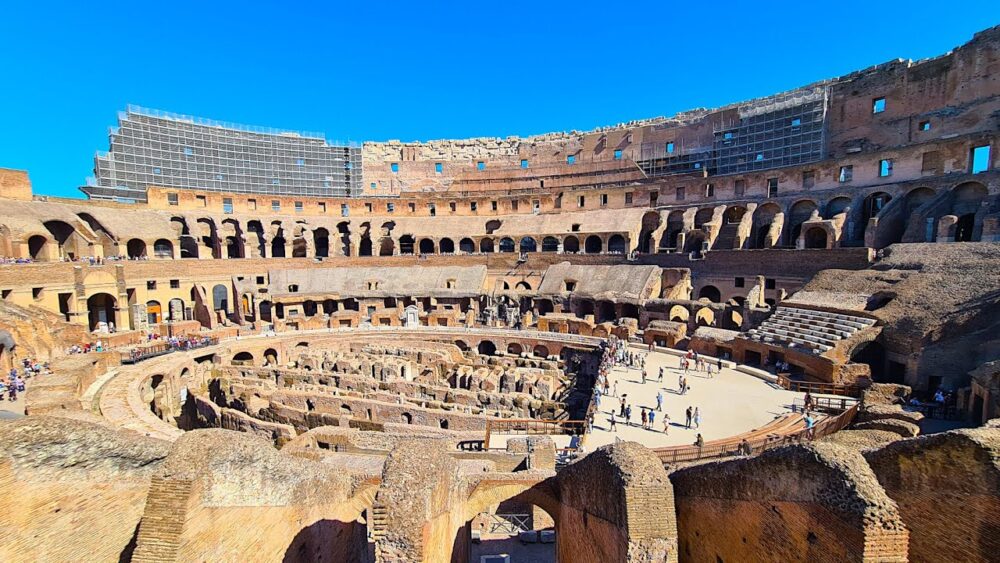
Walking into the Colosseum in Rome for the first time felt like stepping through a doorway into another world. The noise of the modern city faded, and suddenly I was standing in the heart of ancient Rome — the arena that once held up to 50,000 spectators, where gladiators fought, emperors presided, and history was written in blood and spectacle. No photo, no documentary, no history book could prepare me for the sheer scale and atmosphere of this place.
I started at the outer walls, where arches rise in three levels of stone, their weathered surfaces telling the story of nearly two thousand years. It’s almost impossible to imagine how it must have looked when first built in the 1st century AD, gleaming white with marble, decorated with statues, and alive with the sound of cheering crowds. Stepping inside, the Colosseum unfolded like a giant open-air theatre, its tiers of seating curving around the oval arena. Even though much of it is in ruins, the design is still clear — a masterpiece of Roman engineering.
Walking through the underground passages, I could picture the world that once existed below the arena floor. These tunnels, called the hypogeum, were where gladiators waited for their turn to fight, where animals were kept in cages, and where pulleys and trapdoors lifted scenes into the arena above. It was a hidden world of preparation, fear, and anticipation that made the spectacle above possible.
Standing in the centre of the arena, I closed my eyes and imagined the roar of the crowd, the clash of weapons, the drama of life and death played out on the sand. It was humbling — and sobering — to realise how entertainment once meant something so brutal. Yet at the same time, the Colosseum stood as a reminder of Roman power, ambition, and genius for architecture.
From the Colosseum, I walked straight into the Roman Forum, which spreads out like an open-air museum of ruins. This was the political, religious, and social heart of ancient Rome — the place where decisions were made, speeches were given, and daily life unfolded in the shadow of temples and basilicas.
The path led me past the Arch of Titus, celebrating the Roman victory in Jerusalem, and into the centre of the Forum itself. Columns rose like broken teeth against the sky, fragments of marble lay scattered across the ground, and the outlines of ancient buildings hinted at what was once the most powerful city in the world.
I wandered among the remains of the Temple of Saturn, the Temple of Vesta, and the Basilica Julia. Each ruin whispered a story of senators debating, priests performing rituals, or merchants gathering to trade. Walking on the ancient stones of the Via Sacra, the sacred road that connected the Forum to the Colosseum, I felt like I was treading in the footsteps of Julius Caesar, Augustus, and countless ordinary Romans whose lives were tied to this space.
From the higher points of the Forum, the view was spectacular. On one side, the Colosseum loomed in the distance. On the other, the Palatine Hill rose, once the home of emperors. The layers of history were almost overwhelming: here, politics, religion, and daily life all converged, creating a civilisation that shaped the world we know today.
What struck me most about the Forum was the silence. Despite the crowds of visitors, there were moments where I could just stand still, surrounded by fallen columns and half-buried temples, and imagine the noise, the bustle, the energy of the ancient city. It felt like Rome’s heartbeat was still alive in the stones, even after nearly two thousand years.
If you’re planning a visit, I’d recommend starting at the Colosseum early in the morning to beat the crowds, then walking straight into the Forum on the same ticket. Wear comfortable shoes, bring water, and take your time — there’s so much to see, and every corner reveals another piece of history. Guided tours are available if you want to go deeper, but even wandering on your own is unforgettable.
For me, visiting the Colosseum and the Roman Forum was more than just sightseeing. It was a chance to connect with the roots of Western civilisation, to stand where emperors ruled and gladiators fought, and to feel the presence of a city that once commanded the known world. Rome is called the Eternal City for a reason — its past is never really gone. It still stands, waiting to be experienced.