Girona is a compact but exceptionally layered city in northeastern Spain whose development has been shaped by geology, strategic location, and more than two thousand years of continuous human occupation. Situated between the Mediterranean coast, the Pyrenees, and the Iberian interior, Girona functions as a natural gateway between regions, a role that has defined its historical and scientific significance.
Geological Setting and Natural Landscape
Geologically, Girona lies at a transition between several major landscape units. To the east extends the Empordà basin, a low-lying area formed mainly by Neogene and Quaternary sediments deposited by rivers and former shallow seas. To the west and north begin the foothills of the Catalan Pre-Coastal Range and, farther beyond, the Pyrenees, composed largely of Paleozoic metamorphic and igneous rocks shaped during the Variscan orogeny and later uplifted by Alpine tectonics.
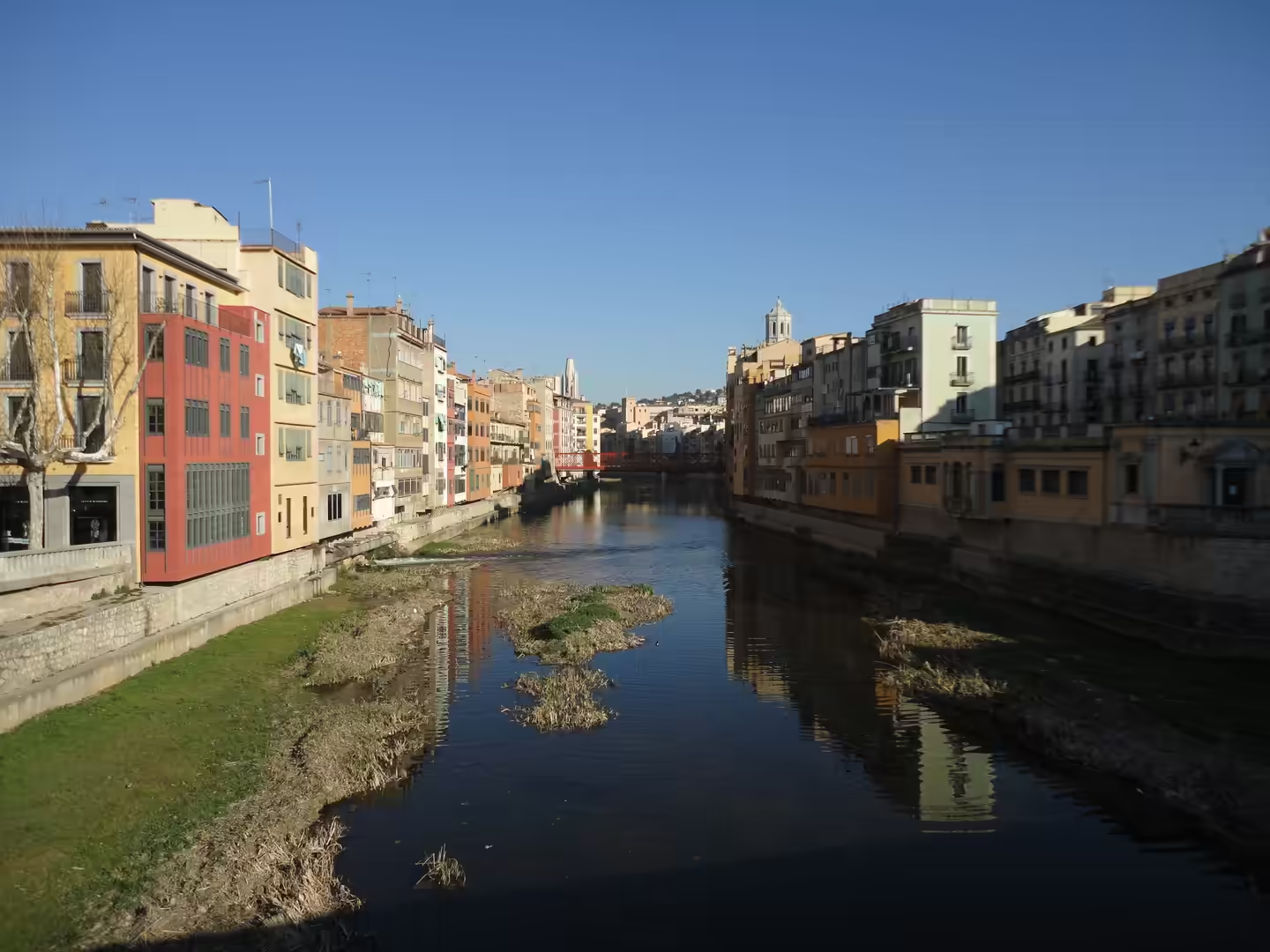
The city itself developed at the confluence of four rivers—the Ter, Onyar, Galligants, and Güell. These rivers carved valleys into softer sedimentary layers, creating fertile soils while also posing a persistent flood risk. The Onyar in particular has repeatedly overflowed, influencing building techniques, street levels, and the distinctive riverside architecture that characterizes Girona today. The surrounding hills provided defensible high ground and building stone, directly influencing urban form.
Roman Origins and Early History
Girona’s documented urban history begins with the Roman foundation of Gerunda in the 1st century BCE. Established as a fortified settlement, its primary function was to control movement along the Via Augusta, the main Roman road connecting Italy with Hispania. The Romans placed the city on elevated ground, a decision that still defines the outline of the historic center known as the Força Vella.
After the decline of Roman authority, Girona passed through Visigothic control and later became a frontier city between the Carolingian Empire and Islamic al-Andalus. This border position made it strategically valuable and repeatedly contested, laying the foundation for its later reputation as a heavily fortified city.
Medieval Girona and Cultural Development
During the Middle Ages, Girona emerged as an important religious and cultural center. One of its most significant communities was the Jewish population, documented from at least the 9th century until the expulsion of 1492. The Jewish Quarter (Call) remains one of the best-preserved medieval Jewish neighborhoods in Europe and offers insight into dense urban living, social organization, and intellectual life in medieval Catalonia.
Christian institutions expanded in parallel, most notably with the construction of Girona Cathedral. Built over several centuries, the cathedral culminated in a Gothic nave of unprecedented width, an architectural and structural achievement that reflects advanced medieval engineering knowledge. Together with churches such as Sant Feliu, the city illustrates the gradual transition from Romanesque to Gothic and later Baroque styles.
Early Modern Period and Military Role
From the early modern period onward, Girona’s proximity to the French border ensured its continued military importance. The city endured numerous sieges, most famously during the Napoleonic Wars in 1808–1809, when prolonged resistance caused extensive destruction. These conflicts left a lasting imprint on the city’s fortifications, urban layout, and collective memory.
In the 19th century, industrialization and the arrival of the railway shifted economic activity toward flatter surrounding areas, while the historic core experienced population decline. This process unintentionally preserved much of the old town, which was later restored rather than replaced.
Modern Girona and Urban Structure
Today, Girona is a clear example of layered urban development. Roman walls, medieval streets, early modern bastions, and contemporary neighborhoods coexist within a small geographic area. The old town remains elevated and compact, while modern districts extend across the plains shaped by river sediments.
The city’s infrastructure continues to reflect geological constraints, particularly in flood management and riverbank stabilization. Girona thus serves as a practical case study in how long-term urban planning adapts to natural processes rather than overcoming them entirely.
Things to See and Scientific Interest
Girona’s city walls provide a continuous elevated route through different historical phases, revealing changes in construction materials and defensive strategies. The cathedral complex and surrounding religious buildings illustrate both architectural evolution and advances in structural engineering. The Arab Baths, despite their name, represent a Romanesque reinterpretation of classical bathing traditions and demonstrate continuity in architectural concepts across cultures.
Along the Onyar River, brightly colored houses stand atop medieval foundations built on unstable alluvial soils, showcasing pragmatic responses to geomorphological challenges. Beyond the city center, nearby hills, terraces, and river corridors reveal how agriculture, water management, and settlement patterns adapted to local geology.