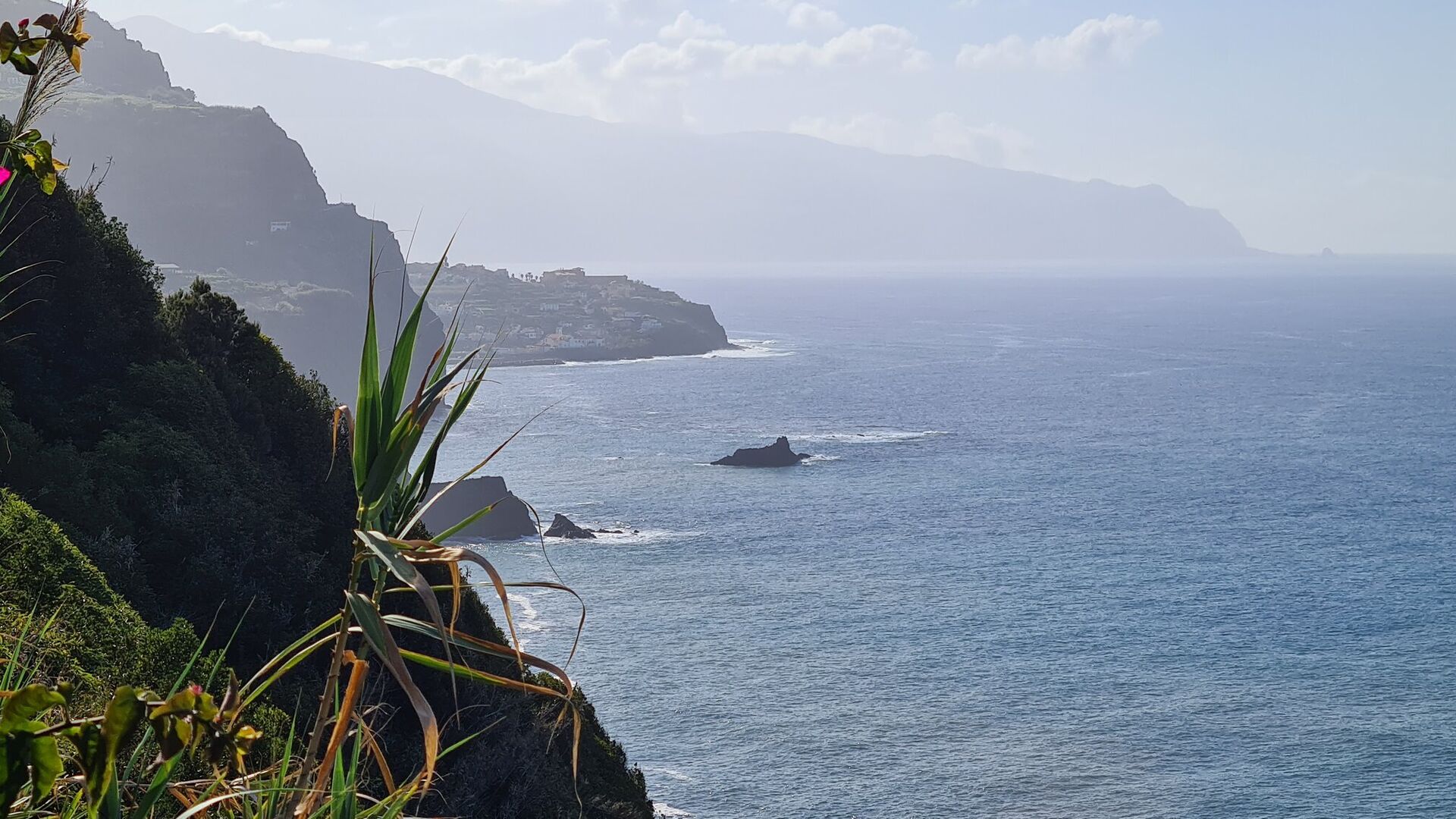




The Madeira Archipelago is an autonomous region of Portugal located in the northeastern Atlantic Ocean and belongs biogeographically to the Macaronesian island group (Azores, Madeira, Canary Islands, Cape Verde). The archipelago comprises the main island of Madeira, Porto Santo, and the uninhabited island groups of Desertas and Selvagens. Madeira is situated on the African Plate in an intraplate oceanic setting; the island rises steeply from the deep-sea basin and therefore exhibits exceptionally high relief energy, with elevations increasing from sea level to over 1,800 m within a very short horizontal distance.
Climatologically, Madeira is characterized by an oceanic–subtropical regime in which orography represents the dominant controlling factor. Moist trade-wind air masses are forced to ascend along the central mountain ridge, where they cool and condense, resulting in pronounced precipitation gradients. The northern slopes and higher elevations are, on average, significantly wetter, whereas the southern coast frequently lies in a rain shadow and experiences drier conditions. This spatial heterogeneity produces a mosaic of microclimates and vegetation zones. Of particular ecological significance is the Laurisilva (evergreen laurel forest), a relic of humid, mild Tertiary forest communities. Its present distribution on Madeira is favored by the combination of orographic moisture, stable temperature regimes, and suitable site conditions.
The cultural landscape is strongly shaped by water management and terracing. Historically central infrastructures include the levadas: linear water conveyance systems that transport water from precipitation-rich catchments to drier regions. From a physical-geographical perspective, these systems are not merely irrigation structures but key landscape-forming elements, as they expanded settlement and land-use areas and indirectly influenced erosion and vegetation dynamics. The capital, Funchal, developed into an economic and administrative center due to its natural harbor setting, leeward position, and role as a node within Atlantic maritime routes.
History
Prior to the 15th century, there is no reliable evidence for permanent human settlement on Madeira. References in historical sources to early sightings or sporadic landings (e.g., by Mediterranean seafaring traditions) are difficult to verify and do not substitute for archaeologically substantiated habitation. The decisive historical turning point is the Portuguese “rediscovery” in the context of Atlantic expansion. From 1419/1420 onward, Madeira was charted through Portuguese expeditions under the patronage of Prince Henry the Navigator and integrated into emerging Atlantic economic and political systems. Planned colonization began in the 1420s.
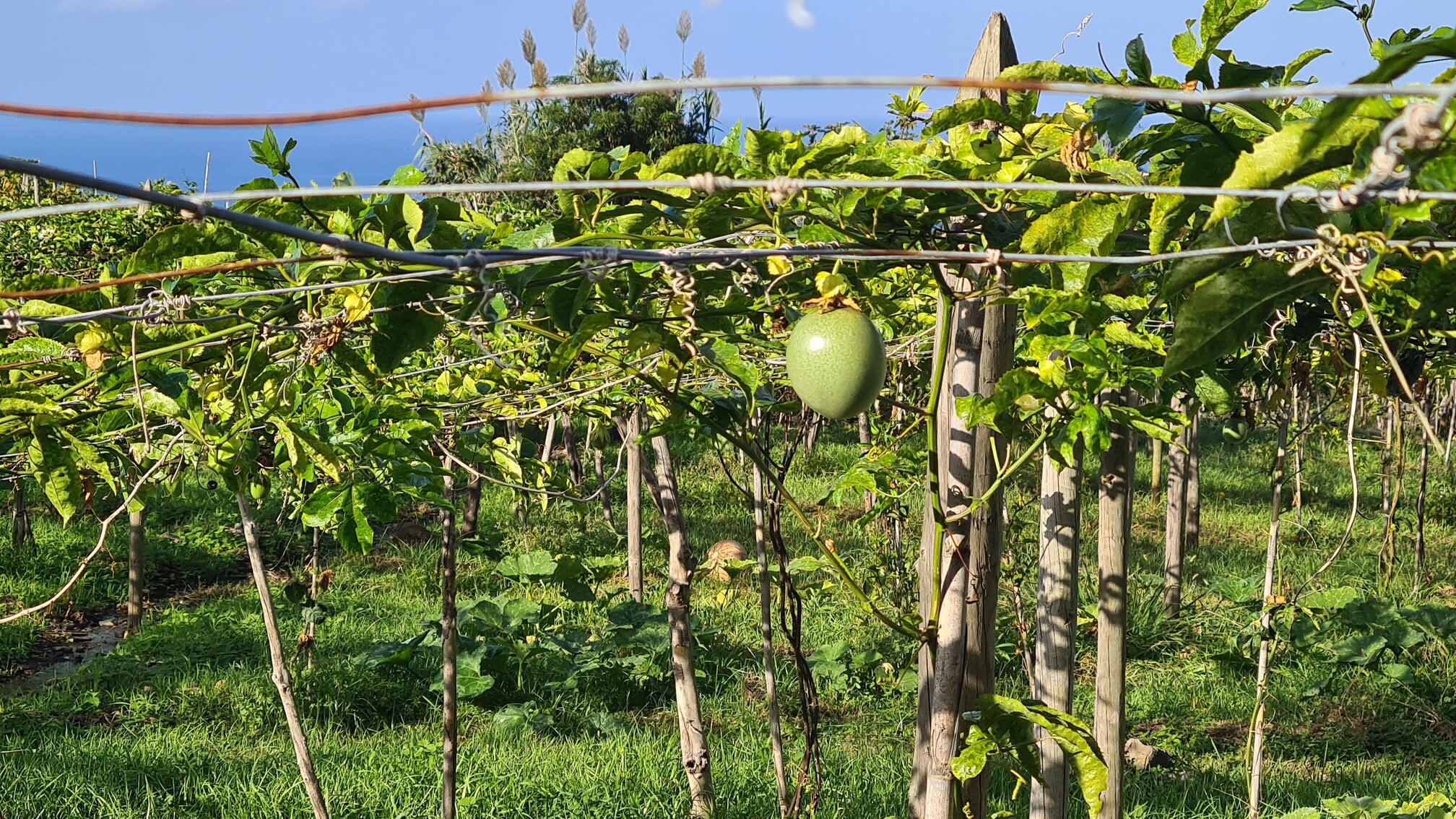
During the early phase, an export-oriented agrarian economy dominated. Madeira represents a prototypical case of early modern plantation development in the Atlantic world. The expansion of sugarcane cultivation in the 15th and 16th centuries led to intensive land use, large-scale deforestation, and the establishment of a labor-intensive production system. Mills and irrigation infrastructure were crucial from both technological and organizational perspectives, while economically Madeira became embedded in transnational trade networks. These processes were closely linked to the formation of Atlantic labor regimes, including the use of enslaved labor in parts of the Atlantic system, although local manifestations varied temporally and socially.
From the 17th century onward, the economic focus gradually shifted from sugar to wine. Madeira wine gained strategic importance in Atlantic trade due to its durability and suitability for long-distance maritime transport. Historically significant is its integration into British–Portuguese trade relations, with British merchants and consumption networks shaping export structures, quality standards, and marketing. Consequently, Funchal developed into a central hub for the transshipment and financing of wine, trade goods, and maritime services.
The 19th century marks another phase of transformation. Madeira was increasingly perceived within the context of European climate therapy, medical discourse, and early international tourism. The mild climate and “insular air” were regarded as health-promoting in contemporary narratives, contributing to a seasonal culture of residence among affluent travelers. At the same time, the island remained economically dependent on agricultural exports; crises caused by plant diseases (e.g., vine diseases) and market fluctuations acted as exogenous shocks that intensified structural change and migration trends.
Politically and administratively, the 20th century was shaped by systemic changes within Portugal and, ultimately, by the institutionalization of regional self-government. Following the Carnation Revolution (1974) and Portugal’s democratic reorganization, Madeira was granted the status of an autonomous region in 1976, with its own regional parliament and government. In late modernity, the economic structure shifted markedly toward the tertiary sector, particularly tourism, services, and related infrastructure. This transformation has been accompanied by planning and sustainability challenges, including land-use pressures, coastal development, water and biodiversity management, and natural hazards.
Geology
Madeira is an oceanic volcanic island whose development is interpreted within the framework of intraplate volcanism on the African Plate. Volcanic construction occurred predominantly during the late Miocene to Pliocene. Age estimates vary depending on datasets and methodologies (radiometric dating of volcanic units, stratigraphic correlations) but generally fall within the range of several million years. The geodynamic model involves either a hotspot mechanism or a combination of mantle-plume-related melting and lithospheric weakness zones. Scholarly debate continues regarding the relative influence of stationary mantle sources versus regional stress fields and rift structures on magma ascent.
Volcanic Construction Phases and Stratigraphy
The island’s development can be conceptually divided into three major phases:
Submarine shield-building phase
Beginning below sea level, basaltic lavas and hyaloclastites (volcanic glassy rocks fragmented by rapid cooling in water) accumulated to form thick, layered sequences constituting the foundation of the island edifice. Typical features include pillow lavas in subaqueous environments and palagonitized tuffs.
Subaerial eruptive and growth phase
Following emergence above sea level, effusive basaltic eruptions predominated, accompanied by pyroclastic deposits (scoria, lapilli, tuffs) and locally more explosive events, depending on magma chemistry, gas content, and interaction with water. The result is a complex volcanic relief composed of lava flows, pyroclastic cones, and conduit and dyke systems, which are today often visible as linear structures in the landscape.
Post-volcanic and erosional phase
With the decline of volcanic activity, exogenic processes became dominant. Vertical and lateral erosion by episodic, sometimes highly energetic runoff events sculpted the deeply dissected relief. Mass movements (landslides, rockfalls) are significant due to steep slopes, fractured basalts, and locally developed hydrogeological weaknesses. Coastal cliffs reflect both tectono-volcanic preconditioning and marine abrasion.
Petrology and Magma Evolution
Petrologically, basaltic rocks dominate, with alkaline basalts to basanites being common in intraplate ocean-island settings. More differentiated series may include trachytic or phonolitic components, explained by fractional crystallization, magma mixing, and variable degrees of mantle melting. Mineralogically, olivine, clinopyroxene, and plagioclase are typical major phases of basaltic lavas. Geochemical signatures (trace elements and isotopic systems) are used to reconstruct mantle source characteristics and melting processes.
Morphology, Relief Energy, and Geomorphological Processes
Madeira’s topography reflects a young, rapidly constructed volcanic edifice subsequently subjected to intense erosion. The central mountain ridge, with peaks such as Pico Ruivo (1,862 m) and Pico do Arieiro, forms a climatic and hydrological watershed. The Paúl da Serra plateau represents a high-elevation, relatively flat morphology that may be interpreted as a remnant surface of volcanic accumulation and/or erosional planation, depending on local stratigraphy and structural geology.
Hydrologically, the ribeiras exhibit strongly episodic discharge behavior. Short, steep catchments respond rapidly to intense rainfall, resulting in high erosive capacity and significant natural hazard potential, including flash floods and debris flows. Lithological controls (basalt layers, tuff horizons, alteration zones) influence slope stability and groundwater flow. Weathering under humid, mild climatic conditions promotes soil development on volcanic substrates, with soil properties strongly dependent on age, ash content, relief position, and moisture dynamics.
Tectonics and Structural Framework
Although Madeira does not lie on an active plate boundary, local fault and fracture systems play a crucial role by controlling magma ascent (dyke swarms), groundwater pathways, spring locations, and susceptibility to mass movements. The spatial arrangement of dykes and scoria cones can provide insights into regional stress fields. Uplift and subsidence tendencies within the island context are additionally influenced by isostatic effects related to volcanic loading and the thermal evolution of the lithosphere.