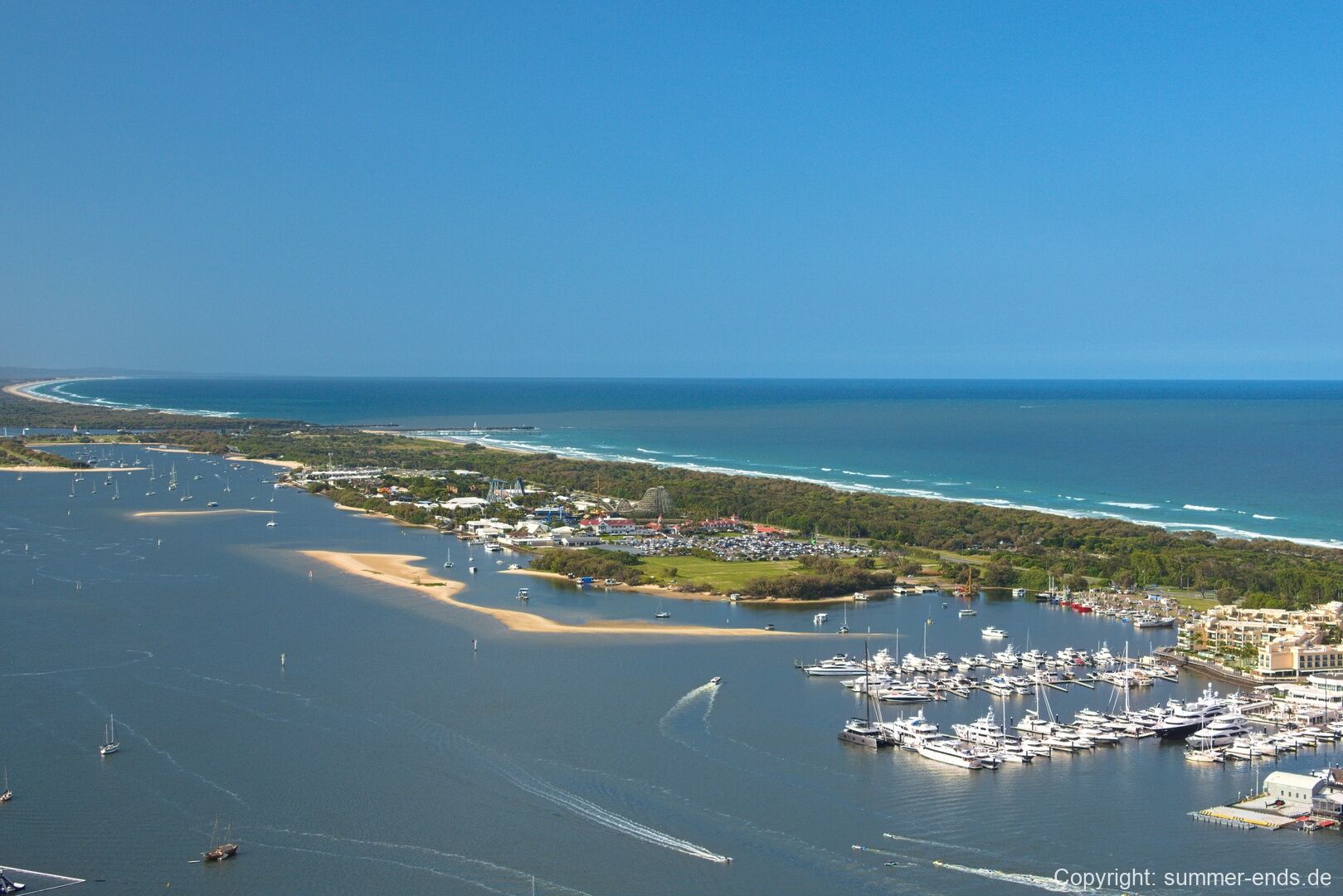
Southport is a coastal suburb and major commercial center of the Gold Coast in southeastern Queensland, Australia. It is located on the southern shores of Moreton Bay and along the Broadwater, approximately 70 kilometres south of Brisbane. Southport functions as the administrative and civic hub of the City of Gold Coast and combines urban, residential, recreational, and maritime land uses. The area is characterized by a mix of high-density development, institutional facilities, waterfront parks, and transport infrastructure. Its sheltered Broadwater frontage contrasts with the exposed ocean beaches further south, giving Southport a distinct coastal setting shaped by estuarine and marine processes.
History
Prior to European settlement, the Southport area was part of the traditional lands of the Kombumerri people, whose connection to the Broadwater, coastal plains, and inland waterways was central to their cultural and economic life. Evidence of long-term Aboriginal occupation includes shell middens, fishing sites, and pathways linked to marine and estuarine resource use.
European settlement began in the mid-19th century, with Southport emerging as one of the earliest coastal settlements on the Gold Coast. During the late 19th century, it developed as a seaside resort and service center, attracting visitors from Brisbane due to its relative accessibility and sheltered waters. In the early 20th century, Southport became the region’s principal town, hosting administrative offices, schools, and medical facilities.
As coastal tourism expanded southward during the mid to late 20th century, areas such as Surfers Paradise grew rapidly, while Southport retained its role as a governmental, commercial, and institutional core. In recent decades, urban renewal, transport development, and population growth have reinforced Southport’s position as a central business district within the wider Gold Coast metropolitan area.
Geology
Geologically, Southport lies on a low-lying coastal plain dominated by Quaternary sedimentary deposits. These sediments consist primarily of marine and estuarine sands, silts, and clays formed through fluctuating sea levels, tidal processes, and longshore sediment transport. The Broadwater itself is a shallow lagoon system separated from the open ocean by barrier islands and sand spits, notably South Stradbroke Island, which plays a key role in wave attenuation and sediment dynamics.
Underlying the coastal sediments are older sedimentary and volcanic units associated with the broader Gold Coast hinterland, although these are not exposed at the surface in the Southport area. Ongoing coastal processes, including tidal exchange, sediment deposition, and shoreline modification, continue to shape the local geomorphology. Human interventions such as dredging, canal construction, and shoreline stabilization have significantly altered natural sediment regimes, particularly within the Broadwater system.
Things to See
Southport offers a range of features reflecting its role as an urban waterfront center and historical focal point of the Gold Coast. The Broadwater Parklands provide extensive open space along the water’s edge, combining landscaped areas with views across the Broadwater toward South Stradbroke Island. The Gold Coast Aquatic Centre and surrounding sporting precinct highlight Southport’s importance as a regional hub for recreation and major events.
The Southport Spit and adjacent marine areas illustrate coastal and estuarine dynamics, while historic buildings and streetscapes reflect the suburb’s early development. Cultural and educational institutions, shopping precincts, and transport nodes further demonstrate Southport’s evolution from an early seaside settlement into a modern metropolitan center closely linked to its coastal environment.