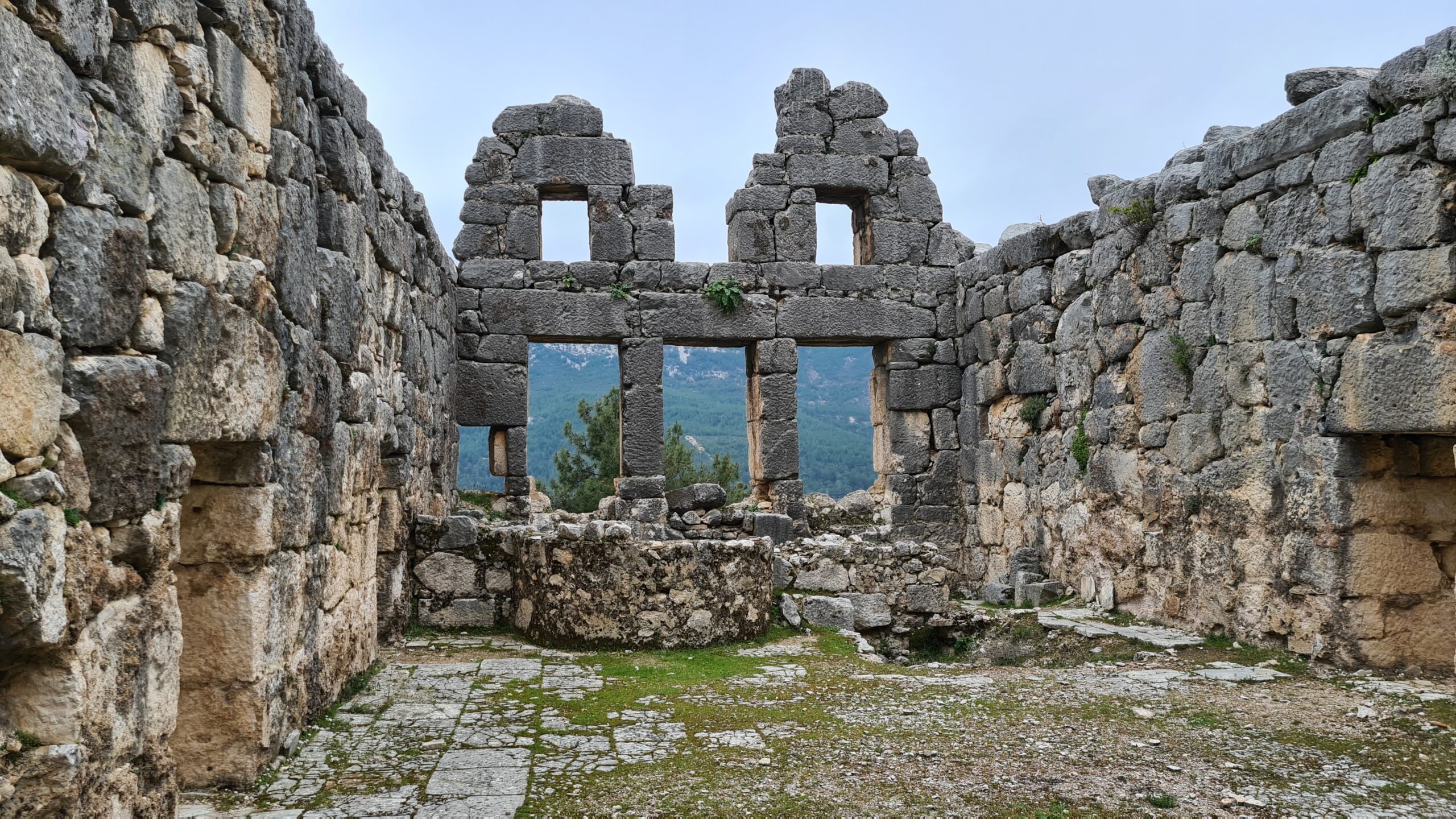
Demre is a small town and district located on the southern coast of Turkey in Antalya Province, along the Mediterranean Sea. It lies within the historical region of Lycia and is situated between the Taurus Mountains and a fertile coastal plain. Demre is best known for its rich archaeological heritage, agricultural production, and strong historical significance.
The town has a relatively small population and a low-density urban structure, surrounded by greenhouses, fields, and citrus groves. Demre’s economy is based primarily on agriculture, particularly greenhouse farming, as well as tourism related to its ancient and religious sites. Its location along the Mediterranean gives the town a strong connection to maritime history and coastal life.
Demre enjoys a Mediterranean climate with hot, dry summers and mild, rainy winters. This climate supports year-round agricultural activity and allows visitors to explore the area in most seasons. Compared to major resort cities, Demre offers a quieter atmosphere and a strong sense of local identity.
History
Demre is built near the ancient city of Myra, one of the most important cities of ancient Lycia. Myra was inhabited as early as the 5th century BCE and flourished during the Hellenistic, Roman, and Byzantine periods as a major port and administrative center.
During Roman rule, Myra became famous for its monumental rock-cut tombs, theater, and civic buildings. In the 4th century CE, the city gained special importance as the seat of Saint Nicholas, the Christian bishop whose legacy later inspired the modern figure of Santa Claus. The Church of St. Nicholas in Demre remains an important pilgrimage site.
Following Arab raids and changing trade routes, Myra gradually declined during the Middle Ages. The region later came under Seljuk and Ottoman control. Modern Demre developed as a rural and agricultural settlement in the late Ottoman and early Republican periods, while its ancient heritage gained renewed attention through archaeological research and tourism.
Geology
Demre’s geology reflects the transition between the Mediterranean coastal plain and the Taurus Mountain range. The coastal area consists mainly of alluvial deposits formed by rivers carrying sediments from the mountains, creating fertile soils ideal for agriculture.
Inland, limestone formations dominate, producing karst landscapes with caves, underground water systems, and steep slopes. These geological features influenced ancient settlement patterns, providing natural defensive positions and suitable rock surfaces for tomb carving.
The coastline near Demre includes both sandy beaches and rocky areas shaped by marine erosion. Tectonic activity has also played a role in shaping the region, as southern Turkey lies within an active seismic zone.
Things to See
Demre offers a remarkable concentration of historical, cultural, and natural attractions:
Historical and Archaeological Sites
- Myra Ancient City, with its Lycian rock-cut tombs
- Roman theater of Myra, one of the largest in Lycia
- Church of St. Nicholas, an important religious and historical site
- Remains of ancient harbor structures at Andriake
Natural and Coastal Attractions
- Andriake ancient harbor area and nearby beaches
- Coastal plains and agricultural landscapes
- Views of the Taurus Mountains
- Walking paths around archaeological sites
Cultural and Local Experiences
- Local markets and traditional Mediterranean cuisine
- Religious and cultural festivals
- Museums focusing on Lycian history
- Small-scale tourism and community life