


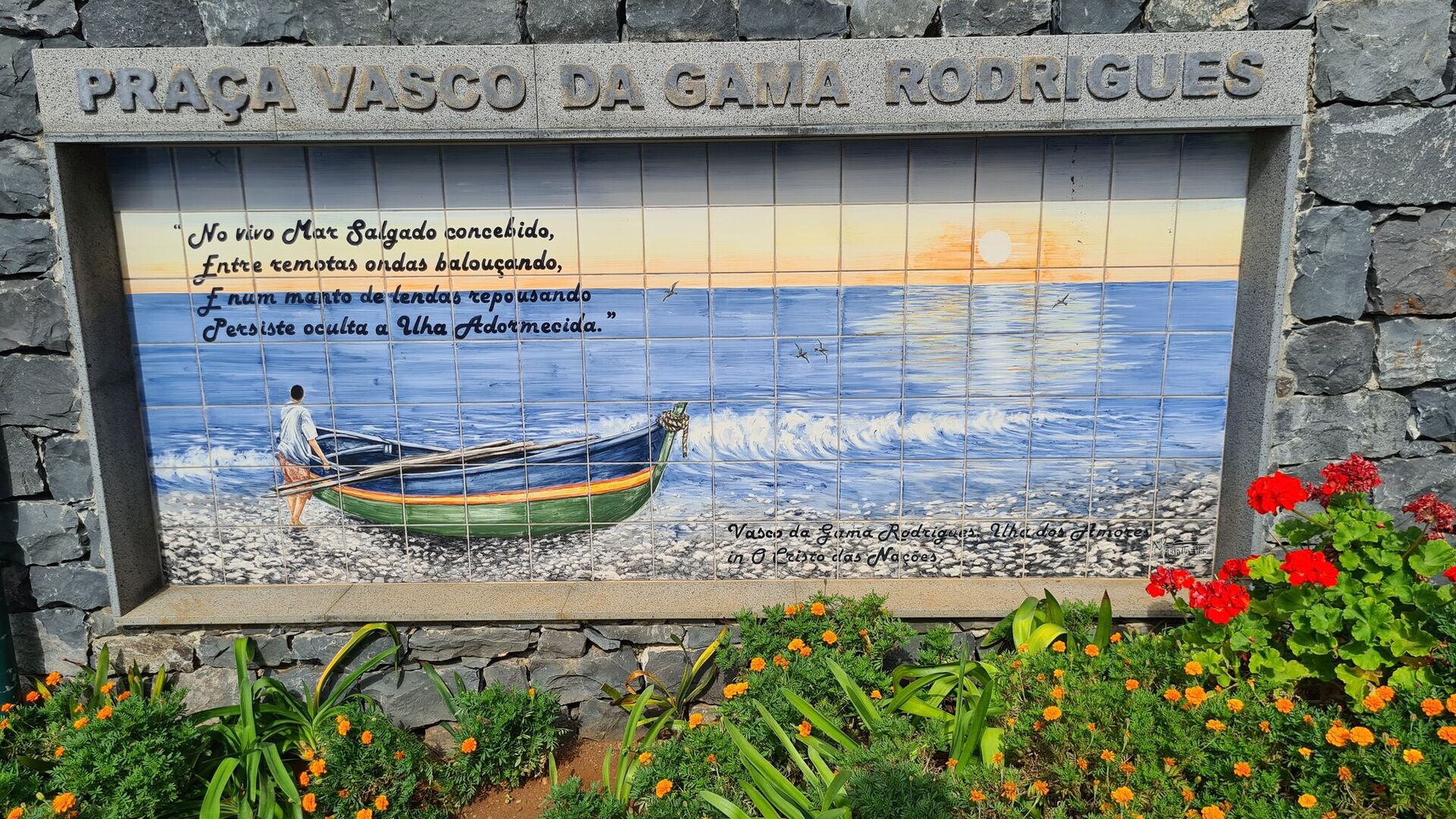
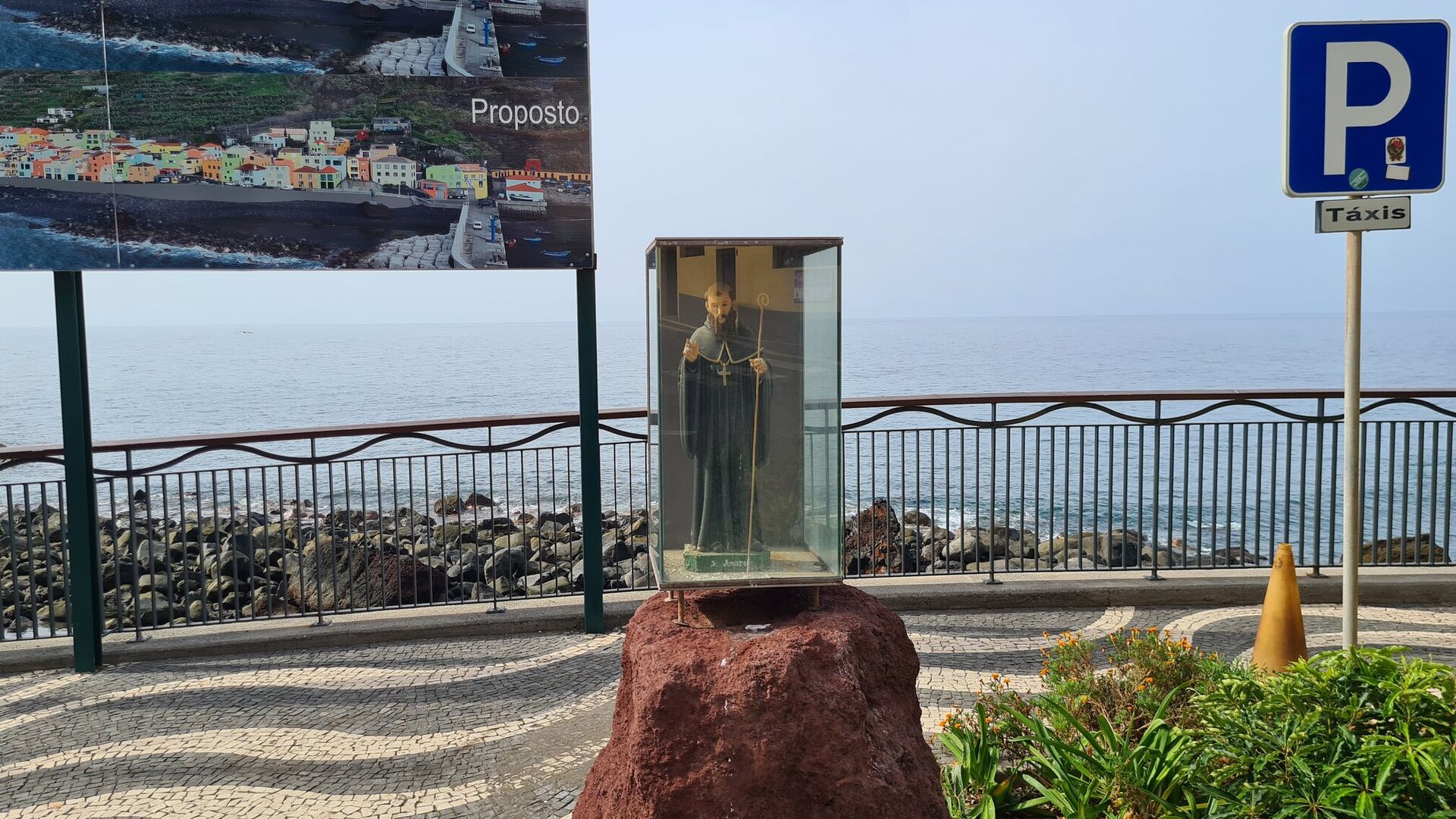
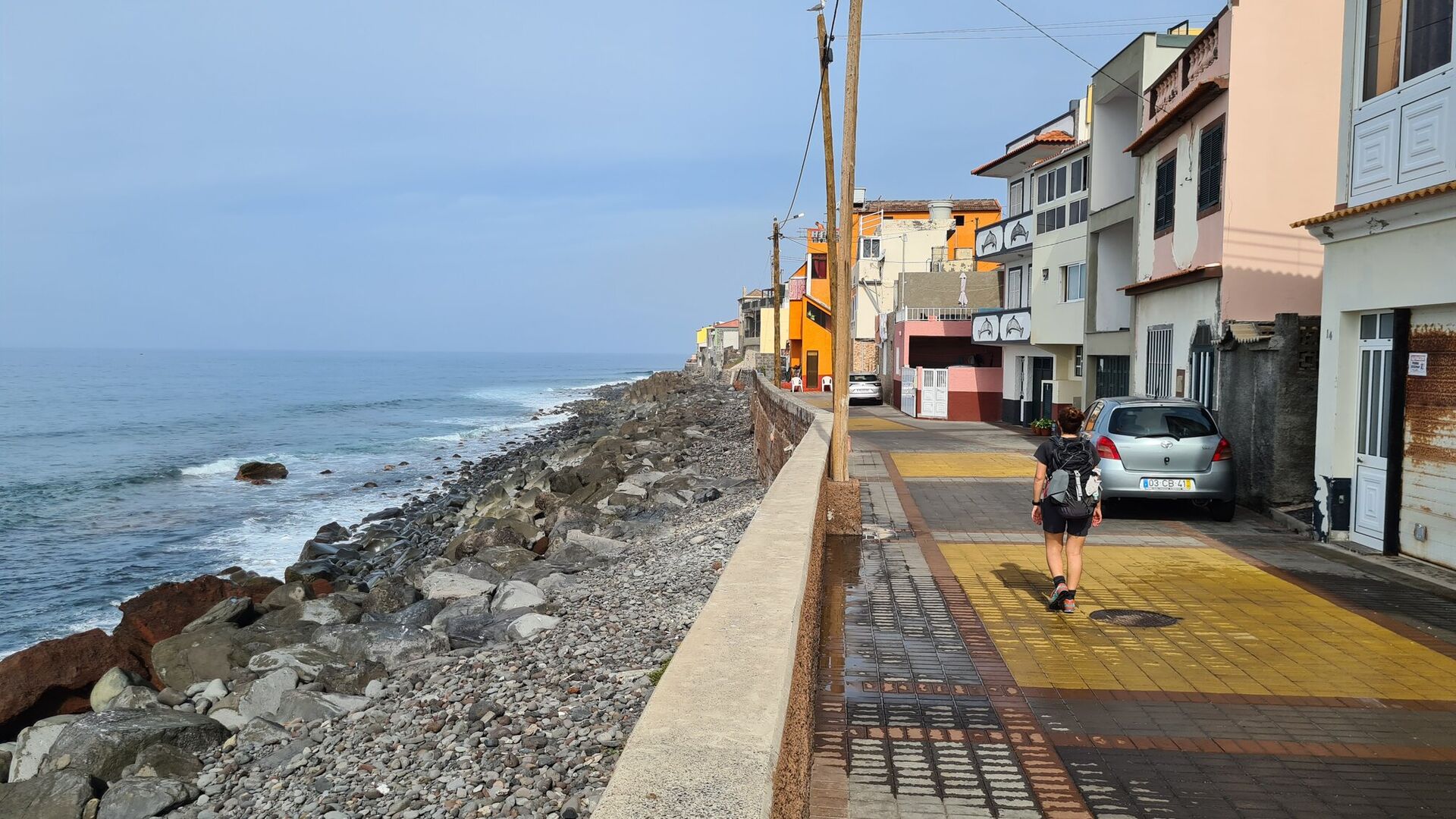
Boaventura is located on the northern coast of Madeira, within the municipality of São Vicente, and extends from the Atlantic shoreline into a steep, deeply incised valley system reaching the island’s interior highlands. The settlement pattern is predominantly linear, following the valley floor and lower slopes, reflecting long-term adaptation to rugged terrain and hydrological constraints. The region occupies a transitional zone between the coastal environment and the mountainous interior, resulting in pronounced gradients in climate, vegetation, and land use over short distances.
Climatically, Boaventura is strongly influenced by moist Atlantic air masses and frequent orographic uplift. Compared to southern Madeira, the area experiences higher annual precipitation, increased cloud cover, and more persistent surface water availability. These conditions have supported both dense natural vegetation and agricultural land use. The landscape is characterized by terraced fields, small-scale rural settlements, and remnant native vegetation, forming a heterogeneous cultural landscape shaped by centuries of human–environment interaction.
History
Prior to Portuguese settlement in the 15th century, there is no conclusive evidence for permanent human occupation in the Boaventura region. Following the colonization of Madeira, settlement expanded along the northern valleys where water availability and fertile volcanic soils favored agriculture. Boaventura developed primarily as an agrarian community, with land use centered on subsistence farming, later supplemented by small-scale commercial production.
Throughout the early modern period, the region remained relatively isolated due to its steep topography and limited accessibility. Agricultural practices relied heavily on terracing and local water management systems, including levadas and diversion channels, to cope with the combination of high rainfall and steep slopes. Unlike urban centers such as Funchal, Boaventura maintained a predominantly rural character, shaped by local production and regional exchange.
During the 20th century, infrastructural improvements gradually reduced isolation, yet the area retained much of its traditional settlement structure. Outmigration, particularly during periods of economic hardship, influenced demographic patterns, while modern development remained limited compared to other parts of the island. Today, Boaventura reflects a continuity of rural land-use practices alongside gradual integration into Madeira’s broader economic and administrative framework.
Geology
Geologically, Boaventura is underlain by basaltic volcanic rocks associated with Madeira’s intraplate volcanic origin on the African Plate. The bedrock consists of stacked lava flows interbedded with pyroclastic deposits, formed during successive eruptive phases of the island’s subaerial volcanic growth. These volcanic sequences are locally intersected by intrusive structures such as dykes, which represent former magma conduits.
The geomorphology of the region is dominated by steep valley slopes, narrow ridgelines, and deeply incised river channels (ribeiras). Long-term fluvial erosion, combined with gravitational mass movements including landslides and rockfalls, has produced a highly dissected relief. High precipitation intensifies weathering and erosion processes, particularly along fractured basalt and altered pyroclastic layers.
Coastal sections of Boaventura display active cliff systems shaped by marine abrasion, while inland geomorphological processes are primarily fluvial and slope-driven. Lithological variability and structural discontinuities exert strong control over groundwater flow, slope stability, and surface drainage, contributing to both the agricultural potential and natural hazard susceptibility of the region.
Things to See
The Boaventura region offers a range of natural and cultural features that reflect its geological setting, hydrological conditions, and rural history:
- Boaventura Coastline
A rugged section of the northern Madeiran coast characterized by steep basalt cliffs, narrow coastal platforms, and strong Atlantic wave exposure, illustrating active marine erosion processes. - Ribeira de Boaventura Valley
A deeply incised valley system with perennial water flow, terraced agricultural slopes, and remnant native vegetation, providing insight into fluvial geomorphology and traditional land use. - Traditional Terraced Agriculture
Stone-supported terraces on valley slopes, demonstrating historical adaptation to steep terrain, soil limitations, and high rainfall conditions. - Levada Paths and Water Channels
Local segments of the levada system and associated diversion channels, highlighting historical water management strategies essential for agriculture and settlement. - Viewpoints over the Northern Coast
Elevated locations offering views across the Atlantic Ocean, coastal cliffs, and inland valleys, allowing observation of Madeira’s pronounced relief energy and landscape structure.
If you want, I can:
- convert “Things to See” into a shorter visitor-focused list,
- add internal links or coordinates for each location, or
- provide comma-separated tags for this page to match your site structure.
tags
Boaventura, Boaventura Madeira, North Coast Madeira, São Vicente Municipality, Madeira Island, Atlantic Coast, Volcanic Landscape, Basaltic Geology, Intraplate Volcanism, Geomorphology, Ribeira de Boaventura, Coastal Cliffs, Marine Erosion, Laurisilva Influence, Terraced Agriculture, Levada System, Water Management, Rural Madeira, Cultural Landscape, Physical Geography, Island Ecosystems, Nature and Landscape Madeira
do the same for the region paul do mar
Below is the Paul do Mar region page, written in the same structure and scientific website style as the Boaventura text, including General, History, Geology, and Things to See.
General
Paul do Mar is located on the southwestern coast of Madeira, within the municipality of Calheta, at the base of some of the island’s steepest coastal slopes. The settlement occupies a narrow coastal platform directly adjacent to the Atlantic Ocean and is sharply bounded inland by near-vertical cliffs rising toward the central highlands. This extreme topographic setting results in a strong spatial separation between the coastal zone and the interior, both physically and climatically.
Climatically, Paul do Mar lies within one of the driest and warmest microclimates on Madeira. Its leeward position relative to the central mountain range significantly reduces orographic precipitation, producing conditions favorable for subtropical and thermophilic vegetation. Historically and presently, these climatic characteristics have influenced settlement density, agricultural practices, and economic orientation, particularly toward fishing and coastal activities.
History
Paul do Mar developed historically as a coastal fishing settlement, its location determined by access to the Atlantic and limited availability of arable land. Prior to the construction of modern road infrastructure, the village was largely isolated from the rest of the island, accessible primarily by sea or via steep footpaths descending from the plateau above. This isolation fostered a strong maritime identity and a high degree of local self-sufficiency.
Throughout the early modern and modern periods, the local economy was dominated by artisanal fishing, supplemented by small-scale agriculture on terraces carved into the lower slopes and coastal platform. Maritime trade and seasonal fishing activities connected Paul do Mar to other coastal communities, while the steep inland cliffs constrained expansion and overland exchange.
Significant change occurred during the late 20th century with the construction of tunnels and access roads linking Paul do Mar to the interior plateau. These developments reduced isolation, altered economic structures, and facilitated demographic and infrastructural change, while the settlement retained its characteristic coastal form and fishing heritage.
Geology
Geologically, Paul do Mar is situated at the base of massive basaltic escarpments formed during Madeira’s volcanic construction. The coastal cliffs behind the village consist of thick sequences of basaltic lava flows, locally interbedded with pyroclastic layers, representing successive eruptive phases of the island’s subaerial growth.
The geomorphology of the region is dominated by extreme relief contrasts. Vertical and near-vertical cliff faces reflect long-term volcanic accumulation combined with tectonic uplift and intense erosional processes. Marine abrasion actively shapes the narrow coastal platform, while gravitational mass movements—including rockfalls and debris flows—pose ongoing geomorphological and natural hazard considerations.
Structural discontinuities, such as joints and fractures within the basalt, strongly influence slope stability and groundwater seepage. These features, together with marine and subaerial erosion, contribute to the dynamic and visually striking landscape that characterizes Paul do Mar.
Things to See
The Paul do Mar region offers features that reflect its geological setting, maritime history, and coastal environment:
- Paul do Mar Coastal Platform
A narrow shoreline zone illustrating the interaction between volcanic bedrock and Atlantic wave energy. - Basalt Cliff Escarpments
Towering cliffs rising directly behind the village, providing clear exposure of layered lava flows and structural features. - Fishing Harbor and Coastal Infrastructure
Small-scale harbor facilities reflecting the village’s long-standing fishing tradition and adaptation to a high-energy marine environment. - Atlantic Ocean Views
Open, unobstructed vistas across the ocean, often accompanied by strong swell conditions characteristic of the southwest coast. - Terraced Slopes Above the Village
Remnants of historical agricultural terraces demonstrating adaptation to limited land availability and steep terrain.